Introduction
Why I started this
Hook looks, at first, like a conventional Hollywood adventure: a big-budget reimagining of Peter Pan, all expansive sets and visual imagination. But there's a stranger film underneath, and much of what makes it strange never reached the screen. Productions this troubled and this reworked tend to arrive half-finished, and Hook is no exception. A lot of what it was trying to do survives only in the material that was removed. Those are the fragments I've spent years tracking down, and the search never really ends.
That work has been an obsession of mine for years, and it runs past nostalgia. I saw the film as a child, but what kept me going was what surfaced once I started digging into the deleted scenes and the harder-to-find production history. When I began researching in 2006, I had no idea how tangled this would get, not just because of how many scenes were cut, but because of how much they change the story. The deeper I went, the more it pulled me in.
That's really where my attachment comes from. It doesn't come from thinking the film is perfect. It never has been, to me, and that's part of its charm. From the start it felt incomplete, like something had gone missing on the way to the screen. Don't get me wrong. The film works. It has its own identity, some beautiful scenes, and an emotional pull that still gets to me after all these years. But underneath that, I've always felt the breaks. The gaps. Connections that don't quite line up and are hard to put into words.
By now there are really two films in my mind: the one I grew up with, and the one I uncovered. It makes the released version feel like a patchwork, a Frankenstein creature, working, but covered in scars. Some of those scars are right there on screen. Others are quieter, almost invisible, buried in the editing, in a sudden shift of tone, in characters who seem to have lost a piece of their own story, in scenes that leave you feeling something came before or after that you never got to see. The film is assembled from separate pieces, stitched together into something that stands, breathes, and even manages to move us, but whose seams never fully disappear.
The irony is that the film is about exactly that: the scars of childhood we bury to protect ourselves, and eventually have to heal.
And the comparison with Frankenstein doesn't stop at the creature. In Mary Shelley's novel, Victor Frankenstein pours everything he has into giving his creation life. Then, the instant it opens its eyes, fear and disgust take over. He can't accept what he's made, and he abandons it almost on the spot.
I've often thought something like that happened with Hook. Spielberg spent 18 intense months on the project, and then he pulled away from it. It's as if, once the film was finished and out in the world, he no longer quite recognized what he'd brought to life. He's talked about some of his regrets, his doubts, the choices he wasn't happy with, sometimes sounding like he'd rather turn away than face this imperfect thing he created.
And yet, just like the creature, Hook goes on living no matter what its maker thinks of it. It grew up inside the imaginations of the kids who found it. People have loved it, stood up for it, handed it down, an audience that saw something in it its flaws couldn't erase. Where its creator may have seen a film that was too heavy, too far from what he'd first imagined, plenty of us found it deeply moving despite it all.
That feeling of incompleteness is exactly what keeps my passion alive.
I don't collect Hook just to own things that are rare, valuable, or nice to look at. Every piece I track down is, before anything else, a way into something the film itself never shows you. It might hold a detail that's different from what ended up on screen: an image that got cut, a forgotten line of text, a character shown in another light, a scene that was talked about but never shown, the leftover trace of an idea dropped somewhere in production.
So I dig. Deleted scenes, older drafts of the screenplay, production stills, trailers, promotional material, anything that gives even a hint of the film Hook could have been. In those scars, the visible ones and the hidden ones, I go looking for abandoned plot threads, characters who changed along the way, ideas that were taken out before anyone ever saw the finished film.
For each deleted scene, I'll lay out what happens, where it sits in the story, and why it matters, both to the narrative and to how you read the film as a whole. Restoring these moments brings back the character work and the themes the film meant to explore before the final cut flattened them.
Sometimes a single photo is enough to prove a scene really was shot. Sometimes one sentence puts a character in a whole new light, or hints that a storyline used to run deeper than what remains. Even tiny differences between two documents can tell you that something was cut, moved, or reworked.
I try to be rigorous, but I can't promise every conclusion is right. Mistakes happen. Sometimes I'll link things that have nothing to do with each other, read too much into a picture, or chase a theory all the way to a dead end. That's part of the work. So take what follows for what it is: the things I've been able to piece together from the material I found. Read it, weigh it, and make up your own mind. You're free to take what I say or leave it.
This page is meant to change over time, as the research goes on. Don't read it as a final verdict. Think of it more as a living archive, something I'll add to, correct, and reshuffle whenever new material turns up.
Here's the thing: a complete version of Hook never really existed in the first place. It kept shifting through rewrites, through the shoot, through cuts and decisions made right up to the last minute. The version that was written and signed off on at the start of production was probably never put together exactly the way it was imagined. It came apart before it ever had the chance to become a finished film.
The theatrical version released in December 1991 runs 136 minutes. A much longer cut existed, possibly around 176 minutes, and it screened on November 9, 1991, at the AMC Glen Lakes 8 Theatre in Dallas. This late into post-production, Hook was still being cut as a much bigger, more ambitious film than the one that eventually opened.
So what I'm mapping out here isn't some definitive Hook. It isn't even the exact cut that screened in Dallas in November 1991, and that cut was only one step among many anyway, a temporary shape the film took before it changed again. What I can do is follow the traces of what's no longer there, gather the fragments, and get at the intentions the film started with.
My hope is that someday Amblin, Sony and Steven Spielberg himself take this further and put together a new version. Not to replace the one we already have, just to let it show a little of what got lost and cut. That's why I started the petition. If any of this speaks to you, sign it. It's a fragile hope. But that's exactly why I'm putting my research out here, to give it some kind of shape.
My thanks go to several people: Cyril Bossy, who pushed me at the start to dig past the scraps of information then available; the team at ConanCompletist.com, for early technical help and for genuinely inspiring work; Tammy Tuckey, for help with the interviews; Ruud Hendriks, for the exchange of ideas that made all this more exciting; and Jack Morrissey, for his support and kindness. My gratitude also goes to all the cast and crew members who took the time to exchange with me over the years, who played along with the interviews and offered their support, with special thanks to Scott Brody.
So read on, and come explore the fragments of everything Hook left behind. Maybe, somewhere in these discoveries, you'll start to see why the idea of a new version still feels necessary to me. I hope you enjoy discovering this as much as I've enjoyed putting it together.
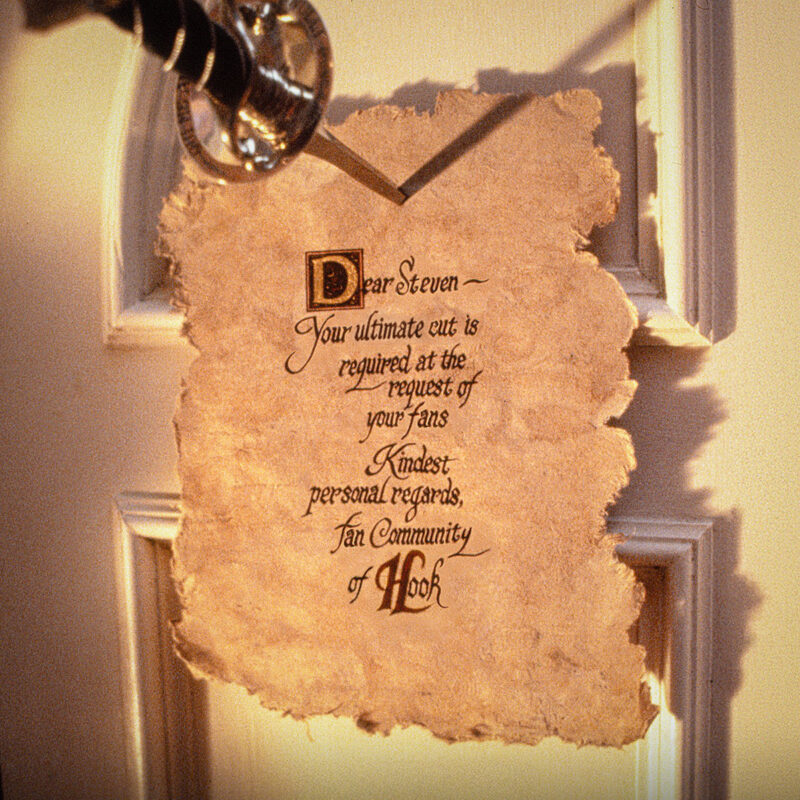
SUPPORT THE ULTIMATE CUT
Why were these scenes deleted?
- Runtime came first. A film that runs long limits how many daily screenings a theater can program, which eats directly into profit. Trimming Hook became a box-office priority during final editing.
- Pacing mattered just as much. The film needed a coherent rhythm, and some deleted scenes worked against it. The quieter, more contemplative ones deepened the characters and the themes but threatened to stall the momentum. The pirates' musical number "Low Below" caused the opposite problem: it was so exuberant that it raised the bar for the film's musical scenes higher than the rest of the movie could reach. Keeping it would have thrown off the balance between the calm passages, the action, and the songs.
- Quality and technique played a part too. Some scenes may simply not have worked on screen, emotional beats that didn't land, a tone that clashed, practical effects that fell short. The film's stylized look was uneven, and Spielberg later admitted he was never fully at ease with it. Spielberg sometimes points to Hook’s flaw when describing it as having become a children’s play… even though that is exactly what the film is about.
- Budget. Scenes built on expensive effects or sets are always the first on the chopping block. Tinkerbell is the obvious example, since she was enormously effects-heavy. There's a twist: instead of dropping, the count of effects shots involving her actually rose between the early budget estimates and the final cut, which is part of why the costs got out of hand. Much of her material was dropped or never filmed at all, particularly in the final battle, where she vanishes and only reappears once the fight is over.
Reconstituting the film
Narrative Sources
- The novelization, published a few weeks before the film and based on an earlier draft of the screenplay, is the most accessible source on the deleted scenes. It was printed in huge numbers, translated into many languages, and is still easy to find; some editions were still being printed as late as 1995.
- The comic adaptation, published in early 1992 by Marvel, gives a direct look at sequences missing from the theatrical cut, and it too survives in many languages and countries.
- The scripts, especially the February 1991 shooting script and, where they exist, later revisions. These are the hardest to track down because of their rarity and value, and the most important, since the novelization and comic both derive from them.
Visual and Documentary Sources
- Production stills from press kits around the world.
- Production paperwork: storyboards, concept art, call sheets, internal notes.
- Merchandise, such as certain trading cards, which preserve images from deleted scenes.
- Period magazines and newspapers, sometimes carrying unseen photos and cast interviews.
The Original Story
And of course one of the sources is Barrie's original book. Hook is a rewriting of it, and a development of its themes through a new prism. For most people the story means the Disney film of 1953, and that is the version nearly everyone carries around, but the material underneath it is a play from 1904 and a novel from 1911, both by J. M. Barrie, and both are stranger, harder and far more melancholy than the cartoon lets on. That is what Hart was working from. The novel in particular keeps surfacing inside the film. Literally, as an object, an almost sacred one, kept within reach on Wendy's bedside table. And in its themes, which run through the whole story. But several of those ideas and concepts were far more pronounced in the scenes that were cut.
The Promise of More Hook
Just two days after Hook reached theaters, Spielberg was already talking about giving some of it back. In a promotional interview with Bruce Westbrook for the Houston Chronicle, published December 13, 1991, he revealed that footage never shown in cinemas would be added to a LaserDisc edition due the following year. The format matters here. LaserDisc was gaining ground at the time as the serious collector's medium, a precursor to the digital formats that followed, well before the DVD. It held a cleaner, more stable image than VHS or Betamax, and it degraded far less, which made it the natural home for the kind of restored, archival material Spielberg had in mind.
There was already precedent for this in Spielberg's own filmography. A collector's edition of E.T. included deleted material introduced by Spielberg himself, among it the abandoned school sequence featuring Harrison Ford as Elliott's principal. Duel had also appeared on LaserDisc in its theatrical version, expanded by roughly twenty minutes from the original television cut. Criterion's LaserDisc edition of Close Encounters of the Third Kind went even further, allowing viewers to explore the different versions the film had taken over the years.
But the most relevant example was 1941. Its LaserDisc release presented an extended version originally assembled for television, restoring a substantial amount of material that had been absent from the theatrical cut. The 118-minute theatrical version grew to roughly 146 minutes.
Hook was not being promised the same kind of full-scale reconstruction or alternate cut. Spielberg was not announcing a new version of the film. But he was promising a the chance to finally see several substantial scenes that had been removed before release. Given what LaserDisc had already made possible for his earlier films, it was a particularly enticing promise...
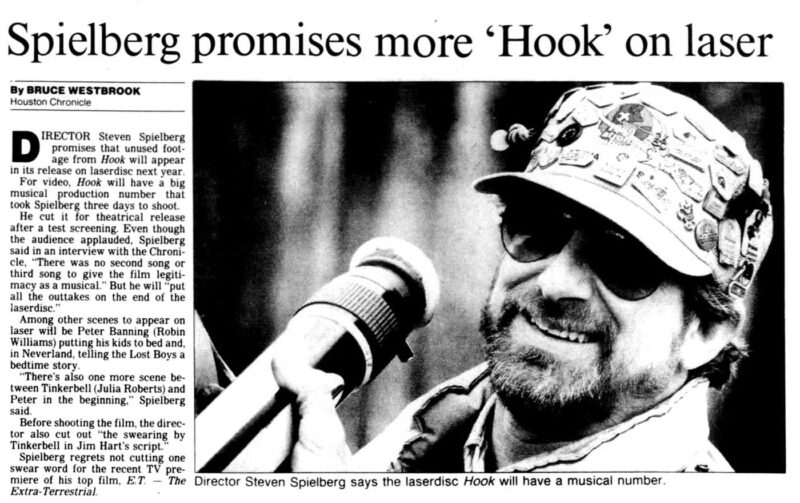
"Spielberg Promises More 'Hook' on Laser," Bruce Westbrook, Houston Chronicle, December 13, 1991
What he described was a set of bonuses placed at the end of the disc, the outtakes from what was, in effect, a longer and partly musical version of the film. The centerpiece was "Low Below," the pirates' large-scale musical number, reportedly three days in the filming and likely more, cut after the November 1991 test screening even though the audience had applauded it. His explanation was almost apologetic: there was, he said, no second or third song to give the film any legitimacy as a musical, so the number was left stranded, too big for the film that remained around it. Rather than bury it, he promised to include all the outtakes from that version of the film at the end of the LaserDisc.
The article mention a few of the other missing pieces: Peter putting the children to bed, the beat that would carry Moira's "When You're Alone"; Peter telling the Lost Boys a bedtime story in Neverland, a scene the young actors who played the boys have often remembered as one of the warmest memories of the shoot; and an early exchange between Tinker Bell and Peter, perhaps the moment in the Pirate Town kitchen where Tink wounds him.
I find this small scrap of press oddly moving. Within forty-eight hours of release, before the reviews had even settled, Spielberg was already gesturing back toward the film he'd had to take apart, and toward the musical shape it once had. The promise was never kept, at least not then. But it confirms what these pages keep circling: a fuller Hook existed, its maker knew exactly what had been removed, and some part of him wanted us to see it. I'll come to these scenes mentionned properly in the first part of Act II.
Deleted scenes

The school Play
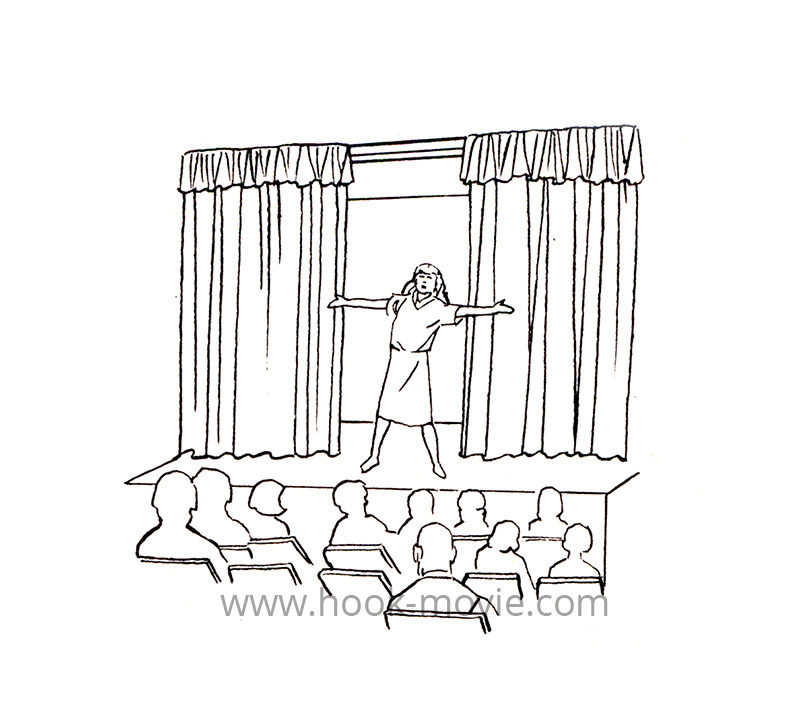
The teacher introduces the show to the parents.
The film opens on a school play, children performing Peter Pan, but the theatrical cut preserves only a fraction of the original scene. In the early drafts this scene held everything together. It's where the stakes were laid out, and where most of the film's themes first surface.
The play runs through the original Barrie story in miniature: Peter chasing his shadow in the nursery and meeting Wendy, Wendy sewing the shadow back on, the flight to Neverland, the pirates, the duel, the return home, and the epilogue where Peter takes Jane back to Neverland. In its longer form, the scene also introduces Peter Banning and the traits that define him, rushed, late, overwhelmed, drained of imagination, walled inside a reality dictated by his job.
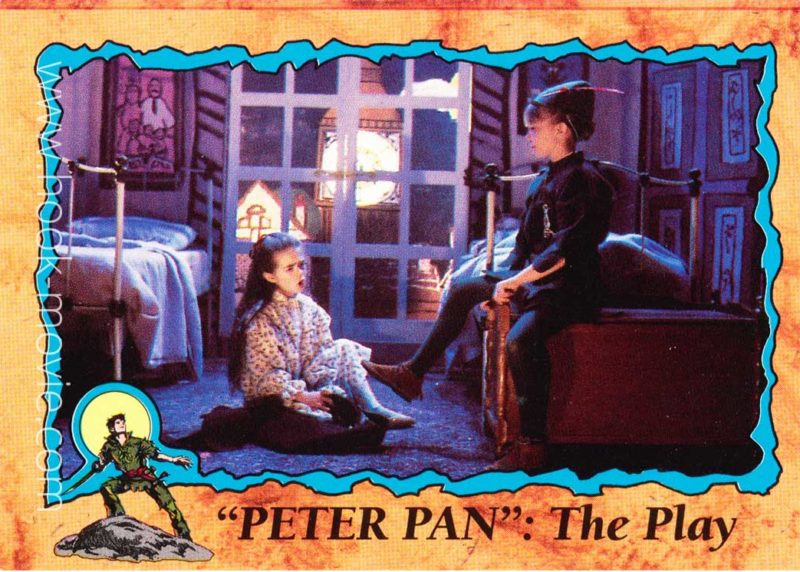
Maggie sews Peter’s shadow back on.
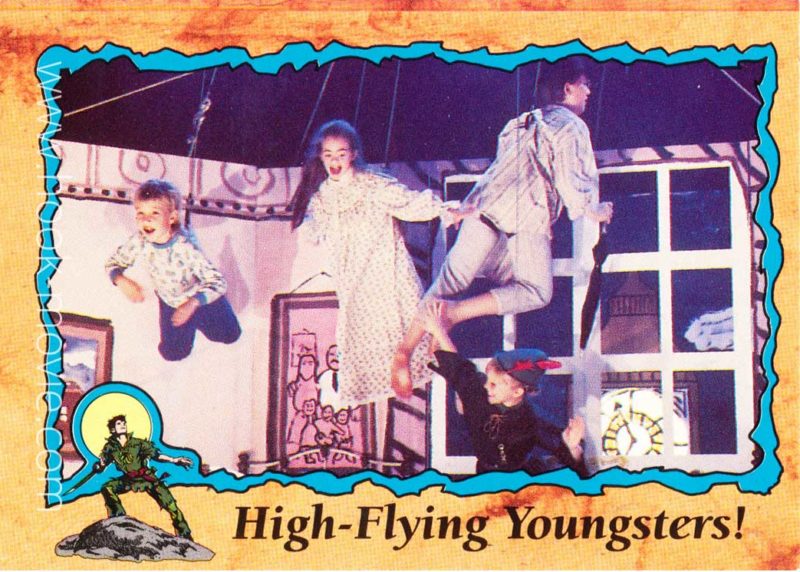
Michael, Wendy and John ready to fly to Neverland.
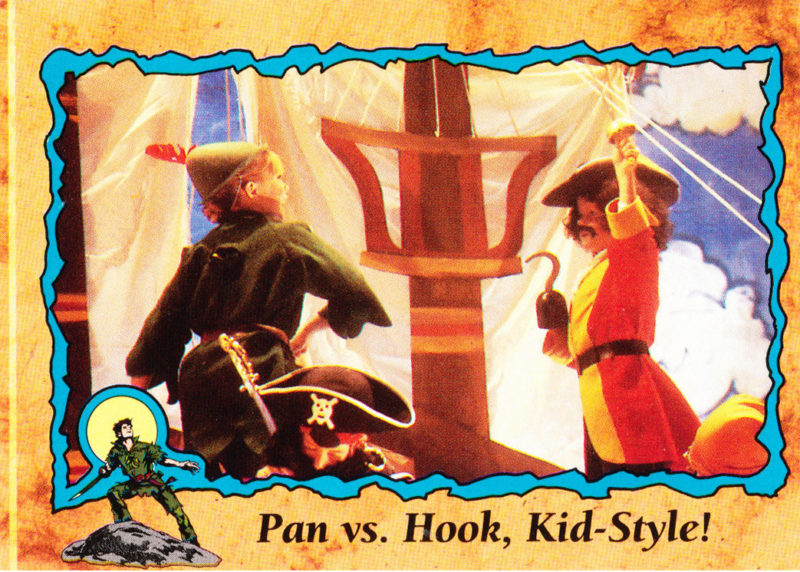
Final duel.
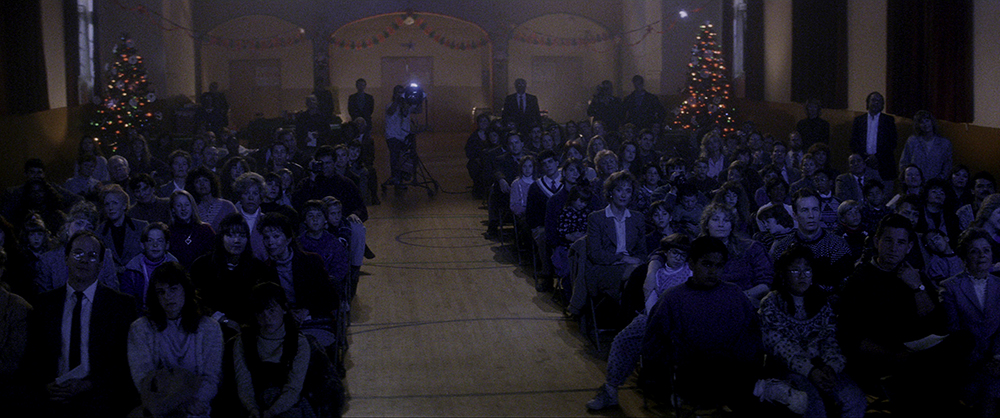
Onstage, Maggie plays Wendy meeting Peter Pan. At that exact moment Peter Banning arrives late, not slipping in quietly so much as bursting in. Hunting for his seat, he crosses the projector beam, blocks the light, and throws a giant shadow over the stage and the children. It plays as physical comedy, but it's really the first image the film gives us of how out of step Peter is with everything around him.
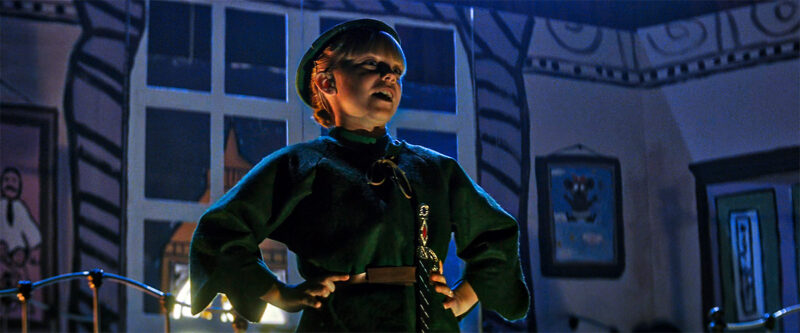
His shadow frightens the young girl playing Peter Pan. The scene doesn't treat Banning as a hero. If anything he's the villain of the moment, set against the child version of himself on stage. He blocks the light, the thing that lets the world of imagination exist, and cuts off the flow of magic between stage and audience. The beat foreshadows the moment he later interrupts Jack's pirate initiation, where this time he projects not his shadow but his light.
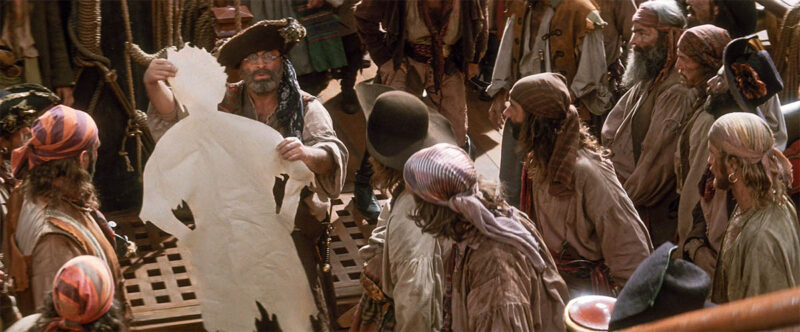
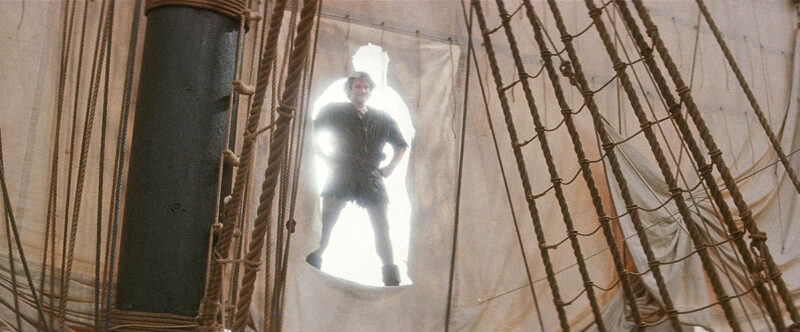
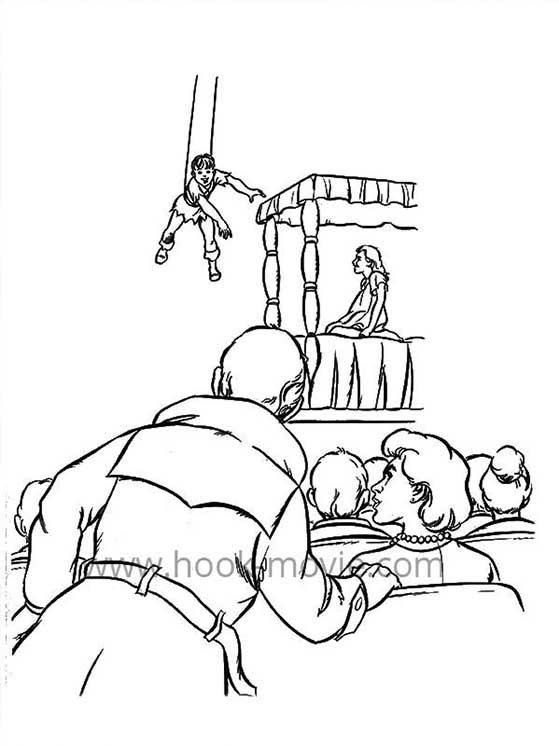
Peter sits, worried about the show’s safety.
The children are suspended by wires to simulate the flight to Neverland.
The scene is a clean illustration of suspension of disbelief. Spielberg breaks the fourth wall to set cynical reality against fantasy, planting us in front of the film itself and inviting us to suspend disbelief despite the visible wires and the open theatricality. The artifice is left in plain sight, and the film treats that as the point. The magic doesn't depend on a seamless illusion. It depends on a viewer who decides to go along with it. Like a parent at a school play, enjoying it fully while seeing every string. That logic justifies the stylized sets, built as mental spaces that resemble a children's theater rather than real places. Hook is a fable aware of its own artificiality, asking you to choose to believe in it.
None of that is Spielberg's invention. In the original story the game is the only law in Neverland. The lost boys live inside a make-believe game nobody is allowed to name as one: when Wendy Darling is wounded, Slightly is sent for a doctor, puts on a hat, comes back as the doctor and carries out the consultation in earnest over the girl lying on the ground.
The others know they are pretending. Peter doesn't, or rather the distinction has never existed for him, and whoever lets the performance drop is rapped on the knuckles for it. That is the material Hook is built on, and the school play is where Spielberg sets it down: a stage where the artifice is in plain sight and the game holds anyway. It also fixes what Banning's amnesia has really cost him. Not a taste for stories. That faculty, the only one the island runs on, which is why the film returns him nothing, not the flight, not the sword, not the crow, until he has it back.
The same story hands out its parts from the outside. Wendy is never asked whether she wants to be a mother; the boys build a house around her while she is unconscious, knock, and put the question through the door, and she is one from that moment. The casting is collective and it holds. This is how Hook will later manipulate Jack in the film: by offering him the role he longs to play and an audience before whom he can perform.
Hook goes after belief itself, and what seals that reading, for me, is that he does it with the object giving the film its name. The Hook was first meant to be black steel. Spielberg chose polished silver chrome instead, knowing the surface would catch and reflect the crew filming the scene. The prop confronts the viewer with their own suspension of disbelief. He uses it that way throughout: when Peter starts gaining ground, Hook presses his hook against the grinding wheel, throwing off sparks, then forces Peter to see himself in its polished surface, which still exposes the ceiling and the artificial lighting overhead. He's trying to strip away the fantasy and reduce Peter to what lies underneath: a drunk, success-obsessed man hiding from his wife and children. He's attacking the belief that lets Peter become Peter Pan again.
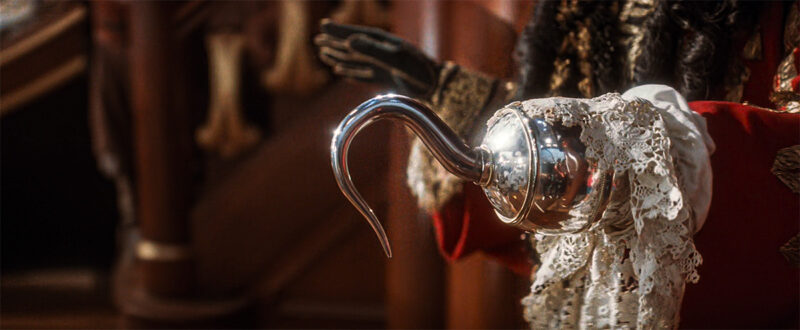
The chrome of the Hook systematically reveals the crew and the technical environment of the shoot.
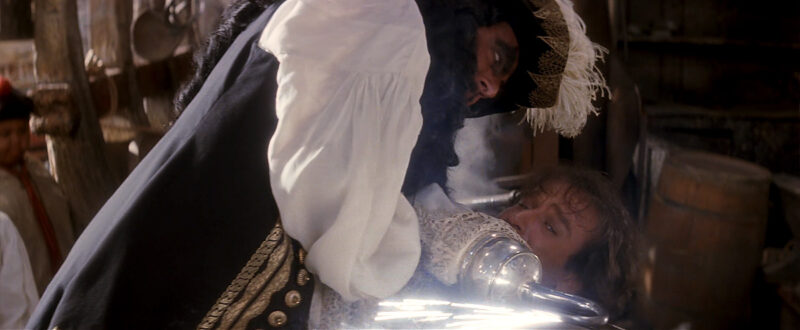
To gain the advantage over Peter, he forces him to look at the reflections in his hook.
This is also why some viewers can't get into the film while children slip in easily. Where part of the adult audience rejects the visible artifice, children accept the rules of the game without friction. They don't read it as rupture; they read it as how stories work. The film asks you to play along rather than swallow it whole. Stare at the wires and the magic disappears; go with the convention and it's right there. Just as Peter's regression makes his redemption possible, the film asks each viewer for a kind of regression: not a child's eye exactly, but a child's capacity for wonder, held without slipping into naïveté.
Neverland is built on soundstages and meant to read as a stage, stylized, artificial, theatrical. The film keeps returning to the language of live performance. It opens on a school play. The deck of the Jolly Roger becomes a platform, the pirates an audience for Hook's act. The Lost Boys' hideout plays less like a forest than a circus, all trapezes and ramps. Even the food fight ends with Peter climbing onto the table, turning it into a stage and stepping into his role.
Spielberg later said he was never comfortable with that stylized look, that his disappointment with Hook was how much it resembled children's theater, even though children's theater is precisely what the film is depicting.
- Maggie, total immersion. She's inside the story, playing Wendy. The pure, active link to fiction.
- Moira, belief. She suspends judgment out of love for her daughter.
- Jack, the uneasy middle. A skeptic who wants in but keeps glancing at his father for validation, copying his manner.
- Peter, the man without imagination. An intruder who breaks the spell, shut out of the fiction, taking no pleasure in any of it.
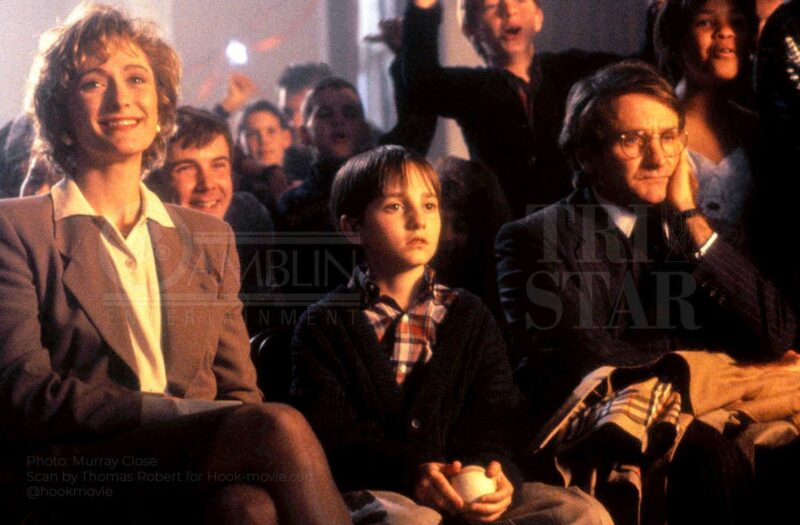
The perfect contrast: Moira delighted, Peter bored, Jack caught somewhere between them.
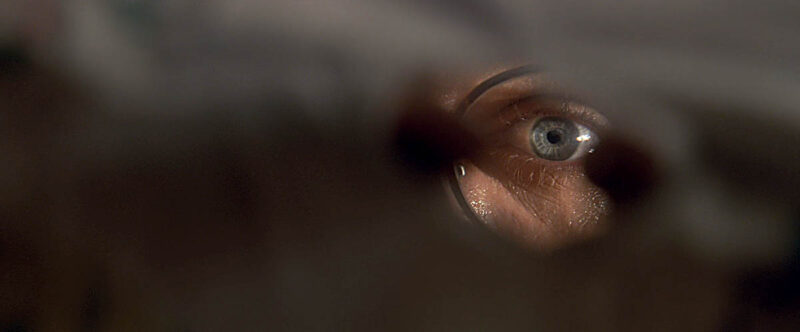
Cutting this sequence reshaped the film's emotional arc. Hook was meant to be about recovering memory. Peter can't take interest in his own past, can't even recognize it, and that absence is what blocks him, from immersion, from pleasure, from being carried along by his daughter's play. Getting his memory back was meant to be how he finds himself again and regains the ability to enjoy the world. Without the scene, Spielberg pushed the central conflict toward a more linear father-son crisis built around Jack.
The cost was Maggie. Losing the scene shrank her thematic weight across the rest of the film and pushed her into the background of Jack's arc.
Maggie is the first character to work on memory. Watch closely and she forgets her lines during the play and has to be prompted. Later, in Neverland, she shows real resistance to forgetting, something a later deleted scene develops, where she introduces another of the film's key ideas. But we're not there yet.
The scene was meant to close on a natural paradise that could read as Neverland.
Note: the character of Peter Pan is played by a girl in the play, as is theatrical tradition. Zachary Williams, Robin Williams' son, would be among the children cut in this scene, as well as Rebecca Hoffman, Dustin Hoffman's daughter (who played Jane, Wendy's daughter, at the very end of the show)...
The scene was filmed in the auditorium of Bishop Conaty High School in Los Angeles.
The Meeting
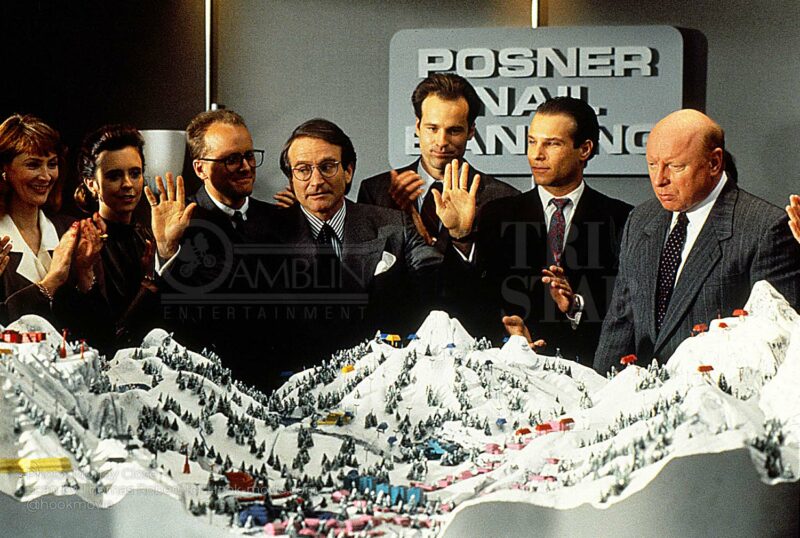
Peter’s team applauds his strategy.
A sunlit forest fills the frame, a paradise you'd take for Neverland, until it's revealed as a scale model in Peter Banning's office atop a San Francisco skyscraper. He studies his miniature world, a tourist resort, with obvious satisfaction, the city's dull fog hanging behind him.
He clips in tiny buildings and ski runs while spelling out his cynical plan for getting this project built. To get past the Sierra Club, the environmental group opposing the development, he intends to convince them the build-out will be gradual and that he cares about the wildlife. He'll leave a token nature reserve at the center to secure his permits, then pave over the rest once the activists have lost interest.
Peter realizes that he is late. Special thanks to Julian De Backer.
Panic seizes Peter when he realizes the time and that he will be late for his son’s baseball game. He gulps down a cappuccino before checking his airline tickets. The coach class was chosen specifically on statistical grounds to reduce risk, with seats located as close as possible to emergency exits. He rushes into the corridor.
Resistance arrives as Dr. Fields, the environmental expert the firm habitually ignores, who tries to make Peter see that certain species need room to survive and demands designated breeding areas.
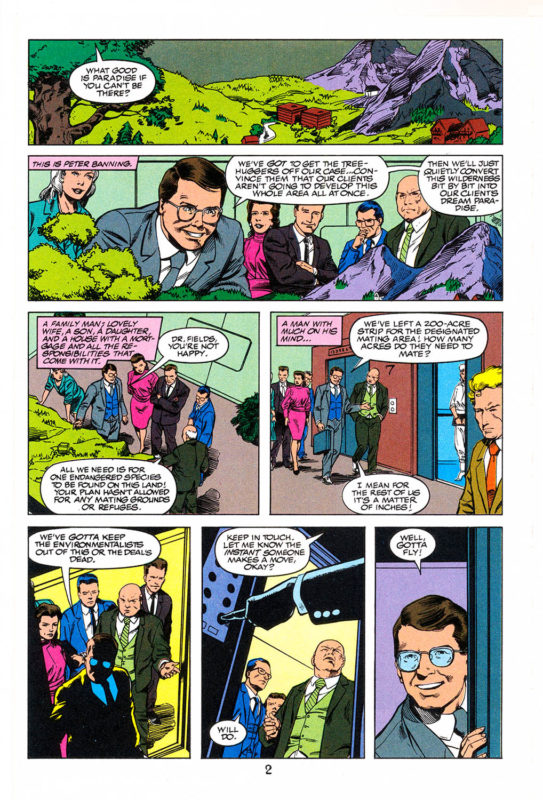
The scene in Marvel’s comic adaptation
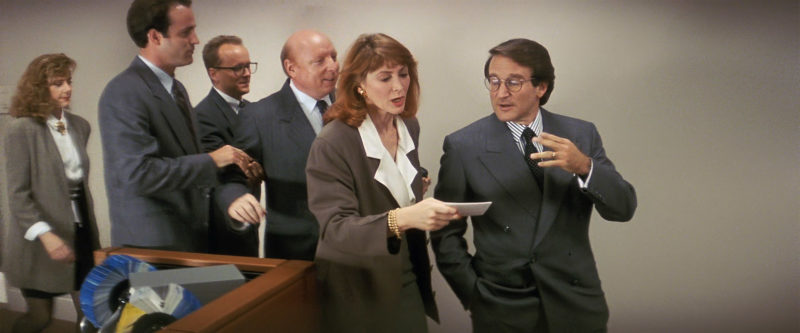
Brad and Ron block Dr. Fields' attempt to talk to Peter by grabbing his arm
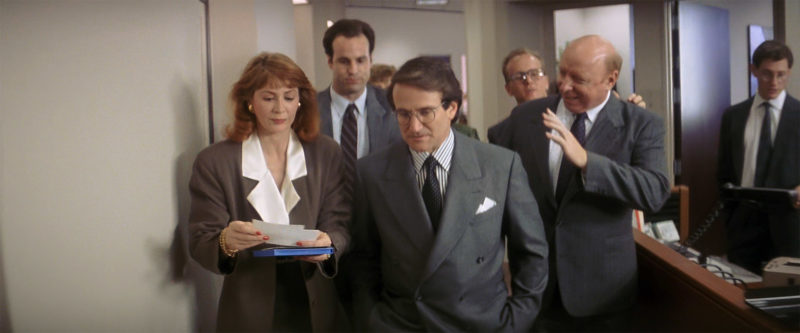
Ron holds him back as he appears to approach Peter.
As in the theatrical cut, this was meant to intercut with Jack's baseball game, where he scans the stands for his father, hunting for an anchor that never appears. The sequence draws a straight line from parental presence to a child's motivation and performance. Peter's repeated absence, ending in his total no-show, frays the bond further.
Peter's world is cold and calculated, with most of the humanity scrubbed out of it. People orbit him in service and he can't manage the basic respect of learning their names. Technology has replaced the magic of human contact: the model paradise, the latest phone, a camera standing in for a father. Everything is a problem to be handled statistically and strategically. Behind that hunger for control sits a complete loss of control over his own family. He can't stop. He'd rather sink back into his files than keep the promise he made his son.
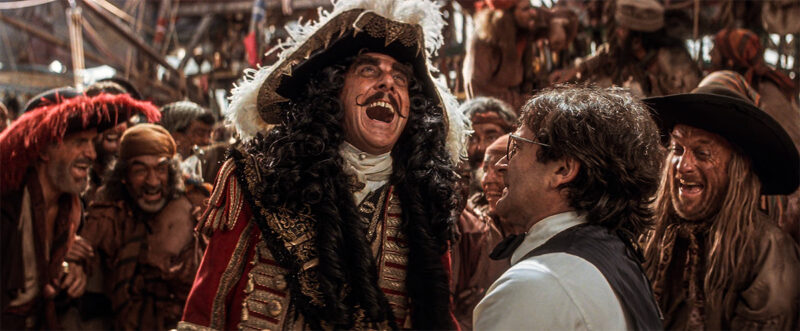
Captain Hook humiliates Peter, making his crew laugh. Peter experiencing what he had made Dr. Fields go through.
To me, this is where the film's title starts to make sense. Whatever darkness and cynicism Hook has, Peter Banning has already taken on. As a narcissistic leader bending nature to his will, he mirrors the arrogance of his old enemy. His statistical obsession and his court of servile associates mark the disappearance of his innocence, replaced by the coldness of a social predator. Captain Hook is an allegory of the traits that pull Banning away from his family, the embodiment of what takes his children from him. In Neverland, Hook is no longer a lone pirate on a ship; he's come ashore, his pirate town fouling the island's nature, claiming territory: Peter's mind. The next scene gets into that.
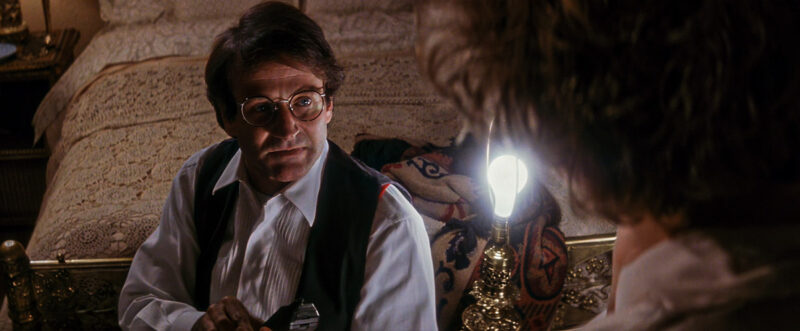
Peter chooses his project over his family.
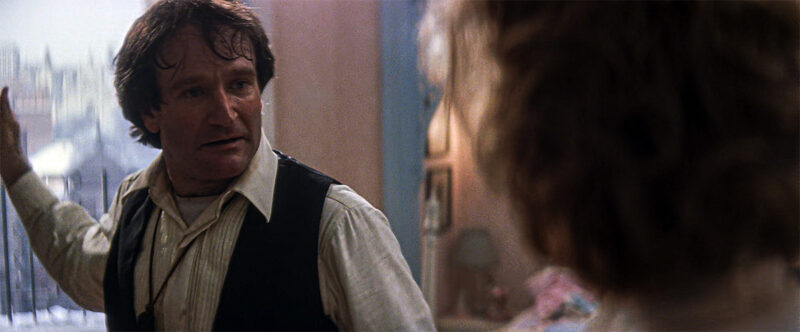
Transformed by his experience, he will choose his family at the end of the film.
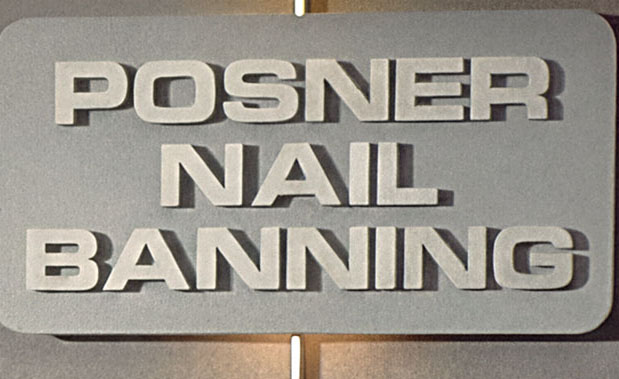
Posner for Leah Adler, Nail for Kate Capshaw and Banning for Peter.
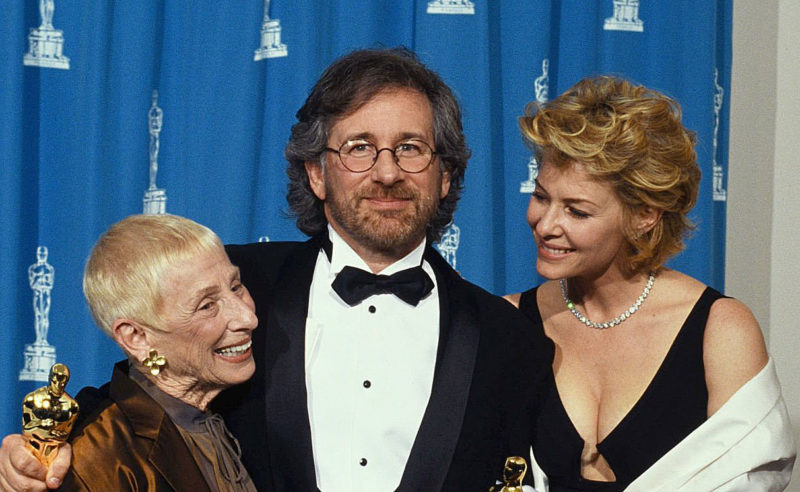
Leah Adler, Steven Spielberg and Kate Capshaw at the 1994 Academy Awards.
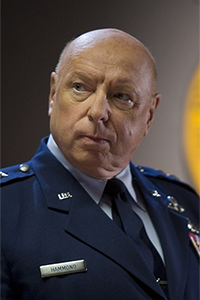
Don S. Davis

Brenda Isaacs
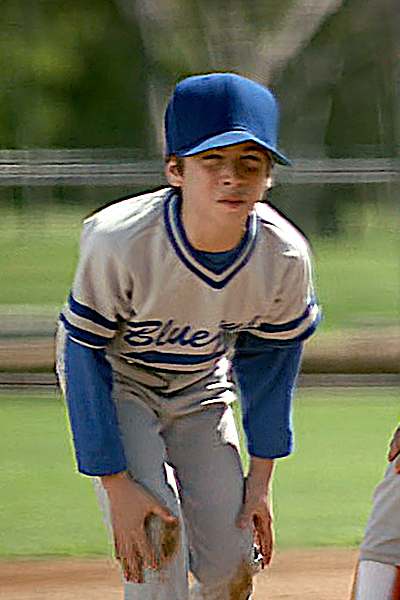
Jake Hoffman
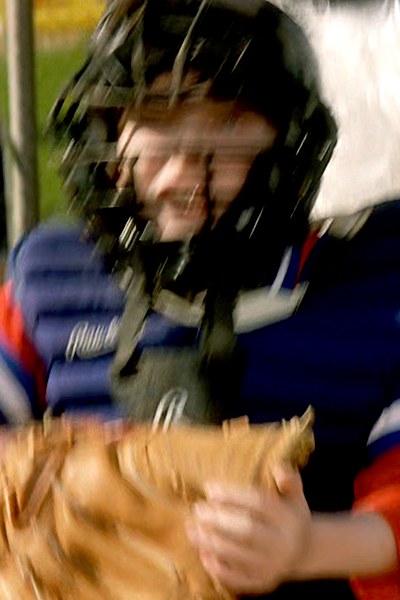
Jake Hart
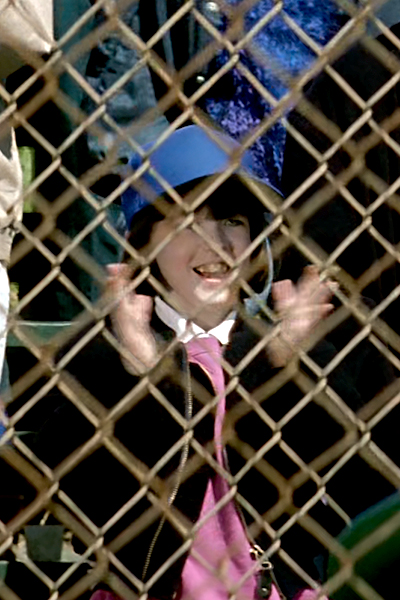
Julia Hart
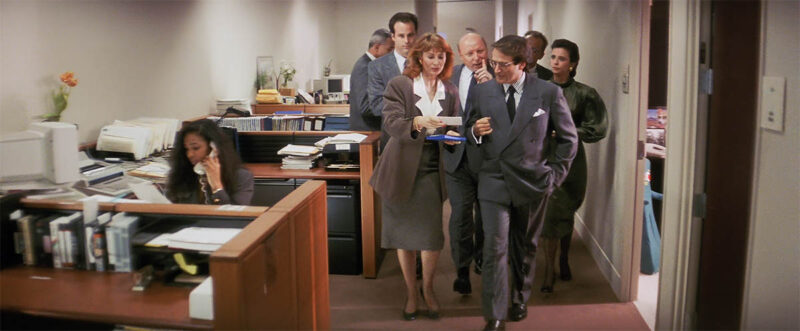
Gumby and Bingo can be seen through the door.
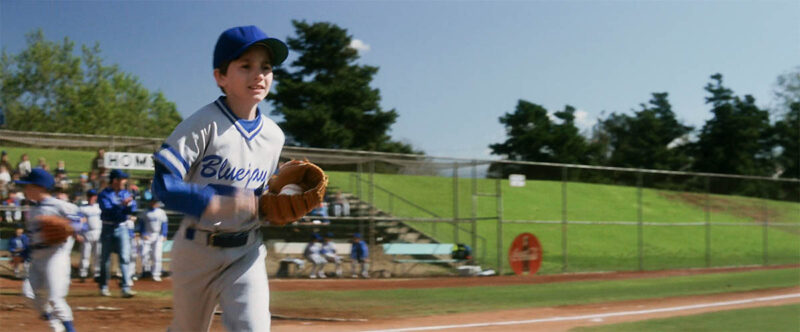
Coca-Cola signs visible in the background.
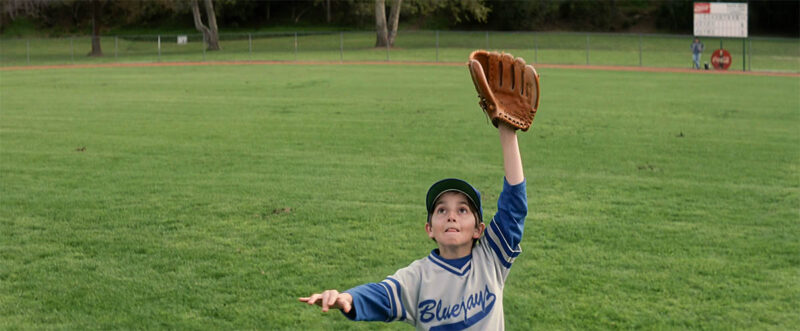
Coca-Cola signs visible in the background.
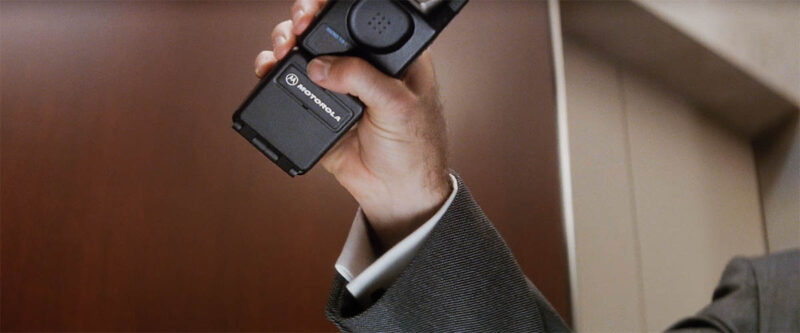
Motorola appearing in the foreground on Peter’s side.
This is only the second deleted scene, and already the density is striking, maybe five minutes of missing footage carrying this much thematic weight.
Spielberg later folds the same ecological concern into The Lost World, reworked around Peter Ludlow: another profit-driven adult, empty of empathy, fixated on control and ownership whatever it costs the natural world.
Several things make this deleted Meeting scene especially interesting. First, because it seems to have been recycled into The Lost World. The idea splits across two moments there, one cut from the final film, set at InGen headquarters during the introduction, and one kept, during the video conference from the island camp.
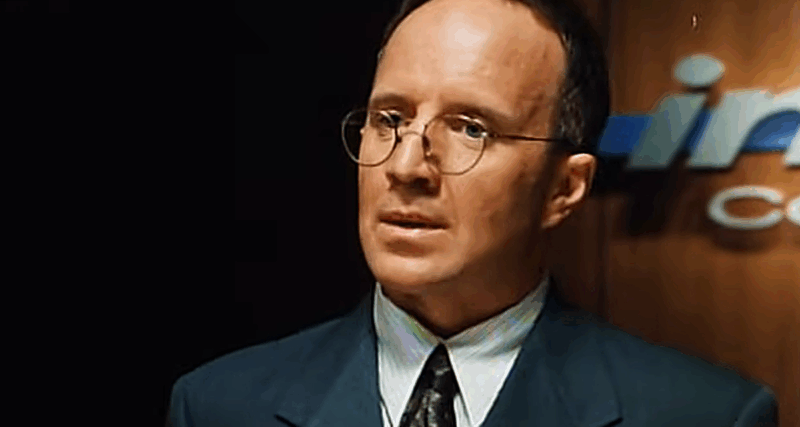
Peter Ludlow, another Peter, the same mindset.
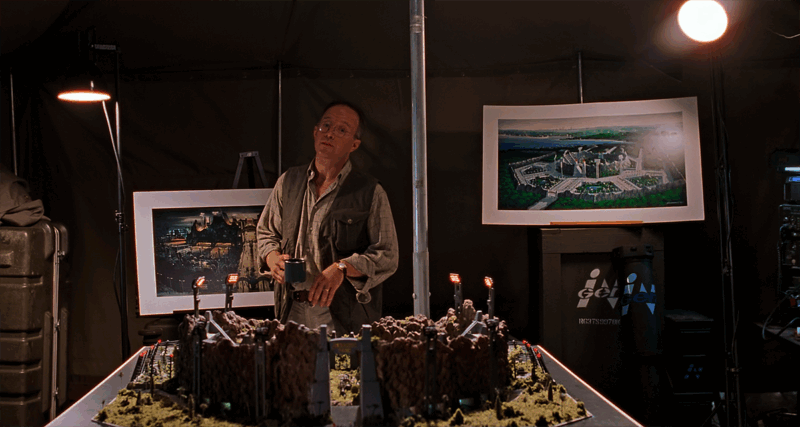
Peter Ludlow dominates the miniature model.
In Hook the idea stays mostly in dialogue. In The Lost World the ecological theme moves to the surface: the Sierra Club becomes Earth First! and Greenpeace, embodied in Nick Van Owen, whose activism gives the film an openly environmental dimension. Jurassic Park and The Lost World echo Hook in other ways too, though those don't touch the deleted scenes.
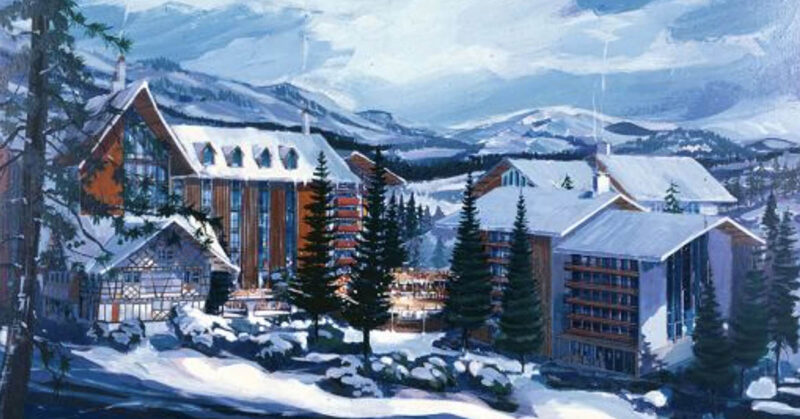
Disney’s concept.
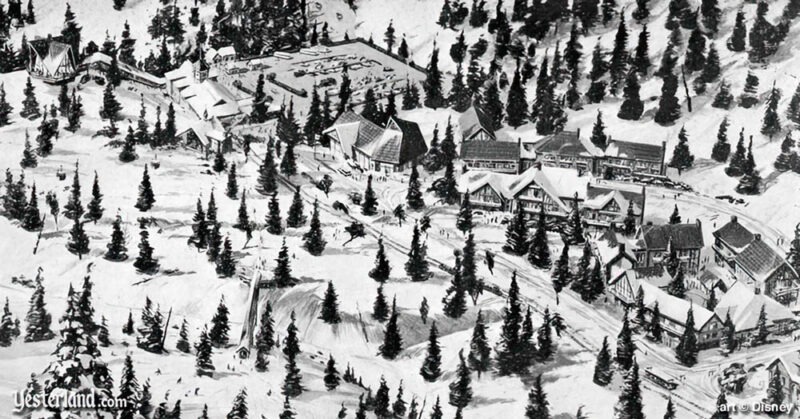
The second thing that makes the scene interesting is how closely it tracks a real fight between Disney and the Sierra Club over a ski resort at Mineral King. In 1965, Walt Disney Productions got a permit from the US Forest Service to build a huge alpine resort in Mineral King Valley, a glacier-carved basin in the Sierra Nevada hemmed in on three sides by Sequoia National Park.
The Sierra Club fought it hard and eventually won. In Sierra Club v. Morton (1972), the Supreme Court ruled against the Club on a technicality but, in doing so, established that environmental groups could sue to block such projects, a principle that reshaped American environmental law. The Club refiled on those grounds and kept at it until the project collapsed, and Mineral King was folded into Sequoia National Park for good.
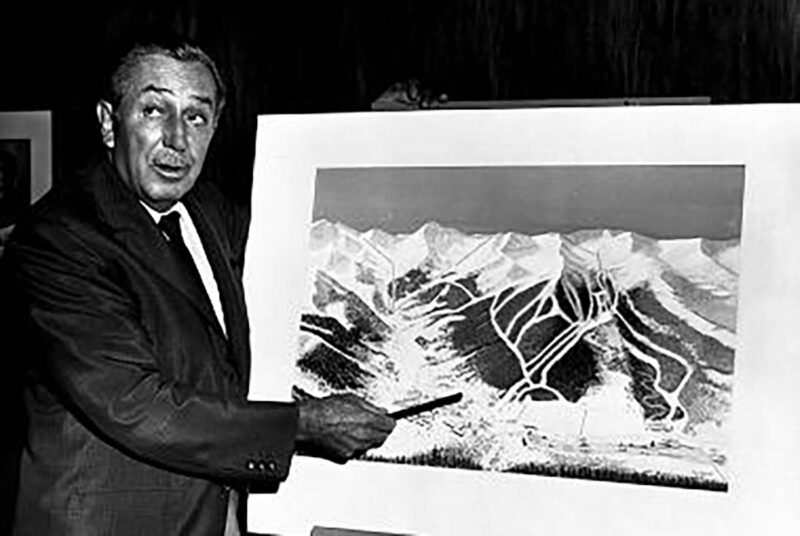
Peter presenting his.
The irony is hard to miss. The company that brought Peter Pan to movie audiences in 1953, and helped define Barrie’s boy who refused to grow up for generations, was also pursuing a much more practical ambition: turning untouched land into a profitable resort. Decades later, Hook gives us a Peter Pan who has grown into that exact kind of man. He is a developer, leaning over a model of the wilderness he wants to build over, looking for ways around the Sierra Club without much sign of hesitation.
To me, this also connects with the references to Bingo and Gumby, elements that evoke children’s programs and contrast completely with this installation project. It creates a parallel with Disney.
The flight to London
Maggie draws during the flight and decides to show her father while the turbulence has him pinned. The first drawing is her own: a "map of her mind," a tangle of colored lines linking San Francisco (New York in some versions of the script) to London, meant to keep her from getting lost in her own thoughts, a way of organizing memory by making it visible. The second is Jack's, and it's far darker: the plane in flames, the whole family parachuting out, except Peter, who falls headfirst into the void.
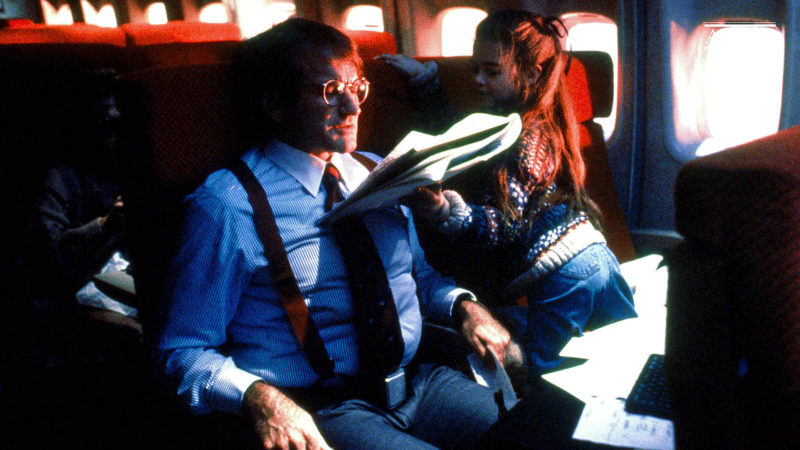
Maggie shows the drawing of the map of her mind to Peter.
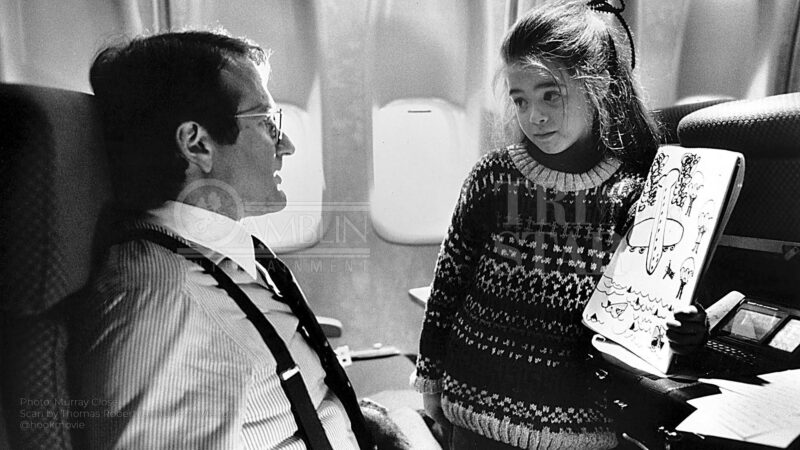
Then she shows him Jack's drawing of the airplane crash.
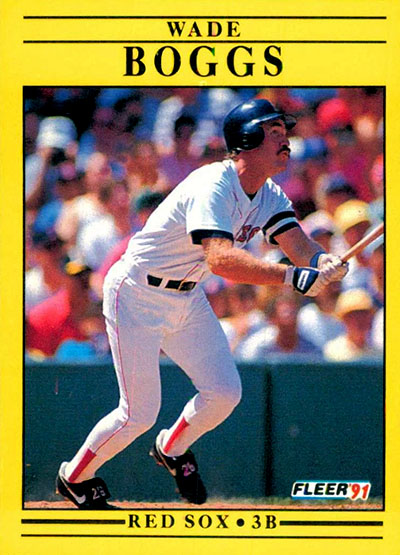
The card Jack holds.
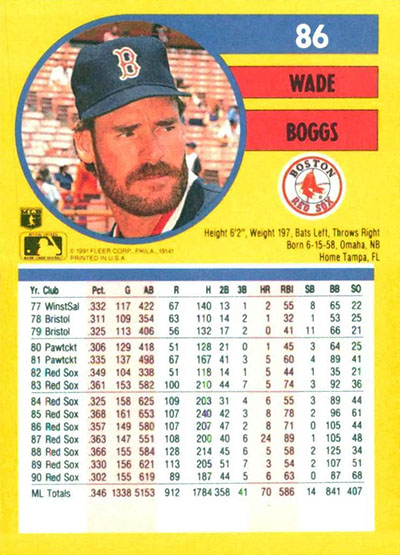
The statistics he memorizes.
Brief as it is, the sequence adds an ironic note to Banning: his fear of flying and of heights. For a man who was once Peter Pan, that disconnection from the air measures the scale of his amnesia. He wants solid ground and rejects any kind of elevation.
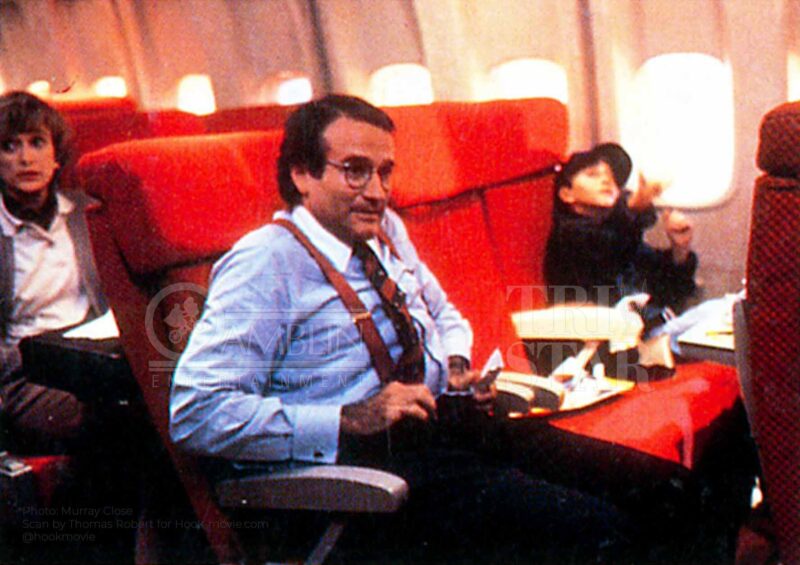
Peter sitting next to Jack.
The contrast between the children sharpens here. Maggie already uses imagination, her map of the mind, to order her reality, foreshadowing her later resistance to forgetting in Neverland. Jack turns his father's cynicism against him: calling Peter's promises "junk bonds," he shows he's absorbed the language of business to express an emotional wound.
The two build memory in different ways, Maggie through creativity, drawing her map; Jack through cards, memorizing the stats of a sport he loves. The link is obvious to me because of my native language. In French, carte means both "card" and "map", one word for the two objects the children use to hold their minds together.
Jack's drift toward the pirates grows out of this. His passion for those stats makes him receptive to them, since the pirates carry traits Peter will have to confront, the same traits that make Wendy call him a "pirate." In a later deleted scene, Hook works on Jack by offering him still more baseball cards, eventually a whole chest of them.
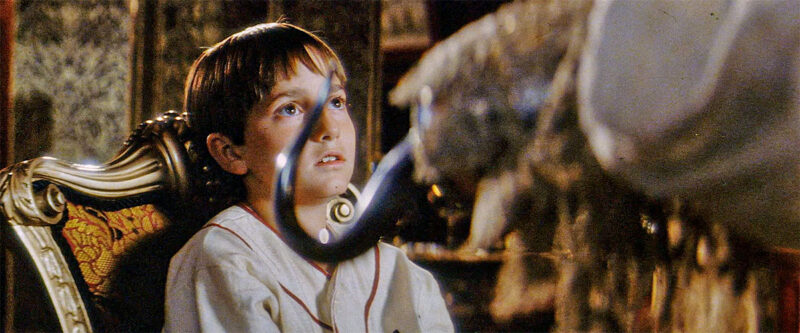
Jack falling to Hook's manipulation.
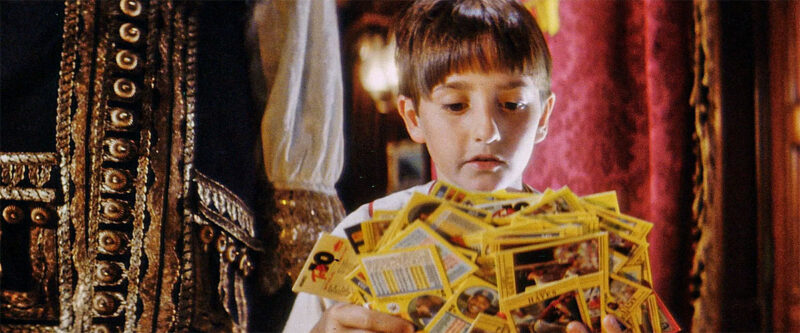
Hook offering more cards than he can hold.
The dropped oxygen mask closes the scene on the family's condition: suffocation. Peter can't breathe, can't find any balance between work and family. He'll feel that suffocation again after Hook humiliates him and his attempt to negotiate fails, his arrogance and cynicism turned back on him like a mirror. He only gets his breath back through the mermaids. In the early scripts, that rescue also brought his first flashes of memory. More about that in the Act 2 section.
Banning's failure runs past the missed game. In the previous scene a secretary handed him Ned Miller's speech for Wendy's tribute, which he coldly called "very personal." On the plane, the close-up of his organizer shows he's forgotten Miller's notes and now has to write the speech himself. Cornered, he admits to Moira that his own drafts don't sound right. The contradiction is revealing: he judged someone else's words "personal," yet he can't produce a single genuine line of his own. His memory and his voice are blocked, a creative void. And again the human stands against the technological: Maggie's imagination builds a connected world that preserves memory, while Peter's organizer erases rather than creates. He's a man with no imagination left, stuck in a shaking plane he's afraid of.
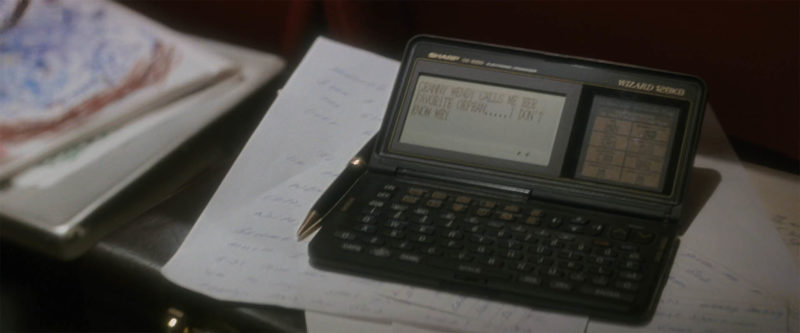
Close-up on the organizer; Maggie's map is visible on the left.
That concept of a map of the mind is the very nature of Neverland as it was written in the original story. The island is never somewhere children travel to; it is what is already inside them, drawn out and given coastlines, and Barrie says so before the story has properly started. That is an interior being described, not a destination, which is why the place can be reached by remembering rather than by going anywhere. Spielberg takes that idea at its word, introduces it here in this deleted scene and will explore it visually much later in the film.
It also means there is no single Neverland. Each child carries one of his own, furnished out of his own head, and no two are the same island. The one the original story shows us is Wendy's. The one Hook takes us into is Peter's. And although all the familiar elements of the Peter Pan story are there, the Neverland we discover in the film is different from the one we know from the original story.
The idea even shaped the film's teaser. The teaser, which sells the film without showing footage, follows a magnifying glass crossing a map, much like the travel sequences in Indiana Jones, tracing Peter's route from London to the Lost Boys' tree. The glass is Hook's, readying his revenge, and the way he burns the map, the same method he uses on Peter's house, may stand for the erasure of Peter's memory. Hook taking control of Peter's memory and, with it, instilling his traits in him.
I speak of Captain Hook as an external character, but he works as a personification of Peter's negative traits, the wound he has to heal.
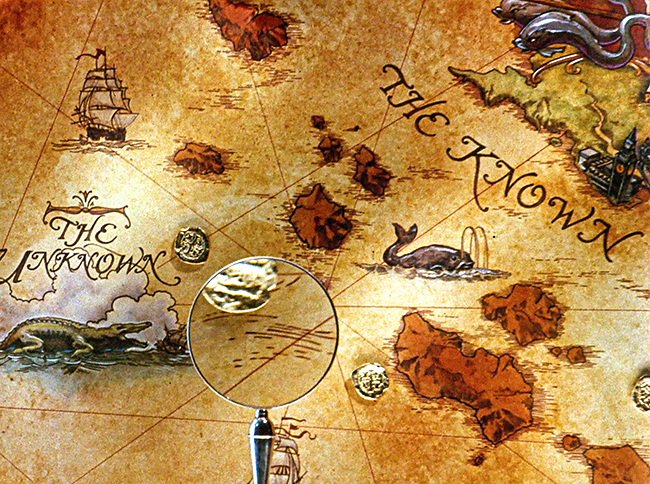
A journey from the known to the unknown.
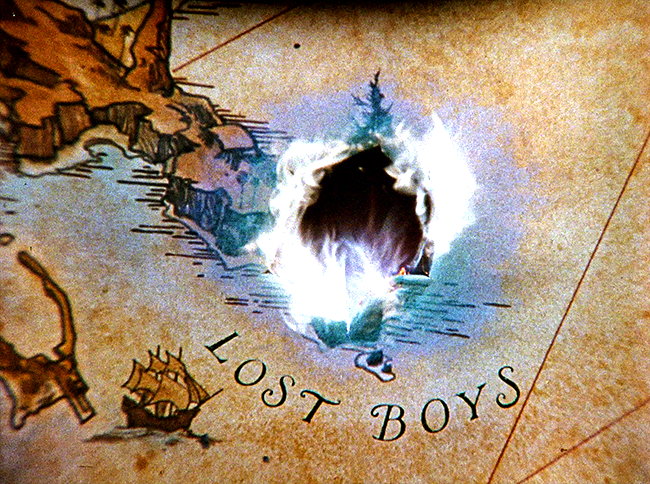
Until the destruction of the map.
The children's kidnapping is what forces the reconstruction, and the island is where it has to happen, a physical representation of his map of mind, where he has to restore balance. To shed his own flaws he has to face Hook, who holds the traits separating him from his children, cynicism, arrogance, tyranny.
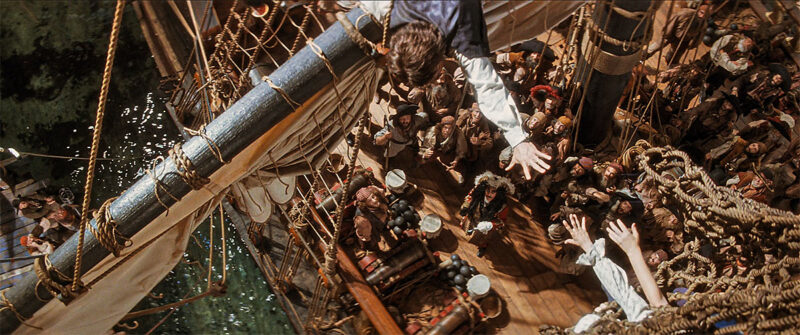
Spielberg visually represents this on several occasions.
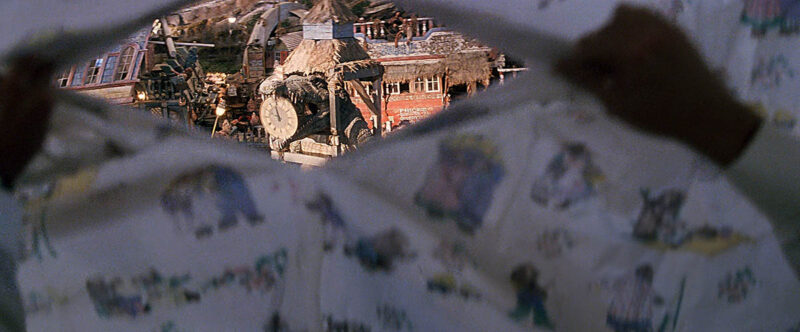
Spielberg explores the idea visually later in the film. When Tinker Bell yanks the nursery rug to drop Peter and carry him off, the rug shows a map. The clearest version comes later, when Peter recovers his memory flying high over Neverland: rising free and untroubled above the island, he reveals the giant compass that marks Neverland for what it is, his map of the mind. And finally, the poster itself is framed by the kind of scale bar typical of maps, complete with a compass rose.
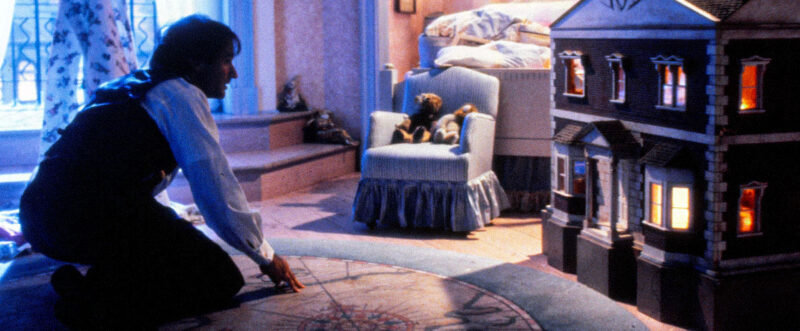
The nursery rug depicts a map, and a compass can be seen on it.
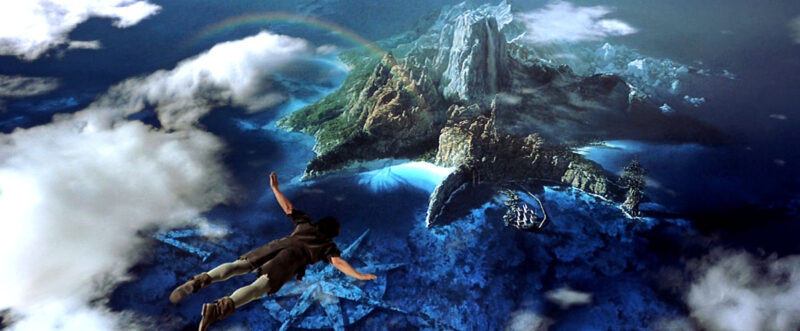
Neverland, Peter’s map of the mind, in which a giant coral compass is visible.
This is the idea that decides what kind of film Hook is. It takes the original story's own first image and builds it at full scale, so that the Peter Pan material ends up staging something else: a story about repairing a mind, with the fantasy used to make memory and redemption into things you can watch happen on screen.
Note: the scene was filmed on Stage 747 at Universal Studios. It is a soundstage that reproduces the interior and cockpit of a Boeing 747. The same set appears in many other films or series, including Die Hard 2 and Kindergarten Cop, to name just two. The airplane captain’s voice is performed by Dustin Hoffman.
The Lost Cufflinks
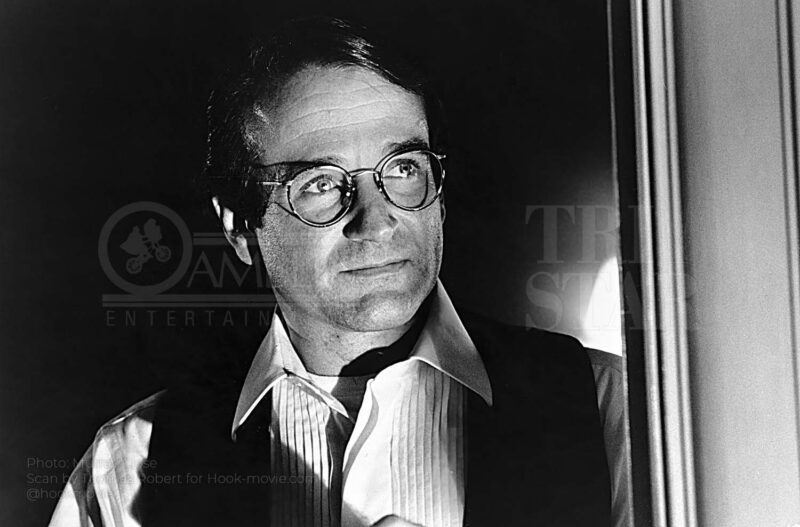
Peter watching Moira and Wendy.
The scene begins after a time skip following Peter's arrival at Wendy's house. Night has settled over Kensington and snow drifts through the streetlamp light. Dressed for the gala, Peter stops in the hallway outside Wendy's bedroom and looks down at his polished shoes; he bends, sighs, pulls in his stomach, a small gesture that exposes his discomfort in his own body.
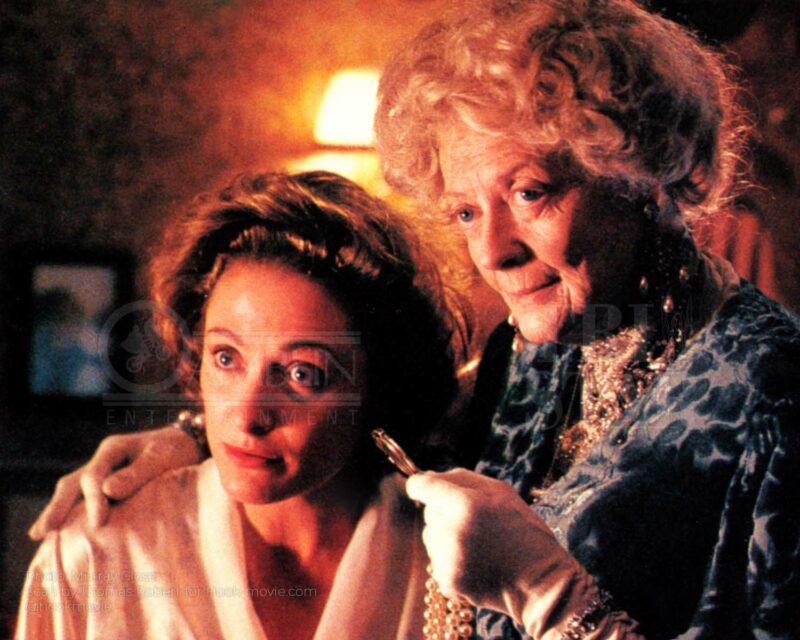
Moira sharing a moment of complicity with Wendy.
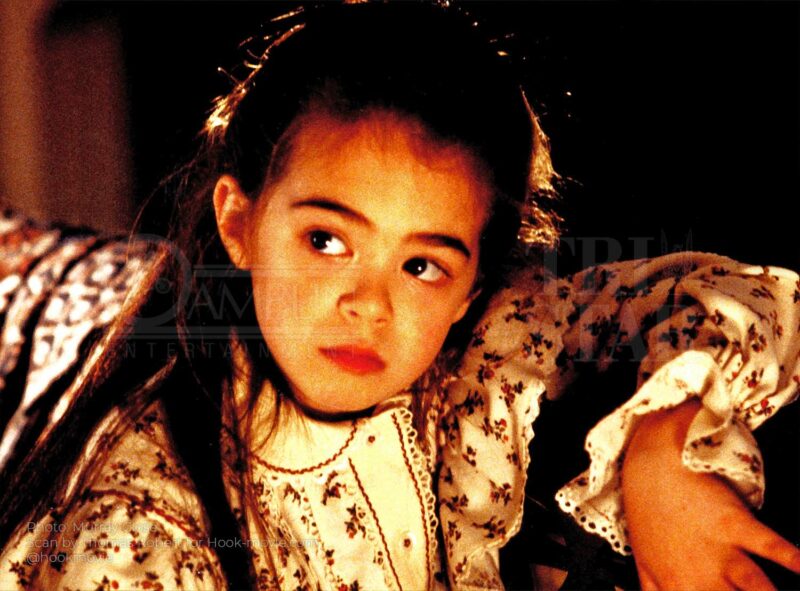
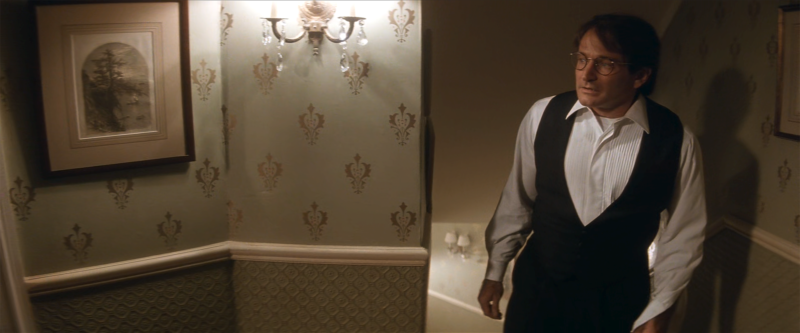
Peter, as if called by his memory.
In the guest room Peter takes the call in chaos, Moira still getting ready, the children playing nearby. He learns the Sierra Club is suing over the project from The Meeting. The news and the noise together make him snap at the children.
In the hallway, Wendy invites the kids to see the nursery. Moira, meanwhile, decides to confront Peter. She reminds him of the promises he's already broken, chief among them, leaving his American work behind to spend time with his family in London. When the phone rings again, she grabs it and throws it out the window. Peter is left stunned, cut off from his professional world.
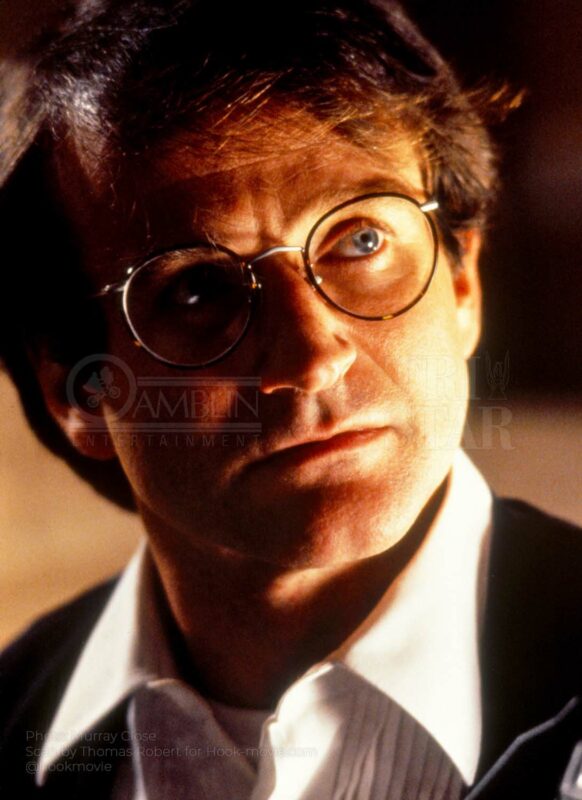
Peter gives Moira a defiant look before answering anyway.
The sequence sets the lightness of childhood against the rigidity of adulthood. Wendy still plays with Moira as if nothing between them had changed. Peter is severed from that energy. His daughter's invitation gets buried under a trivial concern, a cufflink, and he treats family contact as one more problem to manage while fixating on his appearance.
The slippery shoes are an easy stand-in for how little footing he has at home. Anything outside his professional world gets refused. His position on all fours, which the children read as play, is for him only the awkward retrieval of a status object. The encounter with Tootles is a quiet foreshadow: two men at the same level, each searching for something lost. Tootles has lost his marbles, an expression suggesting madness. Peter has lost his memory too, but the only thing he's down on the carpet looking for is a marker of status. You could call that its own kind of madness.
Here Peter occupies the role of George Darling, Wendy's father, a part traditionally played by the actor who plays Captain Hook. The staging makes the point: Peter has become what Wendy already called him, a pirate. His cold authority and his obsession with control echo Hook and wall him off from his children, just as George Darling's emotional distance walls him off from his.
The nursery, where the original adventure began, triggers the first traces of memory. Then his rationality kicks in and he refuses the pull, closing the window. That portal to Neverland is crossed once more by a light like the spotlight that brought the opening play to life, the same light that lets the story exist. The source of creativity, blocked again by Peter, who seals it with a window latch shaped like a hook, shutting out his imagination and his memories.
Hook isn't only present through the illustrations and that hook-shaped latch. Peter is watched throughout. The furniture in Wendy's bedroom is built to suggest a face: two large glass cabinet doors evoke the stern of the Jolly Roger, and the children's bedside lamps supply the pupils, two windows turned to eyes, the pressure rising on a man quite literally under watch.
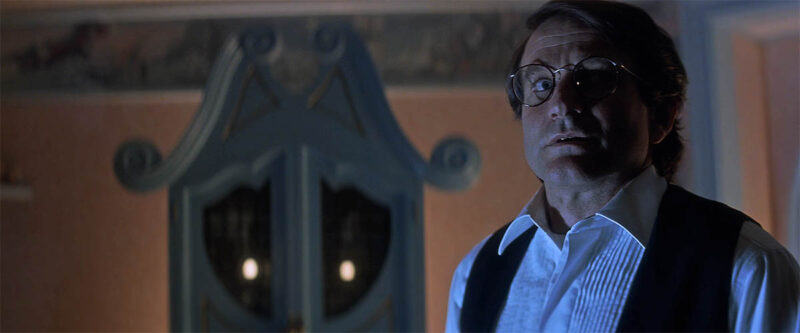
Shivers as fragments of memory return, under Captain Hook’s eyes.
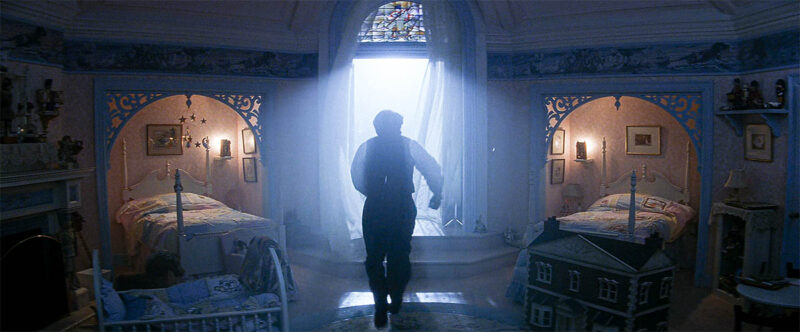
Peter rushes to close the window, the portal, cutting off the light.
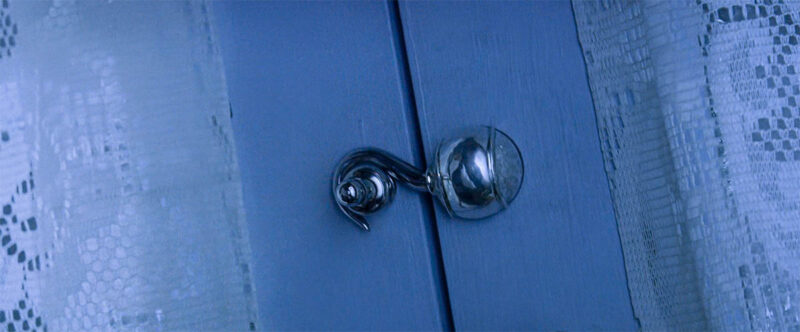
Once again, Peter’s traits reveal his refusal of the light and the memory symbolized by the hook. Peter's reflection is trapped in the hook.
By confronting him and throwing the phone out the window, Moira breaks that authority and cuts the technological tether to his work. The act opens the first crack in his posture. Stepping up to defend her children, she also signals the real risk of separation. Peter's traits have become a genuine threat to the family's balance, which makes his transformation, the return of his memory and his equilibrium, that much more urgent.
Light in the Nursery
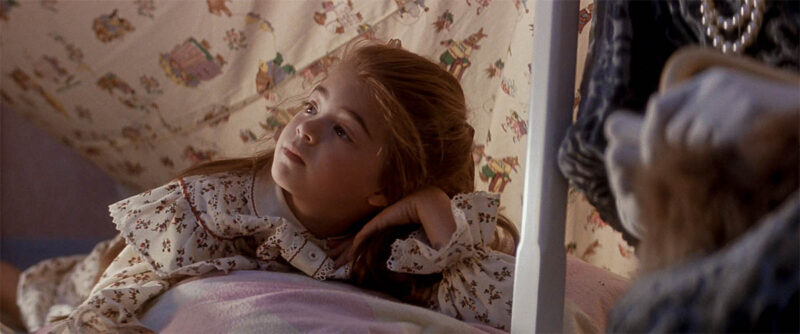
Maggie beside Wendy, fully absorbed in the story.
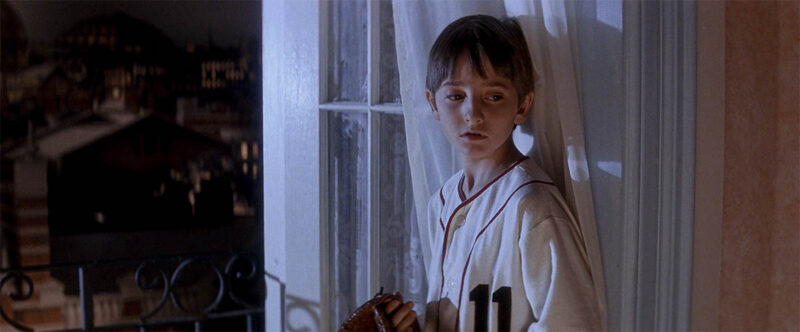
Jack at the window, still caught in between, which makes him doubt.
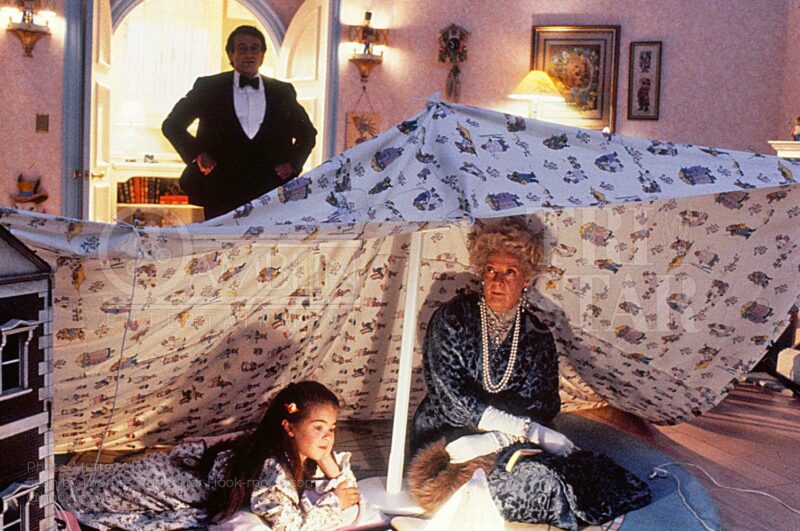
Peter’s entrance breaks the magic of the moment.
Moira
There’s an angel watching you,
When you’re alone.
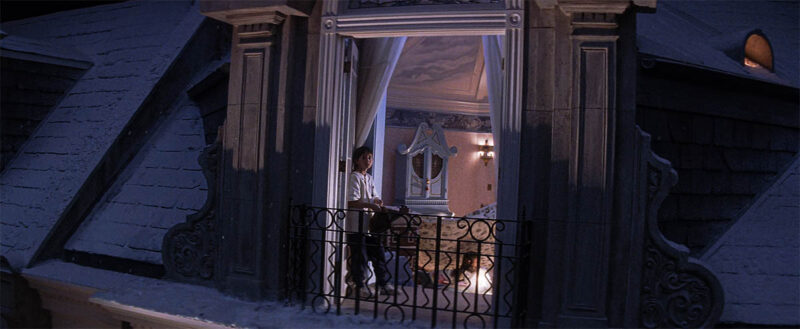
This time, we go in through the window, the same one Peter closed.
For Peter the window is a danger to be sealed. As before, he refuses the opening. The window doesn't just lead outside; it points back to his forgotten past, to Neverland, to the child he's repressed. Closing it, he tries to shut out both the intrusion and the return of his own memory.
Peter finds a safety pin on a teddy bear, which he uses as a cufflink. Clearly visible in this promotional photo.
The gesture quietly inverts childhood and adulthood. Peter takes from a child's object to fix his adult one. Minutes later he gives Jack an adult object, his watch, handing down the very burden that's consumed him. The watch marks a transfer: Peter passes his obsession with time to his son, forcing him to grow up too fast while also trying to fence him inside an oppressive sense of safety. Later the watch will crystallize Jack's resentment, holding every wound Hook will exploit.
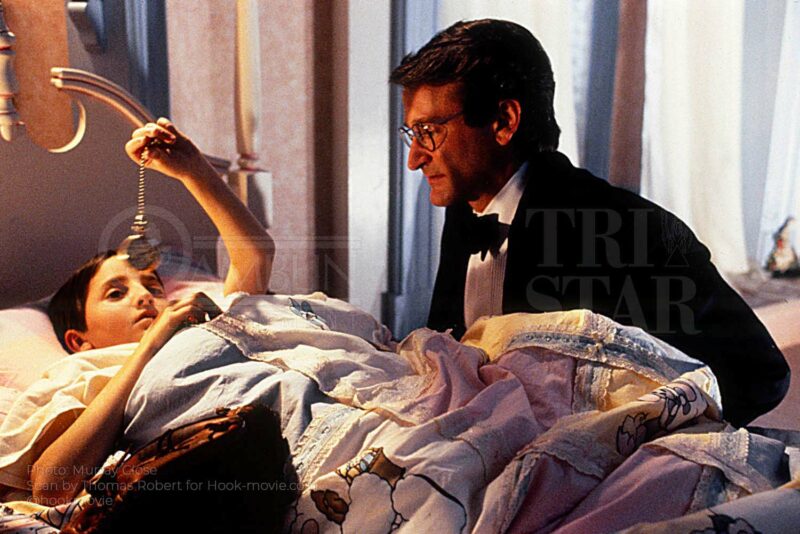
Peter gives his watch to Jack.
Moira's lullaby closes the scene, and in it she fully becomes the protective, loving mother, the emotional refuge Peter in his rigidity can't offer. As she sings, the day's agitation settles and the children drift off. The song, "When You're Alone," which she sings only in part here, ties the nightlights that guard children's sleep to the stars above, casting them as gifts that turn night from something to fear into a protective presence. The little lights work as watch-lights: silent guardians reassuring children that they aren't truly alone. Maggie will sing the same song in full later in the film. The song stays in the theatrical cut, but the narrative reason for her singing it at that moment was removed. More on that in Act 2 section.
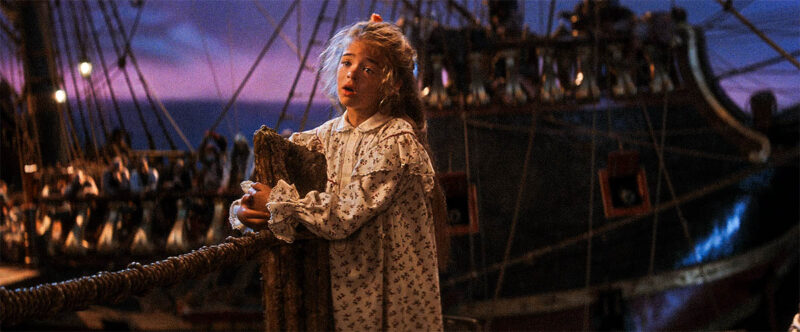
Later, Maggie sings the same lullaby to the captive Lost Boys, taking on the mother's role.
By telling the story of how fairies are born from children's laughter, Wendy is also, indirectly, evoking Tinker Bell, Peter's guardian, a being of light, a living watch-light. The same light Peter has blocked from the start, with his shadow or by closing its source.
The scene leans again on the contrast between the parents. Peter protects his family with locks and cold authority. Moira does it by handing things down and keeping their imagination alive. Her whisper once the children sleep, wishing they could stay like this forever, is every parent's deepest wish, and the story's thematic core: keep innocence alive while growing older. In that suspended moment she's the real pillar of the family, holding the line to wonder while Peter sinks into forgetting.
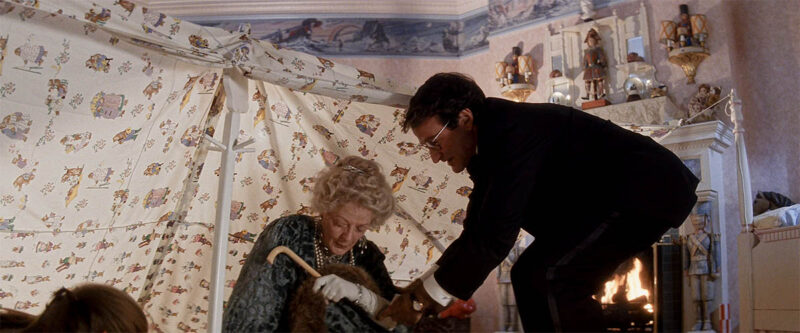
Peter wears the safety pin on his sleeve when he comes for Wendy.
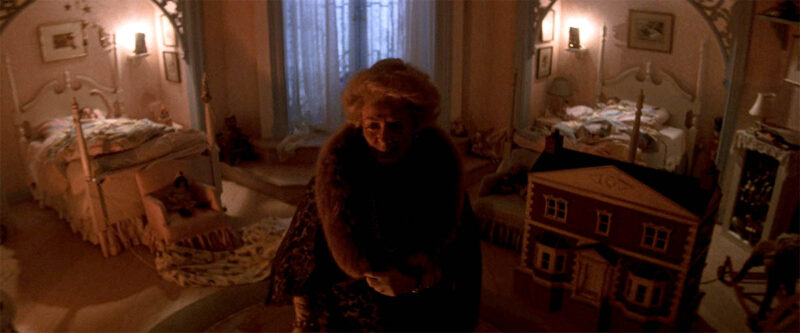
In the theatrical cut, Wendy leaves last, praying over the children.
The Bannings In Distress
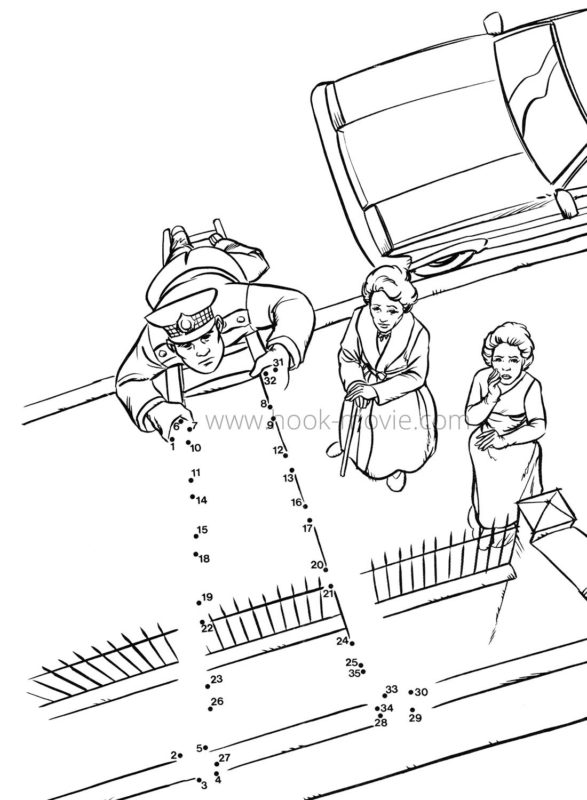
The police officer climbs the ladder to check the roof.
Moira tries to explain the name, revealing that her grandmother is the Wendy who inspired Sir James Barrie's stories. Good treats it as a literary joke and takes his leave. As he goes, every light in the house snaps on, throwing a harsh glare over the Christmas tree, suddenly the brightest thing in the room.
In the silence after, Tootles, frozen by the window, murmurs that he's forgotten how to fly, that the happy thoughts are gone, leaving only emptiness. Moira, moving mechanically, starts tidying to cover her despair, shifting objects without purpose until a clumsy motion sends something crashing down: a ship in a bottle shatters. The sound undoes her, and she collapses into a chair in tears. Peter, helpless, gathers the pieces and freezes, it's the Jolly Roger, Hook's pirate ship.
The police officers investigating the house are searching for physical traces, trying to understand how this could have happened. Inspector Good’s comment about the direction of the door opening, that it had been opened from the inside, already suggests introspection. Whatever took the children didn't come at the family from outside. It came from inside it.
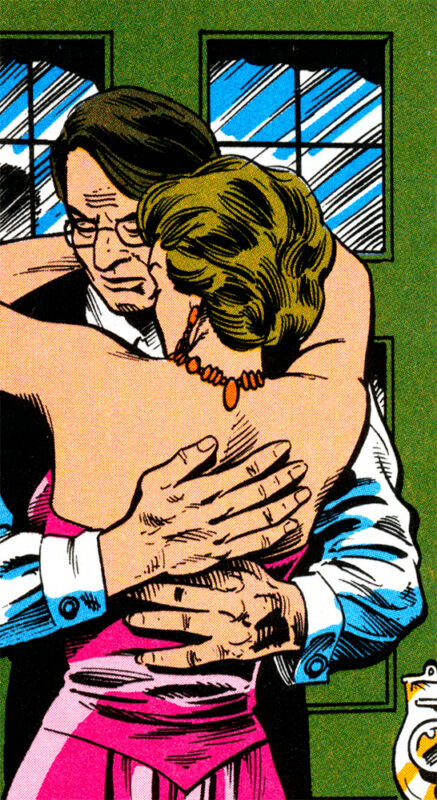
The Bannings In Distress
The image reinforces her earlier speech after Brad's call, where she forced Peter toward the realization that he has to change. Breaking the bottle, she begins expelling Hook from his mind and pushes Peter to start putting that mind back together.
In his memoir Not Dead Yet: The Autobiography, published on 2016, Phil Collins shares a few memories of making Hook and of his time on the set. He had only a single afternoon to shoot his scene, but Inspector Good's role was originally more substantial than the brief appearance that survives in the theatrical cut. By Collins's own account, the scene leaned much further into comedy, with a tone closer to Monty Python, and gave him more dialogue.
Collins recalls that Dustin Hoffman encouraged Spielberg to try a tighter version of the scene. Spielberg then shot a shorter, reduced version, and this was ultimately the version retained in the final cut.
According to Collins, this part of the film was still being rewritten the night before he was due on set, which caused him some stress as he tried to learn his constantly changing dialogue by heart.
During our interview with Paul Babb and Rick Kleber, two actors who played pirates in Captain Hook's crew, we learned of another fragment connected to Inspector Good's investigation. Babb appears to have been involved in a reshoot of several investigative shots, wearing Good's coat and examining objects around Wendy's house. We do not have enough information to determine exactly what was filmed or where these shots were intended to fit into the sequence.
The Forgotten Past of Peter
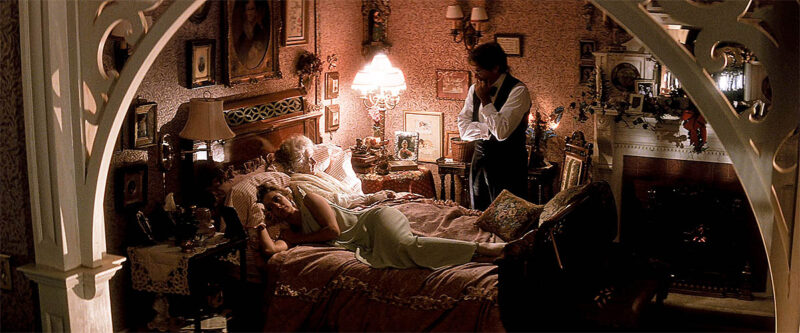
Moira, devastated, is sent to make tea so Wendy can speak with Peter alone.
To clear the room she sends Moira to make tea. Alone with Peter, her tone shifts hard. She confronts him, telling him with full authority that the kidnapping is tied directly to his true nature.
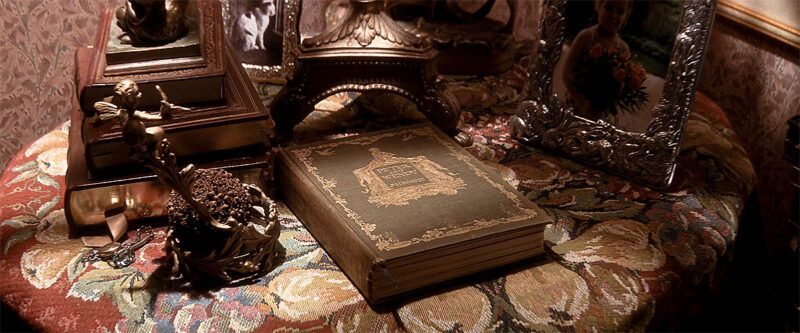
The novel Peter Pan and Wendy preserves Peter’s forgotten past.
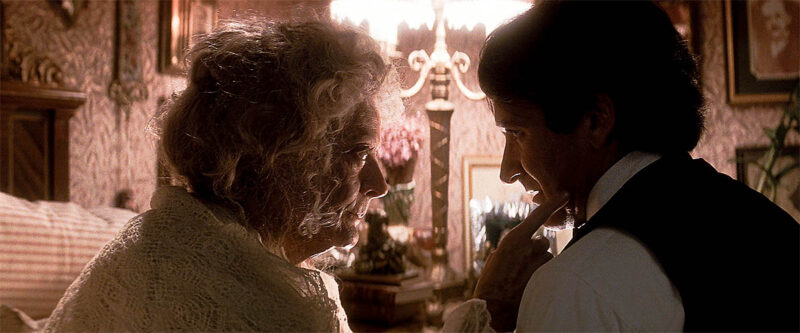
Wendy evokes the memory of a regretful, impossible love.
Wendy admits, with melancholy, that she once hoped he'd come and interrupt her wedding vows. He never did. Only much later, when she was already a grandmother, did he return for good, and on seeing Moira, he chose, immediately and permanently, never to go back to Neverland. Wendy reminds him plainly that the sight of the young girl is what made him stay in the real world.
Wendy's confession can read as morally uncomfortable today, since it sounds like regret over a romance with Peter. It has to be placed inside the logic of Peter and Wendy and the strange time of memory. She isn't longing for the Peter in front of her, but for the Peter of her childhood adventure, the Peter bound up with her own first desires and projections. It's less a living, literal wish than the melancholy of an old woman looking back on a youthful love that never came to anything. That's what makes the scene moving: a quiet bitterness, the recognition that things might have gone otherwise had Peter chosen differently.
The wound didn't keep Wendy from a full life. She seems to have turned the love she felt for Peter into maternal love, then into a protective calling, the love living on in the memory of their adventures, in the kept book, in the decoration of her home, and above all in her devotion to the children she rescued over the years.
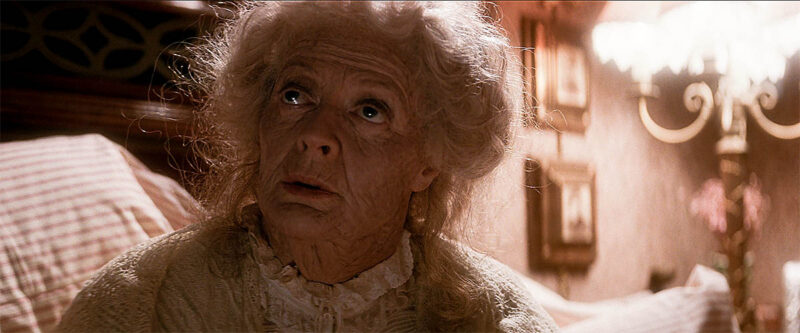
Wendy makes clear the gravity of the threat. Peter alone can save the children.
The scene turns again when Wendy reveals that Peter's enemy has come back for revenge. She presses his hand to the book and begs him to remember who he is, for Maggie and Jack's sake, then shows him an old illustration of Peter Pan, sword raised, defiant. Peter stays unmoved, facing the image of what he was and still refusing to recognize it.
This scene runs close to the final version, but it offers far more detailed memories from Wendy, seeding the visions Peter will recover later, on his inner journey beneath the Nevertree. Amnesiac Peter can no longer create, he can't write his speech, as The Flight to London scene showed. Wendy's use of the book stands against the shot of the organizer erasing the start of his writing, wiping his memory each time he tries to recall it.
Barrie's book works as the preservation of Peter's memory: a structured record of a past he's deliberately buried, a factual account of a reality he suppressed. Wendy keeps that memory alive not only by guarding the book but by furnishing her house with the world of their adventures.
What the missing part of the scene reveals is that Peter didn't originally choose to return to the real world. Wendy recounts taking him in after finding him half-frozen on the windowsill. So this Peter Pan isn't the triumphant, fearless adventurer at all. He's a child in trouble who had to be rescued. And by telling him that the sight of Moira is what made him stay, Wendy marks a deeply formative moment: he stayed out of pure love.
Cutting this part was probably about pacing. The lines spell out, very explicitly, the mechanics that will later let Peter become Peter Pan again. Revealing here that he's the "boy who was afraid to grow up," and how he arrived, found half-frozen on a sill, risked thinning the mystery of his inner reconstruction. The cut also leaves a gap with the final film's flashback, where Peter is never shown cold or in distress. Whether these alternate flashback versions were ever filmed is unknown.
This scene, with several others, supports a reading of the film as something graver and deeper than a story inspired by Peter Pan. I won't develop that here, it gets its own article.
Tink in the Dollhouse
Peter is wrecked. The deal has collapsed, the marriage is strained, the children are gone. Having lost control of everything, he turns to alcohol and drifts back through the house to the scene of the crime, the nursery.
A mystical breeze rises again and draws him to the balcony. As he opens the window and leans on the railing, a light comes racing toward him and bursts into the room, fast enough to knock the decorations over. Taking it for an insect, Peter swings a rolled-up magazine at it; the light strikes back and sends him stumbling.
The light is revealed to be Tinker Bell. Enthusiastic, she immediately recognizes him. She approaches him, stepping on an ink pad on the small desk and leaving tiny footprints on his shirt. Peter exclaims, “Moira!”
Tink identifies him by scent. Incredulous, he puts his glasses back on and dismisses her as a hallucination, so she grabs him hard, urging him to fly to Neverland and rescue his children from Hook. The thought of following the light nearly kills him on the spot, and when she throws fairy dust he sneezes and blows her across the room.
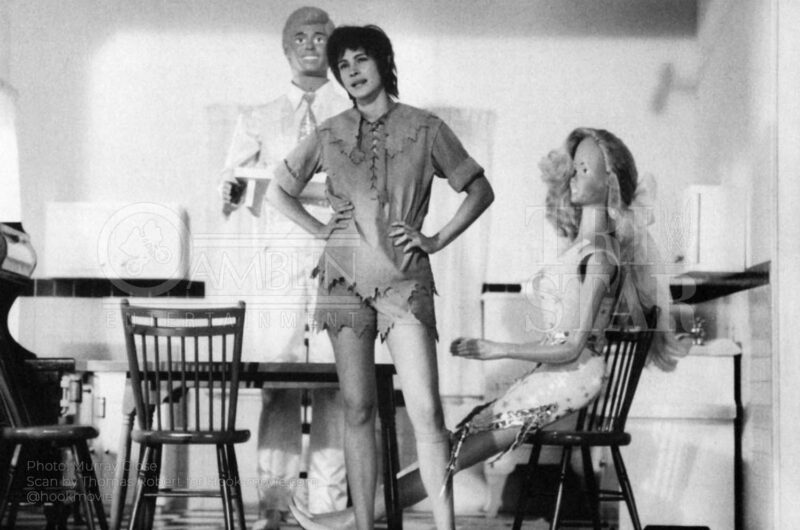
Julia Roberts on the dollhouse set.
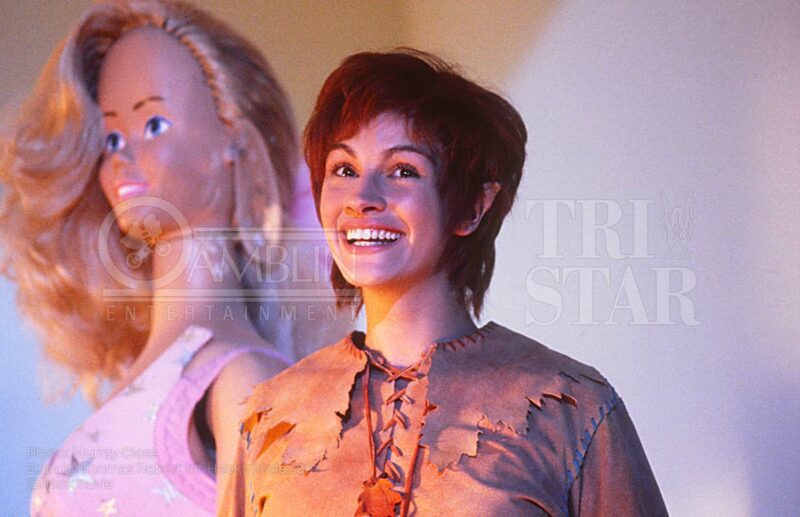
One of the most iconic photos of the film: Julia Roberts during filming of the scene.
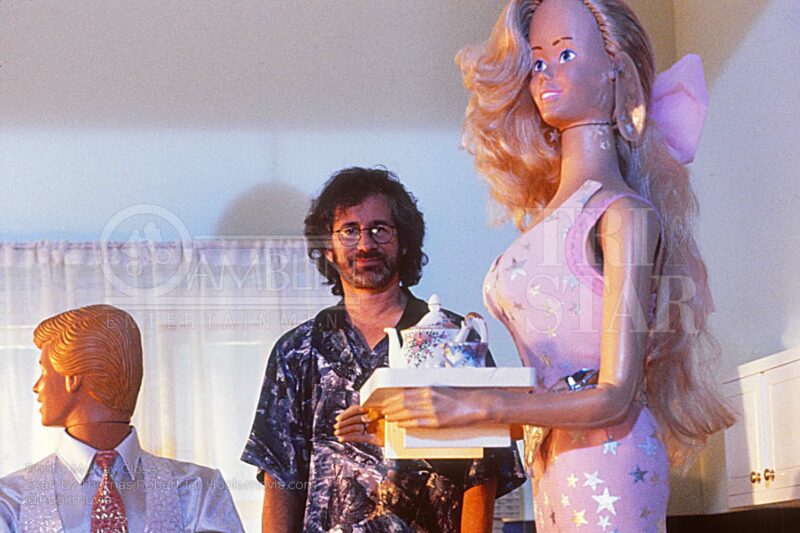
Steven Spielberg on the dollhouse set.
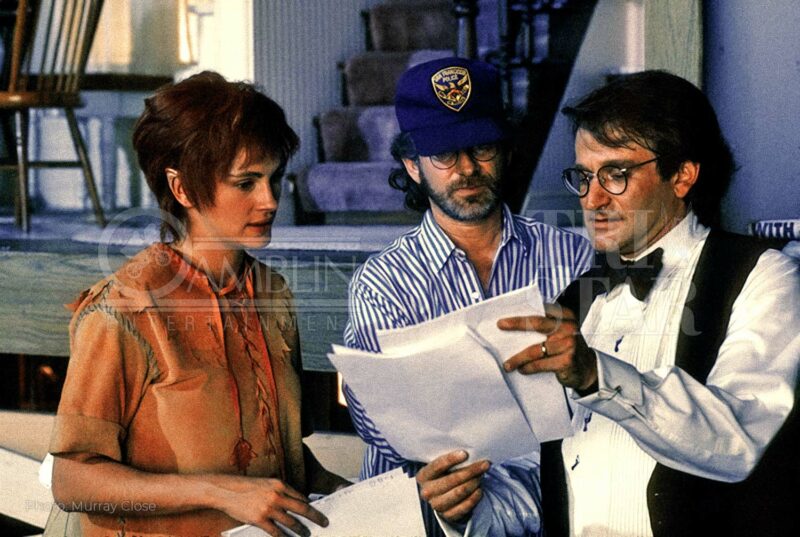
Julia Roberts, Steven Spielberg and Robin Williams preparing the scene.
The scene tracks the final film closely but clarifies things planted earlier. Peter returns to the dark nursery, the light gone from the room and the window. He chooses to cross the portal he kept closing, which brings Tink. We take her point of view as she arrives, forcing Peter to look straight into the camera. That direct look returns at another point in the film, and each time it marks a real shift in his mind and his way of seeing.
The look breaks the fourth wall, the same trick as in the school play. Spielberg leaves the strings showing and lets you see how the spectacle is put together. Peter looks toward the theater projector, and his gaze lines up with ours. The very story he keeps pushing away is the one that comes looking for him.
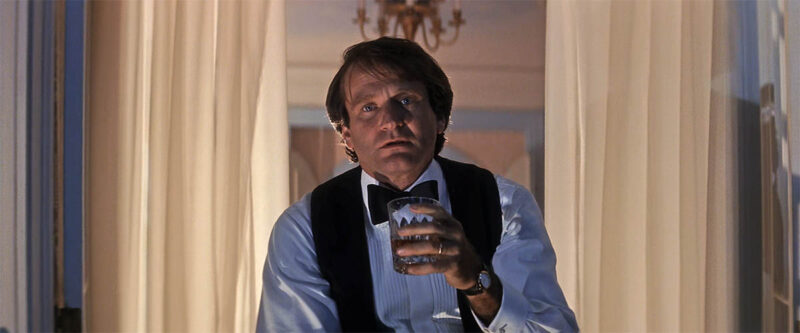
The light reaching for Peter.
Spielberg uses the device twice more. Peter stares into the camera as he starts to grasp that he's the lead in his own story and has to stop being passive and explore what's buried in him, the realization touched off when Jack's ball strikes him.
When he notices his shadow, he turns to the audience with a look that clearly says, “Am I dreaming, or did you just see that too?”
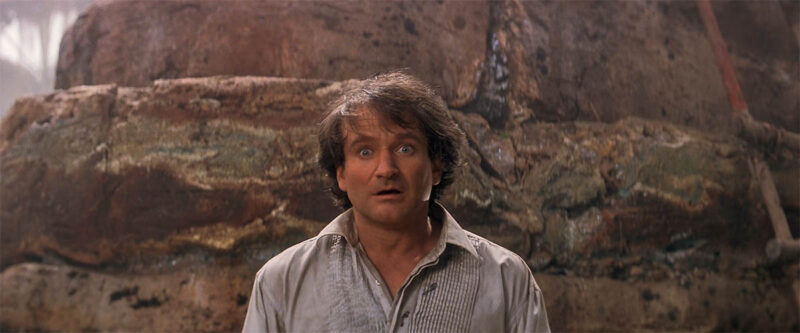
Peter struck by Jack’s ball, which triggers the return of his memory.
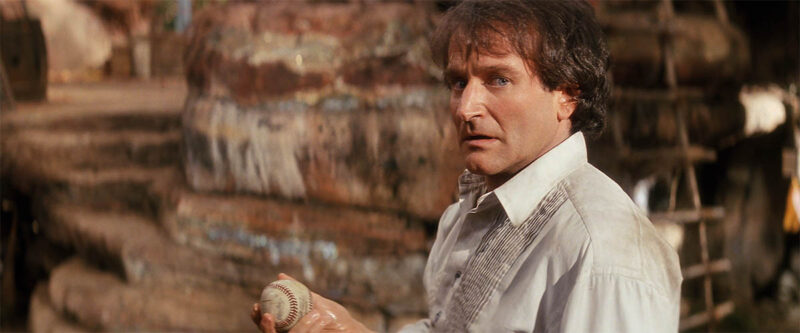
Peter, after seeing his shadow move, looks to the audience. “Am I dreaming, or did you just see that too?”
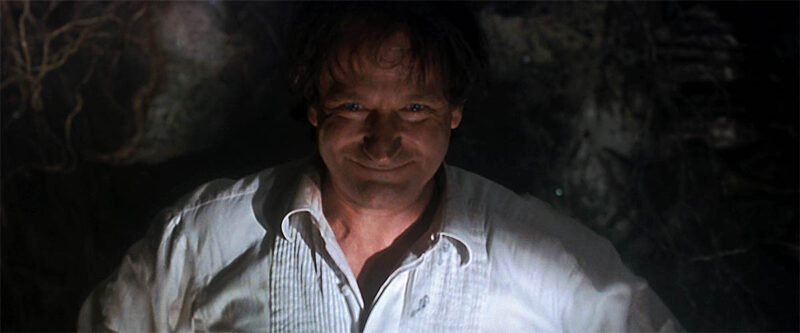
Peter regains confidence and looks at the audience with assurance.
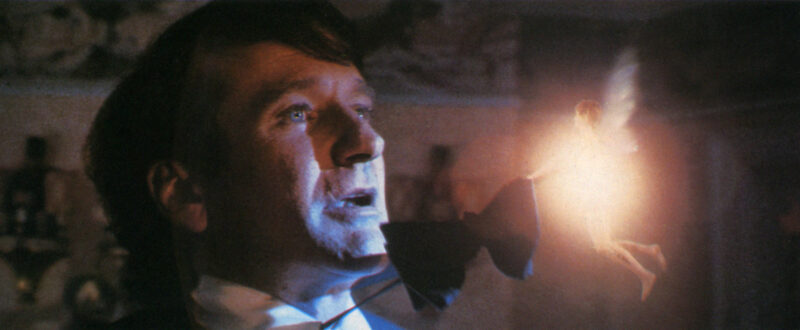
Tinker Bell tries to take Peter to Neverland.
Faced with what he reads as a hallucination, Peter's reflex is to call for Moira, his anchor to reality, against Tink, who embodies the fantastic and the wondrous. He reacts the same way later when Tink tries to kiss him in Neverland, snapping back to reality and to the need to move fast against Hook.
Tink forces Peter toward belief, and she does it by turning the dollhouse into a stage. The little house becomes her theater. When Peter says outright that he doesn't believe in fairies, she answers with a death scene, thrown into with full drama-queen commitment: tumbling down the miniature stairs, lying still, demanding applause to be saved. Peter is press-ganged into the one role left open, her audience of one, and against all his rationality he plays it, clapping without thinking. It's the first real crack in his resistance to the fantastic.
This beat is Barrie's own, turned inside out. In the original play the appeal to belief runs the other way: Peter breaks the fourth wall to save Tinker Bell, turning out to the audience and asking them to respond, their applause the one thing that can keep a dying fairy alive. Barrie was far from sure it would land. He'd built the play in near-total secrecy, its first-night audience was largely London society rather than children, and nothing guaranteed a room of adults would answer a plea to save a fairy; he is said to have kept the orchestra ready to clap in case the stalls stayed silent. They didn't. The response was so overwhelming that the actress playing Peter was left in tears. Here the arrangement flips: Peter is the only audience, and he plays along. Just as Barrie feared his audience might stay silent, Peter answers, and answers positively. That he plays the game at all means there is still something in him worth saving.
The mirror with the opening sharpens here, and it cuts the other way. At the school play Peter killed the light, not truly, only for a beat, stepping into the projector beam and throwing his own shadow across the stage and the child playing Peter Pan. Now that light comes back for him. The thing he blotted out returns embodied as Tink, a being of light staging her own show on her own stage, and this time he can neither step in front of it nor shut it behind a latch. It's almost as if the light he snuffed at the start had been haunting him ever since, waiting to take living form and pull him into the story he keeps refusing.
The Meeting scene showed Peter looming over inert miniatures, much as Hook will loom over his own. Peter loves manipulating models because they give him total control; he stood confident, moving buildings like game pieces. Tink reverses that. A living miniature, she forces him into submission, he has no control over her at all and has to kneel to interact, a being that triggers a deep shift in him.
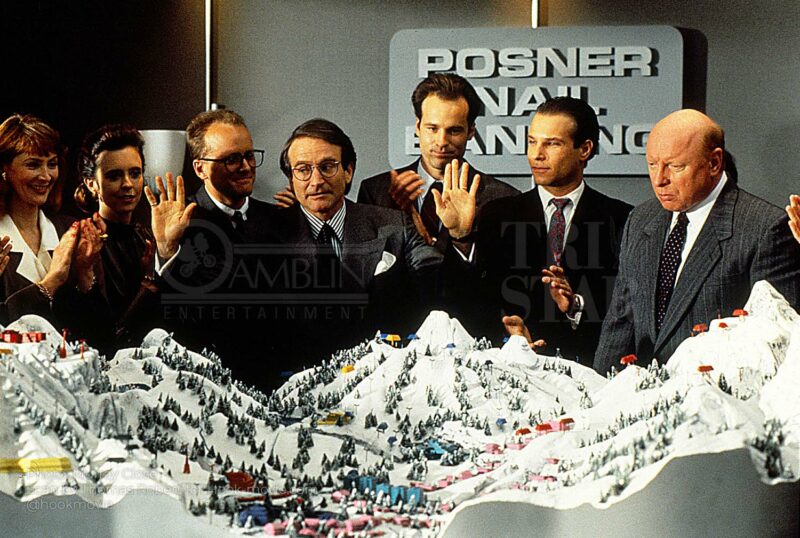
Peter dominating inert miniatures.
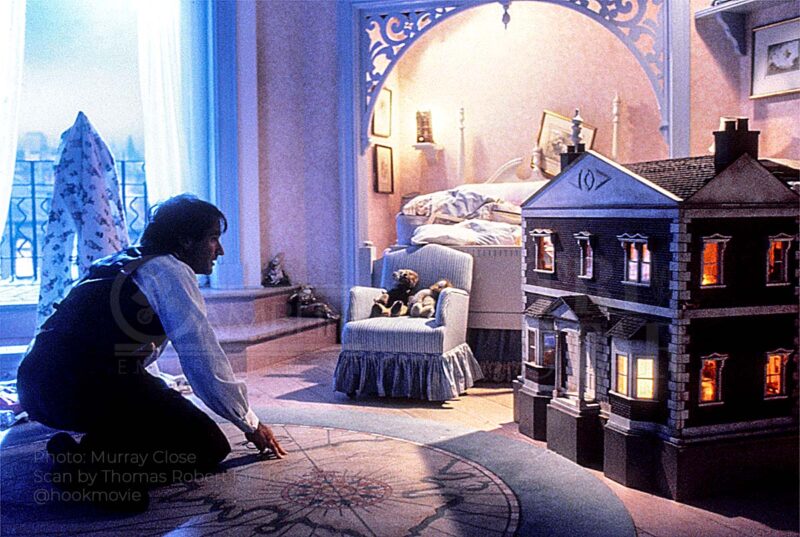
Peter submitting himself to interact with Tinker Bell, the miniature being of light.
There's something else in that posture. On his hands and knees in front of the dollhouse, Peter is put back into the exact bodily attitude of a boy at play, unwilling here, but in the shape of it all the same. Hook keeps returning to this image. Peter and Tootles both end up on the floor hunting for something lost, a marble, a cufflink; Smee crouches over the model of the Jolly Roger in Hook's cabin; Peter has to drop to all fours again to crawl into the ruins of his home under the Nevertree; Jack and Smee play together down at that same level. Each time the film lowers a character to the ground, into the physical grammar of childhood, and here it uses that grammar twice over, to humble Peter before the fairy he once put out like a light, and to make him, almost against his will, begin to play again.
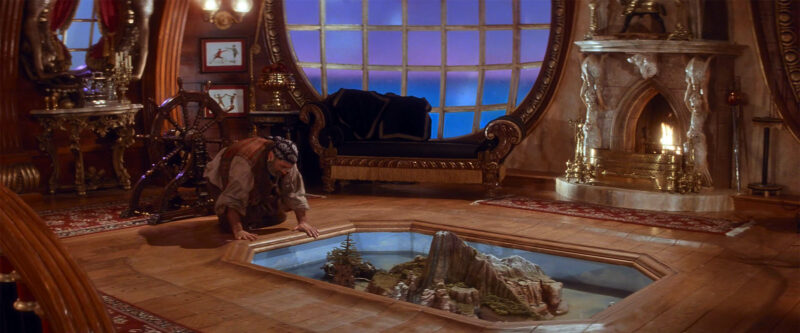
Smee gets down on his hands and knees to play with the miniature Neverland.
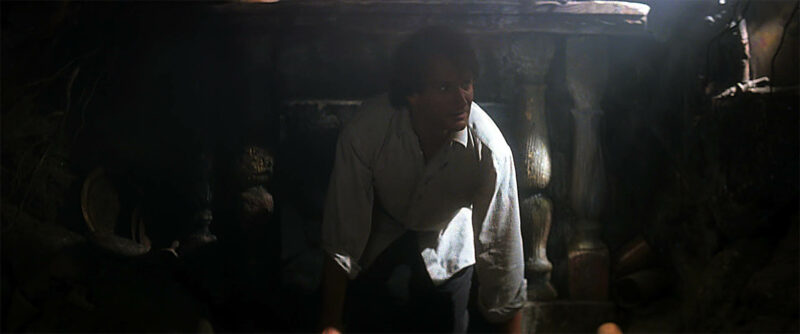
And this is also the posture Peter will have to adopt to enter into the ruins of his house in Neverland.
Look closely at the dollhouse itself. It's Wendy's, a relic of her girlhood, and in Barrie that's never only nostalgia: the doll's house is the small, tidy image of the future already written for a girl, the domestic life of wife and mother she's being quietly readied for. The Barbie and Ken standing in it are Maggie's, set down in the old house generations later, and they make that future literal, the same domestic script carried from Wendy's girlhood to the child now playing in her nursery. They're the traditional family cast in plastic, the roles pre-assigned and waiting, Ken the husband, Barbie the wife, Ken standing in for Peter and Barbie for Moira.
That life written in advance... Fixed from the start and sealed against anything else, it's the one Peter ran from to begin with. We only learn this later, in his flashback: he fled the day he was born, having overheard his whole life laid out in advance, the settled march from childhood to a grown man's work, a marriage, old age, with no gap left for anything else. What the dollhouse holds out to a girl is only the other face of what he escaped. And the escape didn't hold. When he came back to the real world for Moira, that pre-written life closed over him all the same, and turned him into exactly the man he'd sworn never to become, the future that had once driven him to flee reality altogether.
Set against all that, what Tink does with the dolls reads as a small revolt. In the dollhouse kitchen she finds Barbie waiting on Ken, the wife serving the husband just as the arrangement prescribes, and she turns it clean around, sitting Barbie down and setting Ken to serve her instead. She breaks the traditional pattern the dollhouse was built to pass on. The missing part of the scene is mostly that reversal, the feminist gag the theatrical cut leaves out, and an earlier draft pushed it further still, closer to Tink's temperament in Barrie: rather than merely invert the roles, she destroys one of the players, decapitating Barbie out of jealousy. The rival is an artificial womanhood shrunk to her own size, and tearing it apart follows from everything the dollhouse stands for. In the script, a fed-up Tink, after clapping under protest and complaining that Peter left her for “that Wendy ditz,” sizes up Maggie's Barbie and tears its head off.
...
PETER
(clapping under duress)
Okay--I'm clapping. Just stop ringing--
TINK
You didn't really mean it. And ME--
the most important faerie in your life?
TINK SITS UP--livid. She straightens her gown, shaking
herself all over and huffs away through the debris--
TINK
You're scum, Pan. No card. No letter
all these years. Leaving me for that
Wendy ditz. What's she got--I haven't
got. Hmm?
Seething, she poses her mini-body next to Maggie's Barbie
doll. Seeing the competition, Tink rips Barbie's head off.
...
It would seem that this act of brutality toward Barbie was indeed filmed. Steven Spielberg was fully aware that this would likely displease Mattel, the company behind Barbie as its flagship product. Mattel was also responsible for producing the film’s toys.
In his article for Premiere, published in December 1991, journalist Fred Schruers recounts a day he spent visiting the film’s set. During his time there, he had the opportunity to witness the filming of this scene.
“When Tink must tear off Barbie's head, ‘Throw Barbie!’ is Spielberg's instruction, Roberts spikes it hard into the floor. ‘Oh, God, I think that's the end of her head. Mattel's not gonna be happy with that one,’ says Spielberg.”
As in The Meeting, fantasy keeps undercutting the product placement. Coca-Cola stays in the background of Jack's scenes while Peter takes full control of the Motorola, his empty organizer set against Maggie's dense drawings. Here Tink destroys Barbie, a plastic body, an artificial figure, playing with these inert toys like a child before mutilating one. A gesture of a creature born of theater and literature destroying the thing that gradually displaced her in children's imaginations.
Note: The giant Barbie and Ken were created by The Character Shop company.
Conclusion for Act I
Act I ends here, with Peter leaving the real world for Neverland.
None of these missing scenes is long, but several plant things that still pay off in the theatrical cut, even if the scene that set them up is gone.
Mostly, they clarify. Questions the released film raises get explicit answers, and the answers don't just confirm a reading, they anchor the film in a fully worked-out psychological frame aligned with Carl Jung's idea of individuation. Peter Banning has to explore his unconscious to recover lost memory and find the deeper wound holding him back, the one cutting him off from empathy, affection, and the ability to let go. Captain Hook personifies that wound, concentrating the traits that became Banning's flaws.
The theatrical cut puts the Peter–Jack conflict at the center, as though that were the whole point. Read the deleted scenes and it's clear that conflict is a symptom of something deeper rather than the thing itself.
What Spielberg first set out to make wasn't a neat lesson about a father making up with his kids. It runs on an inner conflict, one about memory, amnesia, and buried trauma, and on what that repression does to identity, relationships, and growth. These scenes give us a far less likable Peter Banning than the released film, not just busy and distracted but arrogant, dismissive, emotionally shut, at times contemptuous. That matters, because it makes his transformation psychologically necessary. He doesn't simply need more time with his children. What he actually has to do is reckon with who he's turned into and how he treats the people around him.
Read together, the scenes show how tightly the themes interlock. Right from the school play, the film shows its real subject. Adventure is the surface; belief is what it keeps returning to. Spielberg exposes the strings, the painted backdrops, the projector beam, because he isn't after a perfect illusion, he's after the viewer's willing engagement, the suspension of disbelief children grant on instinct and Peter has lost.
That light runs through the whole act, the projector, the window as portal, Tinker Bell as a living watch-light. Peter keeps blocking it, with his shadow on the stage, with the hook-shaped latches he closes on his own past. It's the source of both creation and memory, the other thread binding these scenes. Against the organizer that erases his words stands Wendy's book, which preserves what he's repressed. Maggie orders her mind through her map, Jack through his statistics; the amnesiac Peter can no longer create, remember, or wonder. That's exactly why his recovery has to run through Neverland.
Seen this way, Neverland is more than an adventure playground. It's a space of reconstruction, where Peter can recover what he's forgotten and confront what he's repressed, the externalized form of his map of the mind, his island, his coral compass, his unconscious made visible. Returning there begins his individuation: he stops reacting to external events and starts facing his unconscious and the archetypes inside it, a confrontation he has to be able to see in order to survive it.
The film belongs to the same family as A Christmas Carol, which it clearly draws on, and it shouldn't be forced into literal realism. Its logic is symbolic. The question isn't whether every detail is plausible but what each element represents. You could replace the Peter Pan books and illustrations in Wendy's house with photo albums and framed pictures of his life, and the theme would stay exactly the same. Spielberg simply borrows the aesthetic of Peter Pan to illustrate his point: the rebuilding of the memory of a man who chose amnesia to cover a deep childhood wound.
In promotional interviews for the film, Spielberg stressed that the film wasn't about effects, flight, or the size of the sets, but about Peter's journey. It isn't a straight Peter Pan adaptation; it's a psychological fresco that uses the world of Peter Pan as a visual language to externalize one man's inner journey.
That's what a lot of critics missed. Few engaged with the symbolic structure. Many wanted a Peter Pan adaptation nearer the original, or at least one that committed fully to fantasy, and Spielberg renders that fantasy through the grammar of children's theater. Peter gets his powers back only when he accepts the rules of the game and lets himself play.
Most critics tried to rationalize the film or rejected it for not matching their expectations. Dismissing the sets as "cardboard" already refuses the film on its own terms: it judges a symbolic, theatrical as if it were meant to be naturalistic. That misses the whole point.
In fairness, they can't really be blamed. They could only respond to what was on screen, with no access to the deleted scenes or the research needed to see the original intentions. A version that kept the themes running through these missing sequences would almost certainly have been easier to understand, and its deeper meaning easier to find.
Act II - Part One coming soon
Introduction
Why I started this
Hook looks, at first, like a conventional Hollywood adventure: a big-budget reimagining of Peter Pan, all expansive sets and visual imagination. But there's a stranger film underneath, and much of what makes it strange never reached the screen. Productions this troubled and this reworked tend to arrive half-finished, and Hook is no exception. A lot of what it was trying to do survives only in the material that was removed. Those are the fragments I've spent years tracking down, and the search never really ends.
That work has been an obsession of mine for years, and it runs past nostalgia. I saw the film as a child, but what kept me going was what surfaced once I started digging into the deleted scenes and the harder-to-find production history. When I began researching in 2006, I had no idea how tangled this would get, not just because of how many scenes were cut, but because of how much they change the story. The deeper I went, the more it pulled me in.
That's really where my attachment comes from. It doesn't come from thinking the film is perfect. It never has been, to me, and that's part of its charm. From the start it felt incomplete, like something had gone missing on the way to the screen. Don't get me wrong. The film works. It has its own identity, some beautiful scenes, and an emotional pull that still gets to me after all these years. But underneath that, I've always felt the breaks. The gaps. Connections that don't quite line up and are hard to put into words.
By now there are really two films in my mind: the one I grew up with, and the one I uncovered. It makes the released version feel like a patchwork, a Frankenstein creature, working, but covered in scars. Some of those scars are right there on screen. Others are quieter, almost invisible, buried in the editing, in a sudden shift of tone, in characters who seem to have lost a piece of their own story, in scenes that leave you feeling something came before or after that you never got to see. The film is assembled from separate pieces, stitched together into something that stands, breathes, and even manages to move us, but whose seams never fully disappear.
The irony is that the film is about exactly that: the scars of childhood we bury to protect ourselves, and eventually have to heal.
And the comparison with Frankenstein doesn't stop at the creature. In Mary Shelley's novel, Victor Frankenstein pours everything he has into giving his creation life. Then, the instant it opens its eyes, fear and disgust take over. He can't accept what he's made, and he abandons it almost on the spot.
I've often thought something like that happened with Hook. Spielberg spent 18 intense months on the project, and then he pulled away from it. It's as if, once the film was finished and out in the world, he no longer quite recognized what he'd brought to life. He's talked about some of his regrets, his doubts, the choices he wasn't happy with, sometimes sounding like he'd rather turn away than face this imperfect thing he created.
And yet, just like the creature, Hook goes on living no matter what its maker thinks of it. It grew up inside the imaginations of the kids who found it. People have loved it, stood up for it, handed it down, an audience that saw something in it its flaws couldn't erase. Where its creator may have seen a film that was too heavy, too far from what he'd first imagined, plenty of us found it deeply moving despite it all.
That feeling of incompleteness is exactly what keeps my passion alive.
I don't collect Hook just to own things that are rare, valuable, or nice to look at. Every piece I track down is, before anything else, a way into something the film itself never shows you. It might hold a detail that's different from what ended up on screen: an image that got cut, a forgotten line of text, a character shown in another light, a scene that was talked about but never shown, the leftover trace of an idea dropped somewhere in production.
So I dig. Deleted scenes, older drafts of the screenplay, production stills, trailers, promotional material, anything that gives even a hint of the film Hook could have been. In those scars, the visible ones and the hidden ones, I go looking for abandoned plot threads, characters who changed along the way, ideas that were taken out before anyone ever saw the finished film.
For each deleted scene, I'll lay out what happens, where it sits in the story, and why it matters, both to the narrative and to how you read the film as a whole. Restoring these moments brings back the character work and the themes the film meant to explore before the final cut flattened them.
Sometimes a single photo is enough to prove a scene really was shot. Sometimes one sentence puts a character in a whole new light, or hints that a storyline used to run deeper than what remains. Even tiny differences between two documents can tell you that something was cut, moved, or reworked.
I try to be rigorous, but I can't promise every conclusion is right. Mistakes happen. Sometimes I'll link things that have nothing to do with each other, read too much into a picture, or chase a theory all the way to a dead end. That's part of the work. So take what follows for what it is: the things I've been able to piece together from the material I found. Read it, weigh it, and make up your own mind. You're free to take what I say or leave it.
This page is meant to change over time, as the research goes on. Don't read it as a final verdict. Think of it more as a living archive, something I'll add to, correct, and reshuffle whenever new material turns up.
Here's the thing: a complete version of Hook never really existed in the first place. It kept shifting through rewrites, through the shoot, through cuts and decisions made right up to the last minute. The version that was written and signed off on at the start of production was probably never put together exactly the way it was imagined. It came apart before it ever had the chance to become a finished film.
The theatrical version released in December 1991 runs 136 minutes. A much longer cut existed, possibly around 176 minutes, and it screened on November 9, 1991, at the AMC Glen Lakes 8 Theatre in Dallas. This late into post-production, Hook was still being cut as a much bigger, more ambitious film than the one that eventually opened.
So what I'm mapping out here isn't some definitive Hook. It isn't even the exact cut that screened in Dallas in November 1991, and that cut was only one step among many anyway, a temporary shape the film took before it changed again. What I can do is follow the traces of what's no longer there, gather the fragments, and get at the intentions the film started with.
My hope is that someday Amblin, Sony and Steven Spielberg himself take this further and put together a new version. Not to replace the one we already have, just to let it show a little of what got lost and cut. That's why I started the petition. If any of this speaks to you, sign it. It's a fragile hope. But that's exactly why I'm putting my research out here, to give it some kind of shape.
My thanks go to several people: Cyril Bossy, who pushed me at the start to dig past the scraps of information then available; the team at ConanCompletist.com, for early technical help and for genuinely inspiring work; Tammy Tuckey, for help with the interviews; Ruud Hendriks, for the exchange of ideas that made all this more exciting; and Jack Morrissey, for his support and kindness. My gratitude also goes to all the cast and crew members who took the time to exchange with me over the years, who played along with the interviews and offered their support, with special thanks to Scott Brody.
So read on, and come explore the fragments of everything Hook left behind. Maybe, somewhere in these discoveries, you'll start to see why the idea of a new version still feels necessary to me. I hope you enjoy discovering this as much as I've enjoyed putting it together.
SUPPORT THE ULTIMATE CUT
Why were these scenes deleted?
- Runtime came first. A film that runs long limits how many daily screenings a theater can program, which eats directly into profit. Trimming Hook became a box-office priority during final editing.
- Pacing mattered just as much. The film needed a coherent rhythm, and some deleted scenes worked against it. The quieter, more contemplative ones deepened the characters and the themes but threatened to stall the momentum. The pirates' musical number "Low Below" caused the opposite problem: it was so exuberant that it raised the bar for the film's musical scenes higher than the rest of the movie could reach. Keeping it would have thrown off the balance between the calm passages, the action, and the songs.
- Quality and technique played a part too. Some scenes may simply not have worked on screen, emotional beats that didn't land, a tone that clashed, practical effects that fell short. The film's stylized look was uneven, and Spielberg later admitted he was never fully at ease with it. Spielberg sometimes points to Hook’s flaw when describing it as having become a children’s play… even though that is exactly what the film is about.
- Budget. Scenes built on expensive effects or sets are always the first on the chopping block. Tinkerbell is the obvious example, since she was enormously effects-heavy. There's a twist: instead of dropping, the count of effects shots involving her actually rose between the early budget estimates and the final cut, which is part of why the costs got out of hand. Much of her material was dropped or never filmed at all, particularly in the final battle, where she vanishes and only reappears once the fight is over.
Reconstituting the film
Narrative Sources
- The novelization, published a few weeks before the film and based on an earlier draft of the screenplay, is the most accessible source on the deleted scenes. It was printed in huge numbers, translated into many languages, and is still easy to find; some editions were still being printed as late as 1995.
- The comic adaptation, published in early 1992 by Marvel, gives a direct look at sequences missing from the theatrical cut, and it too survives in many languages and countries.
- The scripts, especially the February 1991 shooting script and, where they exist, later revisions. These are the hardest to track down because of their rarity and value, and the most important, since the novelization and comic both derive from them.
Visual and Documentary Sources
- Production stills from press kits around the world.
- Production paperwork: storyboards, concept art, call sheets, internal notes.
- Merchandise, such as certain trading cards, which preserve images from deleted scenes.
- Period magazines and newspapers, sometimes carrying unseen photos and cast interviews.
The Original Story
And of course one of the sources is Barrie's original book. Hook is a rewriting of it, and a development of its themes through a new prism. For most people the story means the Disney film of 1953, and that is the version nearly everyone carries around, but the material underneath it is a play from 1904 and a novel from 1911, both by J. M. Barrie, and both are stranger, harder and far more melancholy than the cartoon lets on. That is what Hart was working from. The novel in particular keeps surfacing inside the film. Literally, as an object, an almost sacred one, kept within reach on Wendy's bedside table. And in its themes, which run through the whole story. But several of those ideas and concepts were far more pronounced in the scenes that were cut.
The Promise of More Hook
Just two days after Hook reached theaters, Spielberg was already talking about giving some of it back. In a promotional interview with Bruce Westbrook for the Houston Chronicle, published December 13, 1991, he revealed that footage never shown in cinemas would be added to a LaserDisc edition due the following year. The format matters here. LaserDisc was gaining ground at the time as the serious collector's medium, a precursor to the digital formats that followed, well before the DVD. It held a cleaner, more stable image than VHS or Betamax, and it degraded far less, which made it the natural home for the kind of restored, archival material Spielberg had in mind.
There was already precedent for this in Spielberg's own filmography. A collector's edition of E.T. included deleted material introduced by Spielberg himself, among it the abandoned school sequence featuring Harrison Ford as Elliott's principal. Duel had also appeared on LaserDisc in its theatrical version, expanded by roughly twenty minutes from the original television cut. Criterion's LaserDisc edition of Close Encounters of the Third Kind went even further, allowing viewers to explore the different versions the film had taken over the years.
But the most relevant example was 1941. Its LaserDisc release presented an extended version originally assembled for television, restoring a substantial amount of material that had been absent from the theatrical cut. The 118-minute theatrical version grew to roughly 146 minutes.
Hook was not being promised the same kind of full-scale reconstruction or alternate cut. Spielberg was not announcing a new version of the film. But he was promising a the chance to finally see several substantial scenes that had been removed before release. Given what LaserDisc had already made possible for his earlier films, it was a particularly enticing promise...
"Spielberg Promises More 'Hook' on Laser," Bruce Westbrook, Houston Chronicle, December 13, 1991
What he described was a set of bonuses placed at the end of the disc, the outtakes from what was, in effect, a longer and partly musical version of the film. The centerpiece was "Low Below," the pirates' large-scale musical number, reportedly three days in the filming and likely more, cut after the November 1991 test screening even though the audience had applauded it. His explanation was almost apologetic: there was, he said, no second or third song to give the film any legitimacy as a musical, so the number was left stranded, too big for the film that remained around it. Rather than bury it, he promised to include all the outtakes from that version of the film at the end of the LaserDisc.
The article mention a few of the other missing pieces: Peter putting the children to bed, the beat that would carry Moira's "When You're Alone"; Peter telling the Lost Boys a bedtime story in Neverland, a scene the young actors who played the boys have often remembered as one of the warmest memories of the shoot; and an early exchange between Tinker Bell and Peter, perhaps the moment in the Pirate Town kitchen where Tink wounds him.
I find this small scrap of press oddly moving. Within forty-eight hours of release, before the reviews had even settled, Spielberg was already gesturing back toward the film he'd had to take apart, and toward the musical shape it once had. The promise was never kept, at least not then. But it confirms what these pages keep circling: a fuller Hook existed, its maker knew exactly what had been removed, and some part of him wanted us to see it. I'll come to these scenes mentionned properly in the first part of Act II.
Deleted scenes
The school Play
The teacher introduces the show to the parents.
The film opens on a school play, children performing Peter Pan, but the theatrical cut preserves only a fraction of the original scene. In the early drafts this scene held everything together. It's where the stakes were laid out, and where most of the film's themes first surface.
The play runs through the original Barrie story in miniature: Peter chasing his shadow in the nursery and meeting Wendy, Wendy sewing the shadow back on, the flight to Neverland, the pirates, the duel, the return home, and the epilogue where Peter takes Jane back to Neverland. In its longer form, the scene also introduces Peter Banning and the traits that define him, rushed, late, overwhelmed, drained of imagination, walled inside a reality dictated by his job.
Maggie sews Peter’s shadow back on.
Michael, Wendy and John ready to fly to Neverland.
Final duel.
Onstage, Maggie plays Wendy meeting Peter Pan. At that exact moment Peter Banning arrives late, not slipping in quietly so much as bursting in. Hunting for his seat, he crosses the projector beam, blocks the light, and throws a giant shadow over the stage and the children. It plays as physical comedy, but it's really the first image the film gives us of how out of step Peter is with everything around him.
His shadow frightens the young girl playing Peter Pan. The scene doesn't treat Banning as a hero. If anything he's the villain of the moment, set against the child version of himself on stage. He blocks the light, the thing that lets the world of imagination exist, and cuts off the flow of magic between stage and audience. The beat foreshadows the moment he later interrupts Jack's pirate initiation, where this time he projects not his shadow but his light.
Peter sits, worried about the show’s safety.
The children are suspended by wires to simulate the flight to Neverland.
The scene is a clean illustration of suspension of disbelief. Spielberg breaks the fourth wall to set cynical reality against fantasy, planting us in front of the film itself and inviting us to suspend disbelief despite the visible wires and the open theatricality. The artifice is left in plain sight, and the film treats that as the point. The magic doesn't depend on a seamless illusion. It depends on a viewer who decides to go along with it. Like a parent at a school play, enjoying it fully while seeing every string. That logic justifies the stylized sets, built as mental spaces that resemble a children's theater rather than real places. Hook is a fable aware of its own artificiality, asking you to choose to believe in it.
None of that is Spielberg's invention. In the original story the game is the only law in Neverland. The lost boys live inside a make-believe game nobody is allowed to name as one: when Wendy Darling is wounded, Slightly is sent for a doctor, puts on a hat, comes back as the doctor and carries out the consultation in earnest over the girl lying on the ground.
The others know they are pretending. Peter doesn't, or rather the distinction has never existed for him, and whoever lets the performance drop is rapped on the knuckles for it. That is the material Hook is built on, and the school play is where Spielberg sets it down: a stage where the artifice is in plain sight and the game holds anyway. It also fixes what Banning's amnesia has really cost him. Not a taste for stories. That faculty, the only one the island runs on, which is why the film returns him nothing, not the flight, not the sword, not the crow, until he has it back.
The same story hands out its parts from the outside. Wendy is never asked whether she wants to be a mother; the boys build a house around her while she is unconscious, knock, and put the question through the door, and she is one from that moment. The casting is collective and it holds. This is how Hook will later manipulate Jack in the film: by offering him the role he longs to play and an audience before whom he can perform.
Hook goes after belief itself, and what seals that reading, for me, is that he does it with the object giving the film its name. The Hook was first meant to be black steel. Spielberg chose polished silver chrome instead, knowing the surface would catch and reflect the crew filming the scene. The prop confronts the viewer with their own suspension of disbelief. He uses it that way throughout: when Peter starts gaining ground, Hook presses his hook against the grinding wheel, throwing off sparks, then forces Peter to see himself in its polished surface, which still exposes the ceiling and the artificial lighting overhead. He's trying to strip away the fantasy and reduce Peter to what lies underneath: a drunk, success-obsessed man hiding from his wife and children. He's attacking the belief that lets Peter become Peter Pan again.
The chrome of the Hook systematically reveals the crew and the technical environment of the shoot.
To gain the advantage over Peter, he forces him to look at the reflections in his hook.
This is also why some viewers can't get into the film while children slip in easily. Where part of the adult audience rejects the visible artifice, children accept the rules of the game without friction. They don't read it as rupture; they read it as how stories work. The film asks you to play along rather than swallow it whole. Stare at the wires and the magic disappears; go with the convention and it's right there. Just as Peter's regression makes his redemption possible, the film asks each viewer for a kind of regression: not a child's eye exactly, but a child's capacity for wonder, held without slipping into naïveté.
Neverland is built on soundstages and meant to read as a stage, stylized, artificial, theatrical. The film keeps returning to the language of live performance. It opens on a school play. The deck of the Jolly Roger becomes a platform, the pirates an audience for Hook's act. The Lost Boys' hideout plays less like a forest than a circus, all trapezes and ramps. Even the food fight ends with Peter climbing onto the table, turning it into a stage and stepping into his role.
Spielberg later said he was never comfortable with that stylized look, that his disappointment with Hook was how much it resembled children's theater, even though children's theater is precisely what the film is depicting.
- Maggie, total immersion. She's inside the story, playing Wendy. The pure, active link to fiction.
- Moira, belief. She suspends judgment out of love for her daughter.
- Jack, the uneasy middle. A skeptic who wants in but keeps glancing at his father for validation, copying his manner.
- Peter, the man without imagination. An intruder who breaks the spell, shut out of the fiction, taking no pleasure in any of it.
The perfect contrast: Moira delighted, Peter bored, Jack caught somewhere between them.
Cutting this sequence reshaped the film's emotional arc. Hook was meant to be about recovering memory. Peter can't take interest in his own past, can't even recognize it, and that absence is what blocks him, from immersion, from pleasure, from being carried along by his daughter's play. Getting his memory back was meant to be how he finds himself again and regains the ability to enjoy the world. Without the scene, Spielberg pushed the central conflict toward a more linear father-son crisis built around Jack.
The cost was Maggie. Losing the scene shrank her thematic weight across the rest of the film and pushed her into the background of Jack's arc.
Maggie is the first character to work on memory. Watch closely and she forgets her lines during the play and has to be prompted. Later, in Neverland, she shows real resistance to forgetting, something a later deleted scene develops, where she introduces another of the film's key ideas. But we're not there yet.
The scene was meant to close on a natural paradise that could read as Neverland.
Note: the character of Peter Pan is played by a girl in the play, as is theatrical tradition. Zachary Williams, Robin Williams' son, would be among the children cut in this scene, as well as Rebecca Hoffman, Dustin Hoffman's daughter (who played Jane, Wendy's daughter, at the very end of the show)...
The scene was filmed in the auditorium of Bishop Conaty High School in Los Angeles.
The Meeting
Peter’s team applauds his strategy.
A sunlit forest fills the frame, a paradise you'd take for Neverland, until it's revealed as a scale model in Peter Banning's office atop a San Francisco skyscraper. He studies his miniature world, a tourist resort, with obvious satisfaction, the city's dull fog hanging behind him.
He clips in tiny buildings and ski runs while spelling out his cynical plan for getting this project built. To get past the Sierra Club, the environmental group opposing the development, he intends to convince them the build-out will be gradual and that he cares about the wildlife. He'll leave a token nature reserve at the center to secure his permits, then pave over the rest once the activists have lost interest.
Peter realizes that he is late. Special thanks to Julian De Backer.
Panic seizes Peter when he realizes the time and that he will be late for his son’s baseball game. He gulps down a cappuccino before checking his airline tickets. The coach class was chosen specifically on statistical grounds to reduce risk, with seats located as close as possible to emergency exits. He rushes into the corridor.
Resistance arrives as Dr. Fields, the environmental expert the firm habitually ignores, who tries to make Peter see that certain species need room to survive and demands designated breeding areas.
The scene in Marvel’s comic adaptation
Brad and Ron block Dr. Fields' attempt to talk to Peter by grabbing his arm
Ron holds him back as he appears to approach Peter.
As in the theatrical cut, this was meant to intercut with Jack's baseball game, where he scans the stands for his father, hunting for an anchor that never appears. The sequence draws a straight line from parental presence to a child's motivation and performance. Peter's repeated absence, ending in his total no-show, frays the bond further.
Peter's world is cold and calculated, with most of the humanity scrubbed out of it. People orbit him in service and he can't manage the basic respect of learning their names. Technology has replaced the magic of human contact: the model paradise, the latest phone, a camera standing in for a father. Everything is a problem to be handled statistically and strategically. Behind that hunger for control sits a complete loss of control over his own family. He can't stop. He'd rather sink back into his files than keep the promise he made his son.
Captain Hook humiliates Peter, making his crew laugh. Peter experiencing what he had made Dr. Fields go through.
To me, this is where the film's title starts to make sense. Whatever darkness and cynicism Hook has, Peter Banning has already taken on. As a narcissistic leader bending nature to his will, he mirrors the arrogance of his old enemy. His statistical obsession and his court of servile associates mark the disappearance of his innocence, replaced by the coldness of a social predator. Captain Hook is an allegory of the traits that pull Banning away from his family, the embodiment of what takes his children from him. In Neverland, Hook is no longer a lone pirate on a ship; he's come ashore, his pirate town fouling the island's nature, claiming territory: Peter's mind. The next scene gets into that.
Peter chooses his project over his family.
Transformed by his experience, he will choose his family at the end of the film.
Posner for Leah Adler, Nail for Kate Capshaw and Banning for Peter.
Leah Adler, Steven Spielberg and Kate Capshaw at the 1994 Academy Awards.
Don S. Davis
Brenda Isaacs
Jake Hoffman
Jake Hart
Julia Hart
Gumby and Bingo can be seen through the door.
Coca-Cola signs visible in the background.
Coca-Cola signs visible in the background.
Motorola appearing in the foreground on Peter’s side.
This is only the second deleted scene, and already the density is striking, maybe five minutes of missing footage carrying this much thematic weight.
Spielberg later folds the same ecological concern into The Lost World, reworked around Peter Ludlow: another profit-driven adult, empty of empathy, fixated on control and ownership whatever it costs the natural world.
Several things make this deleted Meeting scene especially interesting. First, because it seems to have been recycled into The Lost World. The idea splits across two moments there, one cut from the final film, set at InGen headquarters during the introduction, and one kept, during the video conference from the island camp.
Peter Ludlow, another Peter, the same mindset.
Peter Ludlow dominates the miniature model.
In Hook the idea stays mostly in dialogue. In The Lost World the ecological theme moves to the surface: the Sierra Club becomes Earth First! and Greenpeace, embodied in Nick Van Owen, whose activism gives the film an openly environmental dimension. Jurassic Park and The Lost World echo Hook in other ways too, though those don't touch the deleted scenes.
Disney’s concept.
The second thing that makes the scene interesting is how closely it tracks a real fight between Disney and the Sierra Club over a ski resort at Mineral King. In 1965, Walt Disney Productions got a permit from the US Forest Service to build a huge alpine resort in Mineral King Valley, a glacier-carved basin in the Sierra Nevada hemmed in on three sides by Sequoia National Park.
The Sierra Club fought it hard and eventually won. In Sierra Club v. Morton (1972), the Supreme Court ruled against the Club on a technicality but, in doing so, established that environmental groups could sue to block such projects, a principle that reshaped American environmental law. The Club refiled on those grounds and kept at it until the project collapsed, and Mineral King was folded into Sequoia National Park for good.
Peter presenting his.
The irony is hard to miss. The company that brought Peter Pan to movie audiences in 1953, and helped define Barrie’s boy who refused to grow up for generations, was also pursuing a much more practical ambition: turning untouched land into a profitable resort. Decades later, Hook gives us a Peter Pan who has grown into that exact kind of man. He is a developer, leaning over a model of the wilderness he wants to build over, looking for ways around the Sierra Club without much sign of hesitation.
To me, this also connects with the references to Bingo and Gumby, elements that evoke children’s programs and contrast completely with this installation project. It creates a parallel with Disney.
The flight to London
Maggie draws during the flight and decides to show her father while the turbulence has him pinned. The first drawing is her own: a "map of her mind," a tangle of colored lines linking San Francisco (New York in some versions of the script) to London, meant to keep her from getting lost in her own thoughts, a way of organizing memory by making it visible. The second is Jack's, and it's far darker: the plane in flames, the whole family parachuting out, except Peter, who falls headfirst into the void.
Maggie shows the drawing of the map of her mind to Peter.
Then she shows him Jack's drawing of the airplane crash.
The card Jack holds.
The statistics he memorizes.
Brief as it is, the sequence adds an ironic note to Banning: his fear of flying and of heights. For a man who was once Peter Pan, that disconnection from the air measures the scale of his amnesia. He wants solid ground and rejects any kind of elevation.
Peter sitting next to Jack.
The contrast between the children sharpens here. Maggie already uses imagination, her map of the mind, to order her reality, foreshadowing her later resistance to forgetting in Neverland. Jack turns his father's cynicism against him: calling Peter's promises "junk bonds," he shows he's absorbed the language of business to express an emotional wound.
The two build memory in different ways, Maggie through creativity, drawing her map; Jack through cards, memorizing the stats of a sport he loves. The link is obvious to me because of my native language. In French, carte means both "card" and "map", one word for the two objects the children use to hold their minds together.
Jack's drift toward the pirates grows out of this. His passion for those stats makes him receptive to them, since the pirates carry traits Peter will have to confront, the same traits that make Wendy call him a "pirate." In a later deleted scene, Hook works on Jack by offering him still more baseball cards, eventually a whole chest of them.
Jack falling to Hook's manipulation.
Hook offering more cards than he can hold.
The dropped oxygen mask closes the scene on the family's condition: suffocation. Peter can't breathe, can't find any balance between work and family. He'll feel that suffocation again after Hook humiliates him and his attempt to negotiate fails, his arrogance and cynicism turned back on him like a mirror. He only gets his breath back through the mermaids. In the early scripts, that rescue also brought his first flashes of memory. More about that in the Act 2 section.
Banning's failure runs past the missed game. In the previous scene a secretary handed him Ned Miller's speech for Wendy's tribute, which he coldly called "very personal." On the plane, the close-up of his organizer shows he's forgotten Miller's notes and now has to write the speech himself. Cornered, he admits to Moira that his own drafts don't sound right. The contradiction is revealing: he judged someone else's words "personal," yet he can't produce a single genuine line of his own. His memory and his voice are blocked, a creative void. And again the human stands against the technological: Maggie's imagination builds a connected world that preserves memory, while Peter's organizer erases rather than creates. He's a man with no imagination left, stuck in a shaking plane he's afraid of.
Close-up on the organizer; Maggie's map is visible on the left.
That concept of a map of the mind is the very nature of Neverland as it was written in the original story. The island is never somewhere children travel to; it is what is already inside them, drawn out and given coastlines, and Barrie says so before the story has properly started. That is an interior being described, not a destination, which is why the place can be reached by remembering rather than by going anywhere. Spielberg takes that idea at its word, introduces it here in this deleted scene and will explore it visually much later in the film.
It also means there is no single Neverland. Each child carries one of his own, furnished out of his own head, and no two are the same island. The one the original story shows us is Wendy's. The one Hook takes us into is Peter's. And although all the familiar elements of the Peter Pan story are there, the Neverland we discover in the film is different from the one we know from the original story.
The idea even shaped the film's teaser. The teaser, which sells the film without showing footage, follows a magnifying glass crossing a map, much like the travel sequences in Indiana Jones, tracing Peter's route from London to the Lost Boys' tree. The glass is Hook's, readying his revenge, and the way he burns the map, the same method he uses on Peter's house, may stand for the erasure of Peter's memory. Hook taking control of Peter's memory and, with it, instilling his traits in him.
I speak of Captain Hook as an external character, but he works as a personification of Peter's negative traits, the wound he has to heal.
A journey from the known to the unknown.
Until the destruction of the map.
Spielberg visually represents this on several occasions.
The nursery rug depicts a map, and a compass can be seen on it.
Neverland, Peter’s map of the mind, in which a giant coral compass is visible.
This is the idea that lifts Hook past being a Peter Pan adaptation or sequel. The Peter Pan material is really a way of staging something else: a story about repairing a mind, with the fantasy used to make memory and redemption something you can watch happen on screen.
Note: the scene was filmed on Stage 747 at Universal Studios. It is a soundstage that reproduces the interior and cockpit of a Boeing 747. The same set appears in many other films or series, including Die Hard 2 and Kindergarten Cop, to name just two. The airplane captain’s voice is performed by Dustin Hoffman.
The Lost Cufflinks
Peter watching Moira and Wendy.
The scene begins after a time skip following Peter's arrival at Wendy's house. Night has settled over Kensington and snow drifts through the streetlamp light. Dressed for the gala, Peter stops in the hallway outside Wendy's bedroom and looks down at his polished shoes; he bends, sighs, pulls in his stomach, a small gesture that exposes his discomfort in his own body.
Moira sharing a moment of complicity with Wendy.
Peter, as if called by his memory.
In the guest room Peter takes the call in chaos, Moira still getting ready, the children playing nearby. He learns the Sierra Club is suing over the project from The Meeting. The news and the noise together make him snap at the children.
In the hallway, Wendy invites the kids to see the nursery. Moira, meanwhile, decides to confront Peter. She reminds him of the promises he's already broken, chief among them, leaving his American work behind to spend time with his family in London. When the phone rings again, she grabs it and throws it out the window. Peter is left stunned, cut off from his professional world.
Peter gives Moira a defiant look before answering anyway.
The sequence sets the lightness of childhood against the rigidity of adulthood. Wendy still plays with Moira as if nothing between them had changed. Peter is severed from that energy. His daughter's invitation gets buried under a trivial concern, a cufflink, and he treats family contact as one more problem to manage while fixating on his appearance.
The slippery shoes are an easy stand-in for how little footing he has at home. Anything outside his professional world gets refused. His position on all fours, which the children read as play, is for him only the awkward retrieval of a status object. The encounter with Tootles is a quiet foreshadow: two men at the same level, each searching for something lost. Tootles has lost his marbles, an expression suggesting madness. Peter has lost his memory too, but the only thing he's down on the carpet looking for is a marker of status. You could call that its own kind of madness.
Here Peter occupies the role of George Darling, Wendy's father, a part traditionally played by the actor who plays Captain Hook. The staging makes the point: Peter has become what Wendy already called him, a pirate. His cold authority and his obsession with control echo Hook and wall him off from his children, just as George Darling's emotional distance walls him off from his.
The nursery, where the original adventure began, triggers the first traces of memory. Then his rationality kicks in and he refuses the pull, closing the window. That portal to Neverland is crossed once more by a light like the spotlight that brought the opening play to life, the same light that lets the story exist. The source of creativity, blocked again by Peter, who seals it with a window latch shaped like a hook, shutting out his imagination and his memories.
Hook isn't only present through the illustrations and that hook-shaped latch. Peter is watched throughout. The furniture in Wendy's bedroom is built to suggest a face: two large glass cabinet doors evoke the stern of the Jolly Roger, and the children's bedside lamps supply the pupils, two windows turned to eyes, the pressure rising on a man quite literally under watch.
Shivers as fragments of memory return, under Captain Hook’s eyes.
Peter rushes to close the window, the portal, cutting off the light.
Once again, Peter’s traits reveal his refusal of the light and the memory symbolized by the hook. Peter's reflection is trapped in the hook.
By confronting him and throwing the phone out the window, Moira breaks that authority and cuts the technological tether to his work. The act opens the first crack in his posture. Stepping up to defend her children, she also signals the real risk of separation. Peter's traits have become a genuine threat to the family's balance, which makes his transformation, the return of his memory and his equilibrium, that much more urgent.
Light in the Nursery
Maggie beside Wendy, fully absorbed in the story.
Jack at the window, still caught in between, which makes him doubt.
Peter’s entrance breaks the magic of the moment.
Moira
There’s an angel watching you,
When you’re alone.
This time, we go in through the window, the same one Peter closed.
For Peter the window is a danger to be sealed. As before, he refuses the opening. The window doesn't just lead outside; it points back to his forgotten past, to Neverland, to the child he's repressed. Closing it, he tries to shut out both the intrusion and the return of his own memory.
Peter finds a safety pin on a teddy bear, which he uses as a cufflink. Clearly visible in this promotional photo.
The gesture quietly inverts childhood and adulthood. Peter takes from a child's object to fix his adult one. Minutes later he gives Jack an adult object, his watch, handing down the very burden that's consumed him. The watch marks a transfer: Peter passes his obsession with time to his son, forcing him to grow up too fast while also trying to fence him inside an oppressive sense of safety. Later the watch will crystallize Jack's resentment, holding every wound Hook will exploit.
Peter gives his watch to Jack.
Moira's lullaby closes the scene, and in it she fully becomes the protective, loving mother, the emotional refuge Peter in his rigidity can't offer. As she sings, the day's agitation settles and the children drift off. The song, "When You're Alone," which she sings only in part here, ties the nightlights that guard children's sleep to the stars above, casting them as gifts that turn night from something to fear into a protective presence. The little lights work as watch-lights: silent guardians reassuring children that they aren't truly alone. Maggie will sing the same song in full later in the film. The song stays in the theatrical cut, but the narrative reason for her singing it at that moment was removed. More on that in Act 2 section.
Later, Maggie sings the same lullaby to the captive Lost Boys, taking on the mother's role.
By telling the story of how fairies are born from children's laughter, Wendy is also, indirectly, evoking Tinker Bell, Peter's guardian, a being of light, a living watch-light. The same light Peter has blocked from the start, with his shadow or by closing its source.
The scene leans again on the contrast between the parents. Peter protects his family with locks and cold authority. Moira does it by handing things down and keeping their imagination alive. Her whisper once the children sleep, wishing they could stay like this forever, is every parent's deepest wish, and the story's thematic core: keep innocence alive while growing older. In that suspended moment she's the real pillar of the family, holding the line to wonder while Peter sinks into forgetting.
Peter wears the safety pin on his sleeve when he comes for Wendy.
In the theatrical cut, Wendy leaves last, praying over the children.
The Bannings In Distress
The police officer climbs the ladder to check the roof.
Moira tries to explain the name, revealing that her grandmother is the Wendy who inspired Sir James Barrie's stories. Good treats it as a literary joke and takes his leave. As he goes, every light in the house snaps on, throwing a harsh glare over the Christmas tree, suddenly the brightest thing in the room.
In the silence after, Tootles, frozen by the window, murmurs that he's forgotten how to fly, that the happy thoughts are gone, leaving only emptiness. Moira, moving mechanically, starts tidying to cover her despair, shifting objects without purpose until a clumsy motion sends something crashing down: a ship in a bottle shatters. The sound undoes her, and she collapses into a chair in tears. Peter, helpless, gathers the pieces and freezes, it's the Jolly Roger, Hook's pirate ship.
The police officers investigating the house are searching for physical traces, trying to understand how this could have happened. Inspector Good’s comment about the direction of the door opening, that it had been opened from the inside, already suggests introspection. Whatever took the children didn't come at the family from outside. It came from inside it.
The Bannings In Distress
The image reinforces her earlier speech after Brad's call, where she forced Peter toward the realization that he has to change. Breaking the bottle, she begins expelling Hook from his mind and pushes Peter to start putting that mind back together.
In his memoir Not Dead Yet: The Autobiography, published on 2016, Phil Collins shares a few memories of making Hook and of his time on the set. He had only a single afternoon to shoot his scene, but Inspector Good's role was originally more substantial than the brief appearance that survives in the theatrical cut. By Collins's own account, the scene leaned much further into comedy, with a tone closer to Monty Python, and gave him more dialogue.
Collins recalls that Dustin Hoffman encouraged Spielberg to try a tighter version of the scene. Spielberg then shot a shorter, reduced version, and this was ultimately the version retained in the final cut.
According to Collins, this part of the film was still being rewritten the night before he was due on set, which caused him some stress as he tried to learn his constantly changing dialogue by heart.
During our interview with Paul Babb and Rick Kleber, two actors who played pirates in Captain Hook's crew, we learned of another fragment connected to Inspector Good's investigation. Babb appears to have been involved in a reshoot of several investigative shots, wearing Good's coat and examining objects around Wendy's house. We do not have enough information to determine exactly what was filmed or where these shots were intended to fit into the sequence.
The Forgotten Past of Peter
Moira, devastated, is sent to make tea so Wendy can speak with Peter alone.
To clear the room she sends Moira to make tea. Alone with Peter, her tone shifts hard. She confronts him, telling him with full authority that the kidnapping is tied directly to his true nature.
The novel Peter Pan and Wendy preserves Peter’s forgotten past.
Wendy evokes the memory of a regretful, impossible love.
Wendy admits, with melancholy, that she once hoped he'd come and interrupt her wedding vows. He never did. Only much later, when she was already a grandmother, did he return for good, and on seeing Moira, he chose, immediately and permanently, never to go back to Neverland. Wendy reminds him plainly that the sight of the young girl is what made him stay in the real world.
Wendy's confession can read as morally uncomfortable today, since it sounds like regret over a romance with Peter. It has to be placed inside the logic of Peter and Wendy and the strange time of memory. She isn't longing for the Peter in front of her, but for the Peter of her childhood adventure, the Peter bound up with her own first desires and projections. It's less a living, literal wish than the melancholy of an old woman looking back on a youthful love that never came to anything. That's what makes the scene moving: a quiet bitterness, the recognition that things might have gone otherwise had Peter chosen differently.
The wound didn't keep Wendy from a full life. She seems to have turned the love she felt for Peter into maternal love, then into a protective calling, the love living on in the memory of their adventures, in the kept book, in the decoration of her home, and above all in her devotion to the children she rescued over the years.
Wendy makes clear the gravity of the threat. Peter alone can save the children.
The scene turns again when Wendy reveals that Peter's enemy has come back for revenge. She presses his hand to the book and begs him to remember who he is, for Maggie and Jack's sake, then shows him an old illustration of Peter Pan, sword raised, defiant. Peter stays unmoved, facing the image of what he was and still refusing to recognize it.
This scene runs close to the final version, but it offers far more detailed memories from Wendy, seeding the visions Peter will recover later, on his inner journey beneath the Nevertree. Amnesiac Peter can no longer create, he can't write his speech, as The Flight to London scene showed. Wendy's use of the book stands against the shot of the organizer erasing the start of his writing, wiping his memory each time he tries to recall it.
Barrie's book works as the preservation of Peter's memory: a structured record of a past he's deliberately buried, a factual account of a reality he suppressed. Wendy keeps that memory alive not only by guarding the book but by furnishing her house with the world of their adventures.
What the missing part of the scene reveals is that Peter didn't originally choose to return to the real world. Wendy recounts taking him in after finding him half-frozen on the windowsill. So this Peter Pan isn't the triumphant, fearless adventurer at all. He's a child in trouble who had to be rescued. And by telling him that the sight of Moira is what made him stay, Wendy marks a deeply formative moment: he stayed out of pure love.
Cutting this part was probably about pacing. The lines spell out, very explicitly, the mechanics that will later let Peter become Peter Pan again. Revealing here that he's the "boy who was afraid to grow up," and how he arrived, found half-frozen on a sill, risked thinning the mystery of his inner reconstruction. The cut also leaves a gap with the final film's flashback, where Peter is never shown cold or in distress. Whether these alternate flashback versions were ever filmed is unknown.
This scene, with several others, supports a reading of the film as something graver and deeper than a story inspired by Peter Pan. I won't develop that here, it gets its own article.
Tink in the Dollhouse
Peter is wrecked. The deal has collapsed, the marriage is strained, the children are gone. Having lost control of everything, he turns to alcohol and drifts back through the house to the scene of the crime, the nursery.
A mystical breeze rises again and draws him to the balcony. As he opens the window and leans on the railing, a light comes racing toward him and bursts into the room, fast enough to knock the decorations over. Taking it for an insect, Peter swings a rolled-up magazine at it; the light strikes back and sends him stumbling.
The light is revealed to be Tinker Bell. Enthusiastic, she immediately recognizes him. She approaches him, stepping on an ink pad on the small desk and leaving tiny footprints on his shirt. Peter exclaims, “Moira!”
Tink identifies him by scent. Incredulous, he puts his glasses back on and dismisses her as a hallucination, so she grabs him hard, urging him to fly to Neverland and rescue his children from Hook. The thought of following the light nearly kills him on the spot, and when she throws fairy dust he sneezes and blows her across the room.
Julia Roberts on the dollhouse set.
One of the most iconic photos of the film: Julia Roberts during filming of the scene.
Steven Spielberg on the dollhouse set.
Julia Roberts, Steven Spielberg and Robin Williams preparing the scene.
The scene tracks the final film closely but clarifies things planted earlier. Peter returns to the dark nursery, the light gone from the room and the window. He chooses to cross the portal he kept closing, which brings Tink. We take her point of view as she arrives, forcing Peter to look straight into the camera. That direct look returns at another point in the film, and each time it marks a real shift in his mind and his way of seeing.
The look breaks the fourth wall, the same trick as in the school play. Spielberg leaves the strings showing and lets you see how the spectacle is put together. Peter looks toward the theater projector, and his gaze lines up with ours. The very story he keeps pushing away is the one that comes looking for him.
The light reaching for Peter.
Spielberg uses the device twice more. Peter stares into the camera as he starts to grasp that he's the lead in his own story and has to stop being passive and explore what's buried in him, the realization touched off when Jack's ball strikes him.
When he notices his shadow, he turns to the audience with a look that clearly says, “Am I dreaming, or did you just see that too?”
Peter struck by Jack’s ball, which triggers the return of his memory.
Peter, after seeing his shadow move, looks to the audience. “Am I dreaming, or did you just see that too?”
Peter regains confidence and looks at the audience with assurance.
Tinker Bell tries to take Peter to Neverland.
Faced with what he reads as a hallucination, Peter's reflex is to call for Moira, his anchor to reality, against Tink, who embodies the fantastic and the wondrous. He reacts the same way later when Tink tries to kiss him in Neverland, snapping back to reality and to the need to move fast against Hook.
Tink forces Peter toward belief, and she does it by turning the dollhouse into a stage. The little house becomes her theater. When Peter says outright that he doesn't believe in fairies, she answers with a death scene, thrown into with full drama-queen commitment: tumbling down the miniature stairs, lying still, demanding applause to be saved. Peter is press-ganged into the one role left open, her audience of one, and against all his rationality he plays it, clapping without thinking. It's the first real crack in his resistance to the fantastic.
This beat is Barrie's own, turned inside out. In the original play the appeal to belief runs the other way: Peter breaks the fourth wall to save Tinker Bell, turning out to the audience and asking them to respond, their applause the one thing that can keep a dying fairy alive. Barrie was far from sure it would land. He'd built the play in near-total secrecy, its first-night audience was largely London society rather than children, and nothing guaranteed a room of adults would answer a plea to save a fairy; he is said to have kept the orchestra ready to clap in case the stalls stayed silent. They didn't. The response was so overwhelming that the actress playing Peter was left in tears. Here the arrangement flips: Peter is the only audience, and he plays along. Just as Barrie feared his audience might stay silent, Peter answers, and answers positively. That he plays the game at all means there is still something in him worth saving.
The mirror with the opening sharpens here, and it cuts the other way. At the school play Peter killed the light, not truly, only for a beat, stepping into the projector beam and throwing his own shadow across the stage and the child playing Peter Pan. Now that light comes back for him. The thing he blotted out returns embodied as Tink, a being of light staging her own show on her own stage, and this time he can neither step in front of it nor shut it behind a latch. It's almost as if the light he snuffed at the start had been haunting him ever since, waiting to take living form and pull him into the story he keeps refusing.
The Meeting scene showed Peter looming over inert miniatures, much as Hook will loom over his own. Peter loves manipulating models because they give him total control; he stood confident, moving buildings like game pieces. Tink reverses that. A living miniature, she forces him into submission, he has no control over her at all and has to kneel to interact, a being that triggers a deep shift in him.
Peter dominating inert miniatures.
Peter submitting himself to interact with Tinker Bell, the miniature being of light.
There's something else in that posture. On his hands and knees in front of the dollhouse, Peter is put back into the exact bodily attitude of a boy at play, unwilling here, but in the shape of it all the same. Hook keeps returning to this image. Peter and Tootles both end up on the floor hunting for something lost, a marble, a cufflink; Smee crouches over the model of the Jolly Roger in Hook's cabin; Peter has to drop to all fours again to crawl into the ruins of his home under the Nevertree; Jack and Smee play together down at that same level. Each time the film lowers a character to the ground, into the physical grammar of childhood, and here it uses that grammar twice over, to humble Peter before the fairy he once put out like a light, and to make him, almost against his will, begin to play again.
Smee gets down on his hands and knees to play with the miniature Neverland.
And this is also the posture Peter will have to adopt to enter into the ruins of his house in Neverland.
Look closely at the dollhouse itself. It's Wendy's, a relic of her girlhood, and in Barrie that's never only nostalgia: the doll's house is the small, tidy image of the future already written for a girl, the domestic life of wife and mother she's being quietly readied for. The Barbie and Ken standing in it are Maggie's, set down in the old house generations later, and they make that future literal, the same domestic script carried from Wendy's girlhood to the child now playing in her nursery. They're the traditional family cast in plastic, the roles pre-assigned and waiting, Ken the husband, Barbie the wife, Ken standing in for Peter and Barbie for Moira.
That life written in advance... Fixed from the start and sealed against anything else, it's the one Peter ran from to begin with. We only learn this later, in his flashback: he fled the day he was born, having overheard his whole life laid out in advance, the settled march from childhood to a grown man's work, a marriage, old age, with no gap left for anything else. What the dollhouse holds out to a girl is only the other face of what he escaped. And the escape didn't hold. When he came back to the real world for Moira, that pre-written life closed over him all the same, and turned him into exactly the man he'd sworn never to become, the future that had once driven him to flee reality altogether.
Set against all that, what Tink does with the dolls reads as a small revolt. In the dollhouse kitchen she finds Barbie waiting on Ken, the wife serving the husband just as the arrangement prescribes, and she turns it clean around, sitting Barbie down and setting Ken to serve her instead. She breaks the traditional pattern the dollhouse was built to pass on. The missing part of the scene is mostly that reversal, the feminist gag the theatrical cut leaves out, and an earlier draft pushed it further still, closer to Tink's temperament in Barrie: rather than merely invert the roles, she destroys one of the players, decapitating Barbie out of jealousy. The rival is an artificial womanhood shrunk to her own size, and tearing it apart follows from everything the dollhouse stands for. In the script, a fed-up Tink, after clapping under protest and complaining that Peter left her for “that Wendy ditz,” sizes up Maggie's Barbie and tears its head off.
...
PETER
(clapping under duress)
Okay--I'm clapping. Just stop ringing--
TINK
You didn't really mean it. And ME--
the most important faerie in your life?
TINK SITS UP--livid. She straightens her gown, shaking
herself all over and huffs away through the debris--
TINK
You're scum, Pan. No card. No letter
all these years. Leaving me for that
Wendy ditz. What's she got--I haven't
got. Hmm?
Seething, she poses her mini-body next to Maggie's Barbie
doll. Seeing the competition, Tink rips Barbie's head off.
...
It would seem that this act of brutality toward Barbie was indeed filmed. Steven Spielberg was fully aware that this would likely displease Mattel, the company behind Barbie as its flagship product. Mattel was also responsible for producing the film’s toys.
In his article for Premiere, published in December 1991, journalist Fred Schruers recounts a day he spent visiting the film’s set. During his time there, he had the opportunity to witness the filming of this scene.
“When Tink must tear off Barbie's head, ‘Throw Barbie!’ is Spielberg's instruction, Roberts spikes it hard into the floor. ‘Oh, God, I think that's the end of her head. Mattel's not gonna be happy with that one,’ says Spielberg.”
As in The Meeting, fantasy keeps undercutting the product placement. Coca-Cola stays in the background of Jack's scenes while Peter takes full control of the Motorola, his empty organizer set against Maggie's dense drawings. Here Tink destroys Barbie, a plastic body, an artificial figure, playing with these inert toys like a child before mutilating one. A gesture of a creature born of theater and literature destroying the thing that gradually displaced her in children's imaginations.
Note: The giant Barbie and Ken were created by The Character Shop company.
Conclusion for Act I
Act I ends here, with Peter leaving the real world for Neverland.
None of these missing scenes is long, but several plant things that still pay off in the theatrical cut, even if the scene that set them up is gone.
Mostly, they clarify. Questions the released film raises get explicit answers, and the answers don't just confirm a reading, they anchor the film in a fully worked-out psychological frame aligned with Carl Jung's idea of individuation. Peter Banning has to explore his unconscious to recover lost memory and find the deeper wound holding him back, the one cutting him off from empathy, affection, and the ability to let go. Captain Hook personifies that wound, concentrating the traits that became Banning's flaws.
The theatrical cut puts the Peter–Jack conflict at the center, as though that were the whole point. Read the deleted scenes and it's clear that conflict is a symptom of something deeper rather than the thing itself.
What Spielberg first set out to make wasn't a neat lesson about a father making up with his kids. It runs on an inner conflict, one about memory, amnesia, and buried trauma, and on what that repression does to identity, relationships, and growth. These scenes give us a far less likable Peter Banning than the released film, not just busy and distracted but arrogant, dismissive, emotionally shut, at times contemptuous. That matters, because it makes his transformation psychologically necessary. He doesn't simply need more time with his children. What he actually has to do is reckon with who he's turned into and how he treats the people around him.
Read together, the scenes show how tightly the themes interlock. Right from the school play, the film shows its real subject. Adventure is the surface; belief is what it keeps returning to. Spielberg exposes the strings, the painted backdrops, the projector beam, because he isn't after a perfect illusion, he's after the viewer's willing engagement, the suspension of disbelief children grant on instinct and Peter has lost.
That light runs through the whole act, the projector, the window as portal, Tinker Bell as a living watch-light. Peter keeps blocking it, with his shadow on the stage, with the hook-shaped latches he closes on his own past. It's the source of both creation and memory, the other thread binding these scenes. Against the organizer that erases his words stands Wendy's book, which preserves what he's repressed. Maggie orders her mind through her map, Jack through his statistics; the amnesiac Peter can no longer create, remember, or wonder. That's exactly why his recovery has to run through Neverland.
Seen this way, Neverland is more than an adventure playground. It's a space of reconstruction, where Peter can recover what he's forgotten and confront what he's repressed, the externalized form of his map of the mind, his island, his coral compass, his unconscious made visible. Returning there begins his individuation: he stops reacting to external events and starts facing his unconscious and the archetypes inside it, a confrontation he has to be able to see in order to survive it.
The film belongs to the same family as A Christmas Carol, which it clearly draws on, and it shouldn't be forced into literal realism. Its logic is symbolic. The question isn't whether every detail is plausible but what each element represents. You could replace the Peter Pan books and illustrations in Wendy's house with photo albums and framed pictures of his life, and the theme would stay exactly the same. Spielberg simply borrows the aesthetic of Peter Pan to illustrate his point: the rebuilding of the memory of a man who chose amnesia to cover a deep childhood wound.
In promotional interviews for the film, Spielberg stressed that the film wasn't about effects, flight, or the size of the sets, but about Peter's journey. It isn't a straight Peter Pan adaptation; it's a psychological fresco that uses the world of Peter Pan as a visual language to externalize one man's inner journey.
That's what a lot of critics missed. Few engaged with the symbolic structure. Many wanted a Peter Pan adaptation nearer the original, or at least one that committed fully to fantasy, and Spielberg renders that fantasy through the grammar of children's theater. Peter gets his powers back only when he accepts the rules of the game and lets himself play.
Most critics tried to rationalize the film or rejected it for not matching their expectations. Dismissing the sets as "cardboard" already refuses the film on its own terms: it judges a symbolic, theatrical as if it were meant to be naturalistic. That misses the whole point.
In fairness, they can't really be blamed. They could only respond to what was on screen, with no access to the deleted scenes or the research needed to see the original intentions. A version that kept the themes running through these missing sequences would almost certainly have been easier to understand, and its deeper meaning easier to find.
Act II - Part One coming soon