
Introduction
At first glance, Hook appears to be a conventional Hollywood adventure film: a large-scale reinterpretation of the Peter Pan myth, supported by expansive production design and overt visual imagination. However, beneath this apparent accessibility lies a structurally layered work, defined as much by its omissions as by what remains on screen. Like other major productions shaped by complex and unstable creative processes, Hook also survives as a partially concealed narrative, one that can only be fully understood by examining what was removed from the final cut.
The version released in theaters in December 1991 shows a runtime of 136 minutes. However, we know that a noticeably longer cut, estimated at around 176 minutes, actually existed. This extended cut was screened during a test screening on November 9, 1991, at the AMC Glen Lakes 8 Theatre in Dallas. This simple fact confirms that at an advanced stage of production, Hook was thought of as a much more expansive and ambitious movie than the one ultimately offered to the public.
Why were these scenes deleted?
The removal of these scenes does not stem from a single or isolated decision, but from a set of artistic, industrial, and economic constraints:
- The runtime of the film was a determining factor. A feature film that is too long reduces the number of possible daily screenings in theaters, which directly affects its profitability. Shortening Hook thus became a strategic priority during the final editing phase, in a logic of box-office performance.
- The narrative pacing also weighed heavily. Several deleted scenes were more contemplative, leaving more room for relationships between characters and thematic exploration. However, these moments were perceived as liable to slow down the overall dynamic of the film.
- Artistic quality and technical constraints also played a role. Some scenes may not have yielded the expected result on screen: poorly translated emotional intentions, discordant tone, or insufficiently convincing practical effects. The film adopts an unevenly stylized aesthetic, an approach with which Spielberg himself admitted not feeling fully comfortable.
- The budget, finally, was a central parameter. Scenes involving complex special effects or costly sets are traditionally the first threatened. The character of Tinkerbell, extremely demanding in visual effects, is a striking illustration of this. A notable fact, however: far from being reduced, the quantity of effects shots concerning her increased between the initial estimates and the final version, contributing to the explosion of costs.
BUT the problem that the removal of some of these scenes implies major changes. Several deleted scenes did not fall under simple anecdotal digressions: they participated in the exploration of structuring concepts of Spielberg's initial intentions. The resistances encountered, whether industrial, financial, or creative, seem to have led the director to reconfigure his project towards a more conventional form, more conformed to the image that was expected of him at that moment in his career. This normalization, even if it made the film more "comfortable" for the studio and the public, contributed to attenuating the thematic heart of the narrative.
The experience of Hook moreover marks the culmination of a period where Spielberg had to deal with a form of submission to studio demands, sometimes to the detriment of his personal vision. The films that will follow bear witness to a clear inflection in his working method: from this moment on, the director will impose his choices more firmly and will no longer let himself be constrained in the same way. These choices will lead Spielberg directly to Schindler's List, Jurassic Park standing as the last film of this period. Both works meet a major success, although thought out according to radically different logics: one as a large-scale commercial product, relying on a high budget and an assumed industrial ambition; the other as a more refined artistic expression, conceived with a deliberately more restricted budget. But we are moving away from the main subject: Hook.
Understanding the importance of the deleted scenes and the ideas they were meant to introduce allows Hook to be viewed differently, not as a naïve film, as some film critics or intellectuals might claim, but as an uneven work deprived of the themes that originally carried its ambition.
Reconstituting the film
To understand the importance of the deleted scenes, several source documents are explored.
Narrative Sources
- The film's novelization, published somes weeks before the movie release, based on an earlier version of the screenplay, constitutes the most accessible source concerning the deleted scenes. This novel was massively produced, translated into a multitude of languages and still remains available and easily findable. Some were even still printed until 1995.
- The comic book adaptation, published in early 1992, offers a direct visualization of sequences absent from the theatrical cut. Published by Marvel, this adaptation also remains findable and in a huge number of languages and countries.
- Scripts, notably the February 1991 shooting script, and in certain cases, later revisions when available. This source is the most difficult to find due to the limited number of copies and their values. It nevertheless remains the most important since it represents the base material of the two previous ones.
Visual and Documentary Sources
- Shooting photographs, issuing notably from press kits around the world.
- Production documents: storyboards, concept arts, call sheets, and internal notes.
- Merchandising products, like certain trading cards, revealing images of deleted scenes.
- Magazines and newspapers of the era, sometimes containing unseen visuals and testimonies from actors.
Whenever possible, I attach a lot of importance to being able to process these documents personally. Most of the pictures used here are original scans digitalized specifically for this project. And I take great pleasure in cleaning and restoring these images. I use these materials for purposes of analysis, criticism, and research. Under no circumstances are they used for commercial purposes. I apply a watermark not to claim ownership, but to protect my research work and to prevent these materials from being used for other purposes.
It’s important to understand that the deleted scenes from the film are truly what guided me in creating this space and in doing what I do around the film. However, when I began my research in 2007, I was far from realizing the complexity of what I was about to uncover, especially its richness. The more I discover, the more passionate I become.
There are genuinely two films in my eyes: the one I knew as a child, and the one I see now, stripped of a significant portion. It makes the released version feel like a patchwork, almost a Frankenstein.
I hope you will enjoy discovering all of this as much as I have enjoyed working on it.
I will examine what happens in each deleted scenes, detailing their content and their place in the story. We will also attempt to explain why these sequences may be important for the narrative, as well as for the overall appreciation and understanding of the film. By analyzing these moments that were removed from the final cut, it becomes possible to better grasp narrative intentions, elements of character development, or themes the film seeks to explore whose importance was reduced in the final cut.
Deleted scenes

The school Play
Originally, the film opened with a school play in which children perform Peter Pan. In the final cut, only a few seconds of this sequence remain. Yet in the early drafts of the screenplay, this scene functioned as the film’s missing link, its thematic DNA, the space where all the dramatic stakes crystallized.
This introduction presents the original story of Peter Pan as written by James Barrie through key moments: Peter chasing his shadow in the nursery and meeting Wendy; the scene in which she sews his shadow back on; Wendy and her brothers flying to Neverland; the discovery of Captain Hook and the pirates; the final duel; the return to the real world; and finally the epilogue, in which Peter takes Jane to Neverland. In its extended version, the scene also introduces Peter Banning and the traits that define him: a man perpetually rushed, late, overwhelmed, deprived of imagination, confined within a reality dictated by his work.
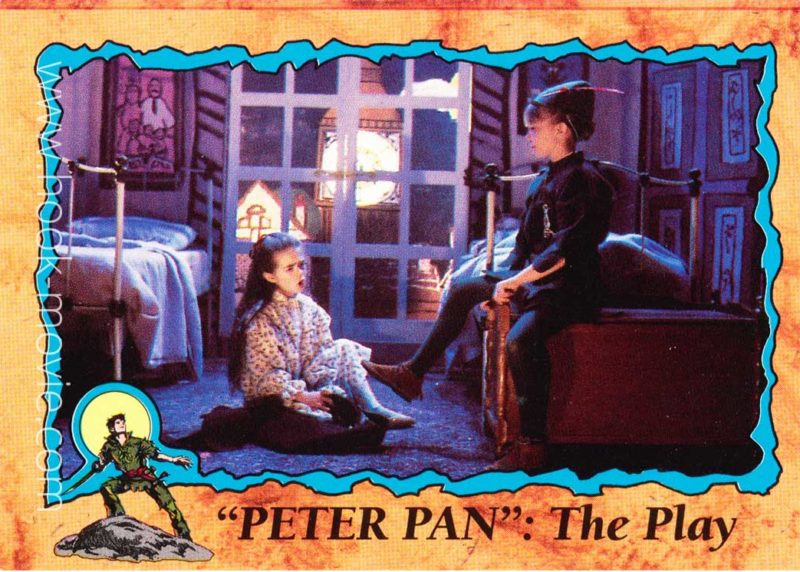
Wendy meets Peter
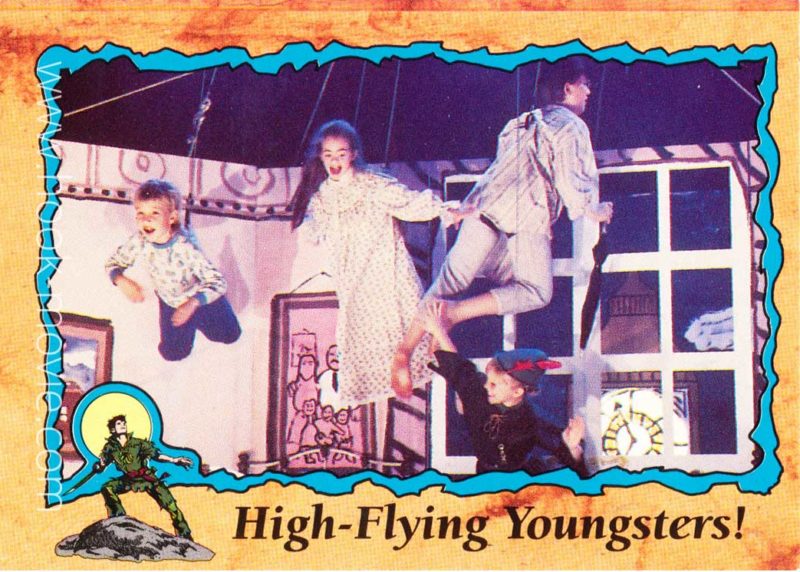
Michael, Wendy and John ready to fly to Neverland
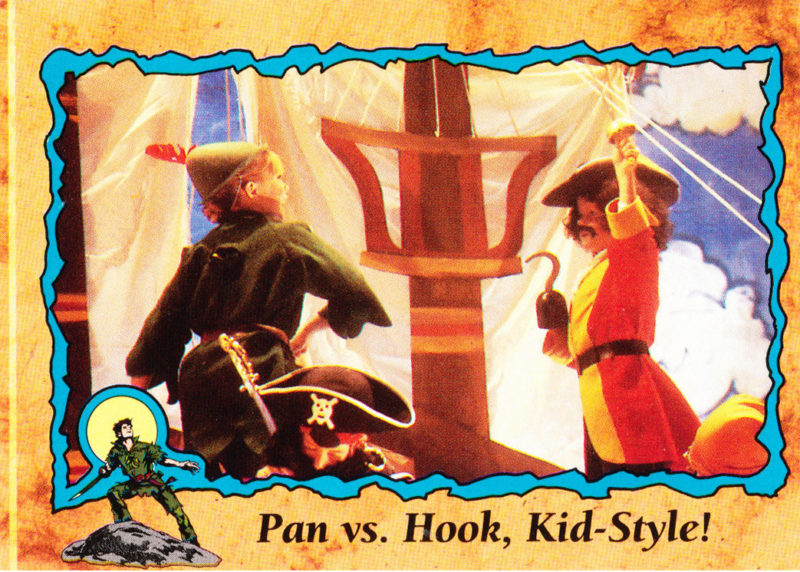
Final duel
The staging was deliberately simple and theatrical: painted backdrops, visible wires for flight, intentionally exaggerated performances by the children. Everything was exposed, artificial, yet the magic operates. Parents and children in the audience are fully absorbed in the performance. Spielberg films this audience as a mirror of the viewer. The auditorium is like a cinema, with a central beam explicitly recalling that of a projector.
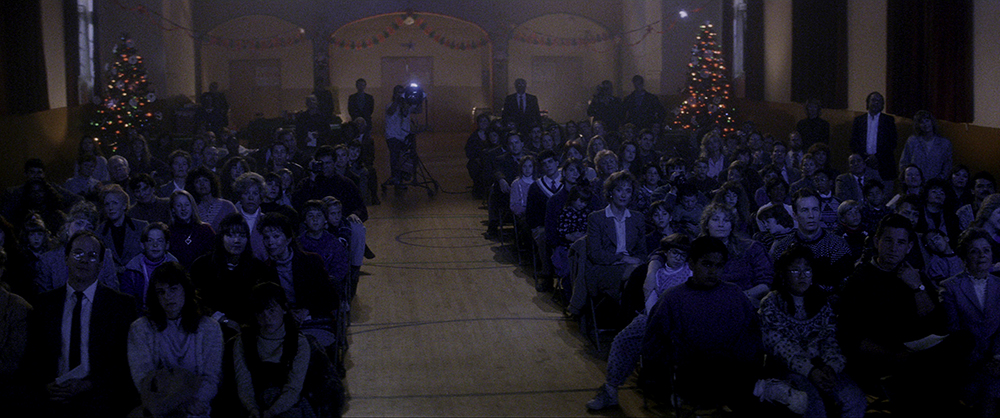
Onstage, Maggie plays Wendy meeting Peter Pan for the first time. At that precise moment, Peter Banning arrives late. He does not simply enter the auditorium; he bursts in. As he looks for his seat, he crosses the projector beam, blocks the light, and casts a giant shadow over the stage and the children. This interruption is not a clumsy gag: it is the first visual assertion of his profound dissonance with the world around him.
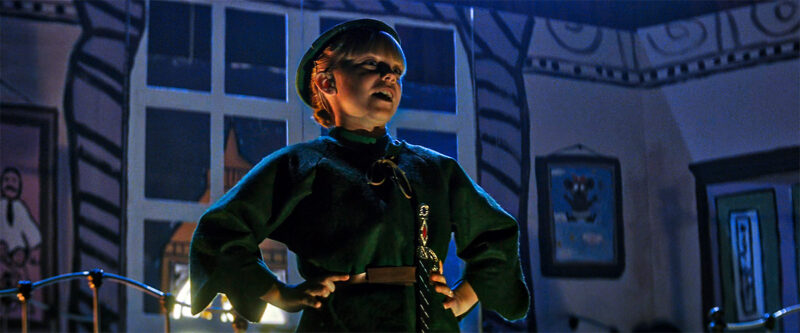
His shadow frightens the young actress playing Peter Pan. Visually, Peter Banning is not presented as a hero, but as the antagonist of his own youthful fictional double. He literally blocks the passage of light, the symbol of what allows the world of imagination to exist, and interrupts the circulation of magic between stage and audience. The scene foreshadows the moment when Peter interrupts Jack’s initiation ceremony into piracy; this time, he will project not his shadow, but his light.
Even once seated, Peter remains absent. He stays glued to his phone, taking business calls and ignoring the performance. When he finally looks, he does not perceive the story but the risks: visible wires, possible falls, hazards to manage. Where other parents choose to believe, Peter sees only a logistical problem. His reaction to Maggie “flying” on stage is not wonder but pure anxiety. Childhood is no longer, for him, a space of trust and joy, but a fragile condition that must be controlled.
This scene provides a clear illustration of the concept of suspension of disbelief. Spielberg plays with a break in the fourth wall to confront cynical reality with fantasy. In doing so, he positions us, the spectators, in front of the film itself. He explicitly invites us to suspend our disbelief, despite the visible wires and the openly theatrical staging. Spielberg does not attempt to conceal the artifice; on the contrary, he presents it as a necessary condition of belief. The film asserts that magic does not arise from perfect illusion, but from the voluntary engagement of the viewer’s gaze. This approach fully justifies the stylized sets, conceived not as realistic simulations but as mental spaces. Hook thus presents itself as a fable aware of its own artificiality, asking the audience to actively choose to believe in it. What confirms this choice lies in the very object that gives the film its name: the Hook.
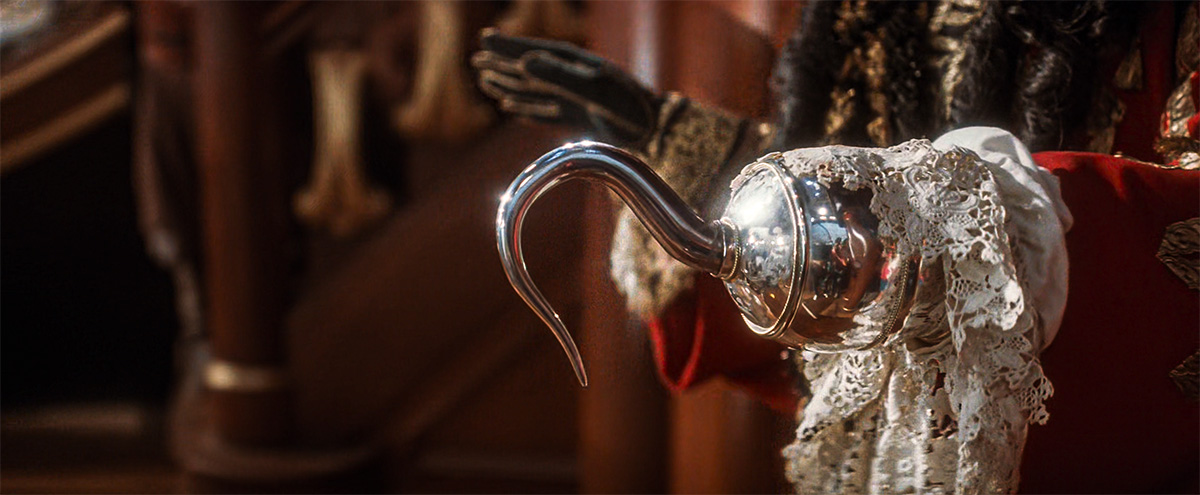
For the same reason, some viewers struggle to enter the film, while children may have accessed it more immediately. Where part of the adult audience rejects the work because of its visible artificiality, children spontaneously accept the rules of the game. They do not experience it as rupture, but as a natural component of storytelling. This difference in reception suggests that Hook does not demand naïve credulity, but openness to imagination. Those who reject the convention see the wires; those who accept it see the magic. In a certain way, just as Peter’s regression allows for his redemption, the film calls for a form of regression that enables each viewer to appreciate the work not with a child’s eye, but with the capacity for wonder that a child possesses, without lapsing into naivety.
The Banning family embodies the different states of perception and immersion one can experience in relation to a fiction work, whether a play or a film:
- Maggie: total immersion. She plays a role within the story; she embodies Wendy. She is the pure and active link to fiction.
- Moira: the embodiment of belief; she suspends her judgment out of love for her daughter.
- Jack: the hesitant in-between; a skeptic who desperately tries to enter the story while seeking validation from his father, whose behavior he strongly imitates.
- Peter: the man without imagination; an intruder who breaks the spell. He is completely closed to fiction and takes no pleasure from the performance.
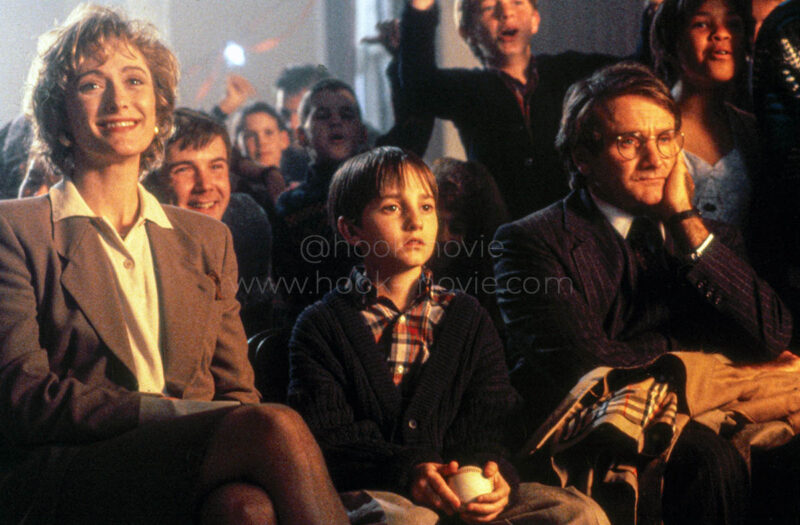
The perfect contrast: Moira delighted by the performance, Peter utterly bored, and Jack suspended somewhere in between.
The removal of this extended introduction scene radically altered the emotional trajectory and overall intention of the film. Originally, as Spielberg stated in Cannes in 2016, Hook was conceived as “a big Technicolor fairy tale about amnesia.” The film was meant to address the recovery of memory as a way of becoming a fulfilled adult again. By cutting this scene, Spielberg shifted the central conflict toward a more linear father–son crisis centered on Jack.
This choice resulted in a significant loss: Maggie’s role. The suppression of the scene reduced her thematic importance throughout the rest of the film, relegating her to the background in favor of Jack’s narrative arc.
Maggie is the first to work on her memory. If one pays attention, it becomes clear that she does not remember her lines during the play and must be prompted. Later, in Neverland, she demonstrates strong memory and resistance to forgetting. This will be explained in a later deleted scene, in which Maggie introduces another fundamental concept of the film. But we are not there yet.
The scene was meant to conclude on an image of a natural paradise...
Note: the character of Peter Pan is played by a girl in the play, as is theatrical tradition. Zachary Williams, Robin Williams' son, would be among the children cut in this scene, as well as Rebecca Hoffman, Dustin Hoffman's daughter (who played Jane, Wendy's daughter, at the very end of the show)...
The scene was filmed in the auditorium of Bishop Conaty High School in Los Angeles.
The Meeting
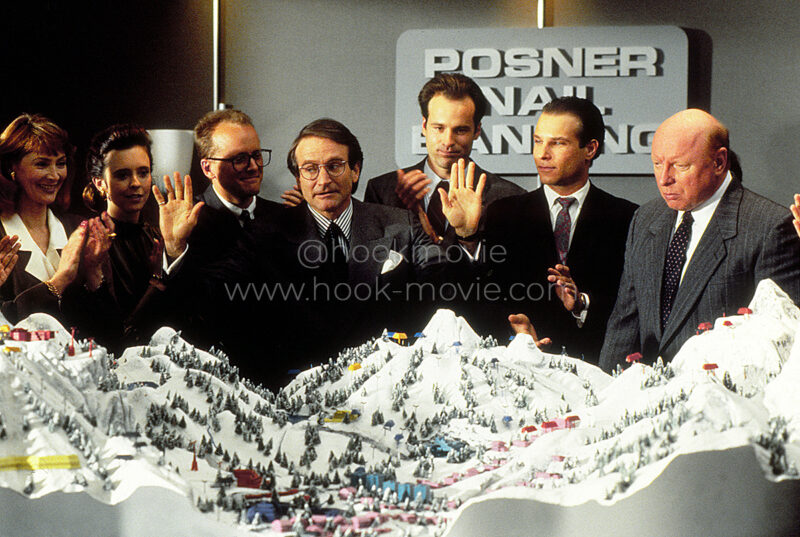
Peter’s team applauds his strategy.
The action opens with a revealing visual transition: a close-up of a sunlit forest, a true paradise easily mistaken for Neverland, which is ultimately revealed to be a scale model in Peter Banning’s office at the top of a San Francisco skyscraper. Peter contemplates a miniature world of a tourist complex with evident satisfaction, in sharp contrast to the dull fog of the city behind him.
Peter manipulates the model by clipping in miniature buildings and ski slopes while explaining his cynical strategy to get this project built. To manipulate the Sierra Club, the environmental organization opposing the project, he must convince them that the development will be gradual and that he cares about wildlife. He leaves only a token nature reserve at the center to obtain permits, planning to pave everything over once Sierra Club activists have moved on to something else.
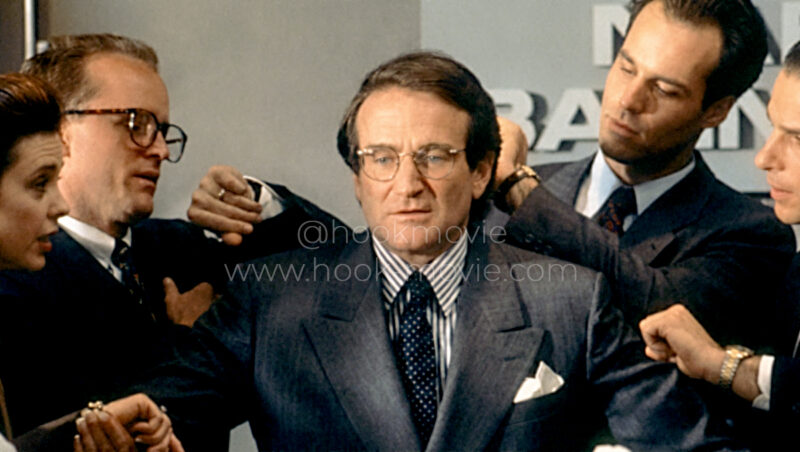
Peter realizes that he is late.
Panic seizes Peter when he realizes the time and that he will be late for his son’s baseball game. He gulps down a cappuccino before checking his airline tickets. The coach category was chosen specifically on statistical grounds to reduce risk, with seats located as close as possible to emergency exits. He rushes into the corridor.
Opposition then appears in the form of Dr. Fields, the environmental expert the firm routinely ignores. Dr. Fields attempts to alert Peter to the necessity of leaving sufficient space for the survival of certain species and demands designated breeding areas.
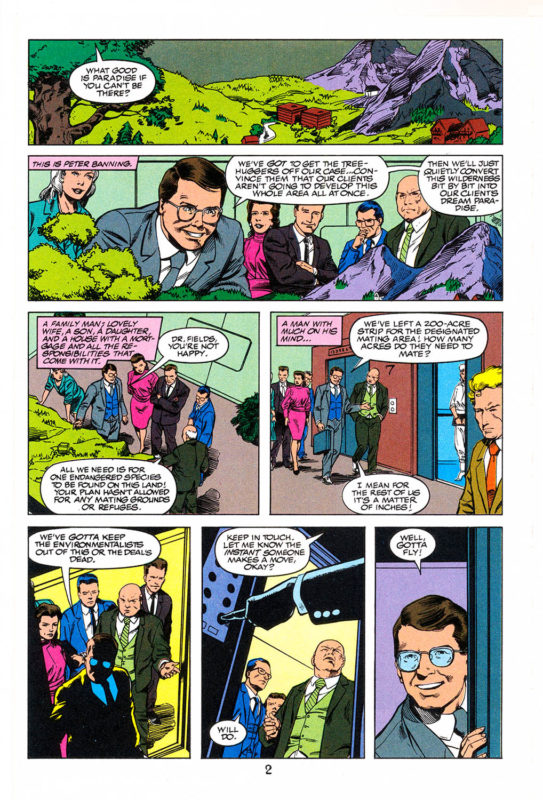
The scene in Marvel’s comic adaptation
Peter, supported by his associates Brad and Ron, who share his contempt for ethical constraints, views Dr. Fields as a nuisance to be ridiculed and dismissed. He orchestrates the expert’s public humiliation by placing a paternal arm around his shoulders. Adopting a syrupy tone, he questions the real needs of animals during mating season with a vulgar undertone, asking how much space these creatures truly require to reproduce, before asserting that for most of the men present it amounts to only a few inches. This crude joke, reducing an ecological issue to a mockery of male anatomy, provokes immediate laughter from his entourage. The expert, who was attempting to defend endangered species, is left red with embarrassment and completely disarmed by such arrogance.
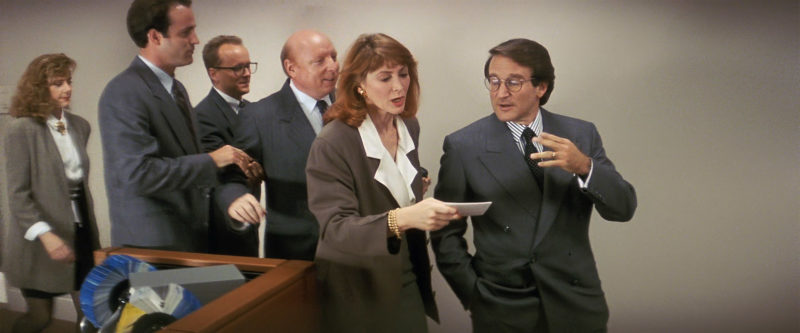
Brad and Ron block Dr. Fields' attempt to talk to Peter by grabbing his arm
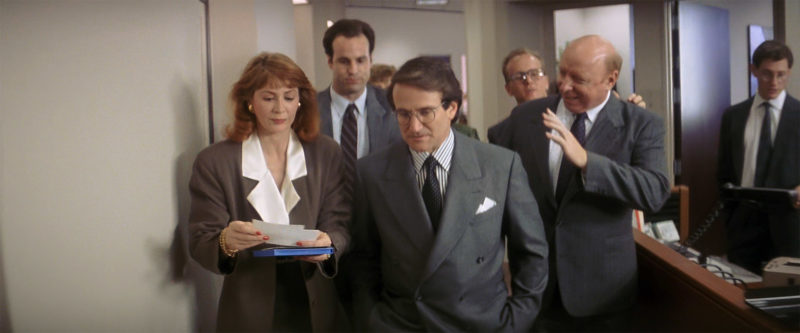
Ron holds him back as he appears to approach Peter.
Peter is followed by his entire staff. He orders an employee, whose name he mispronounces, to film the game for him, thereby diminishing the responsibility of his presence since it will be recorded on videotape. One of his secretaries hands him a speech written by Ned Miller for the tribute evening honoring Wendy. After reading a few lines, Peter judges it to be “very personal.” Brad orders the Sierra Club file to be deleted as Peter disappears into the elevator. Yet moments later, Peter reappears via the stairwell, out of breath and on the verge of a heart attack, to reread certain files one last time.
As in the final cut of the film, this scene was intended to be intercut with segments of Jack’s baseball game, where on the field he searches the stands for his father, desperately seeking emotional anchoring. The sequence demonstrates the direct correlation between parental presence and support, and the motivation and performance that result from it. Peter’s repeated absence, culminating in his complete failure to attend the game, further weakens his relationship with his son.
Everything in Peter’s world is cold, calculated, soulless, and dehumanized. People swarm around him in service, yet he is incapable of showing even minimal respect by remembering their names. The nature of human interaction and its magic has been replaced by technology: artificial paradise models, the latest mobile phones, and a camera that becomes a substitute for his parental responsibility, delegated to an employee. Everything is treated as a problem to be managed statistically, strategically, and methodically.
Yet this need for total control conceals an absolute loss of control over his own family life. He has become incapable of stopping, preferring to plunge back into his office files rather than honor the promise made to his son.
This scene introduces a strong ecological theme and a deeply problematic portrayal of Peter’s behavior. Peter Banning runs his company with cold authoritarianism, his employees functioning like a king’s court. His narcissism manifests in a desire to reshape the world for profit, at the expense of wildlife, and he does not hesitate to publicly humiliate those who oppose him. Peter foreshadows the tyrannical behavior of Captain Hook, establishing a climate in which power and mockery prevail over empathy and respect for his own family commitments. Like Peter, Hook delights in the use of miniatures representing Neverland to devise plans and strategies. He also does not hesitate to place dissenters in a torture box or to make jokes that provoke laughter from his entire crew.
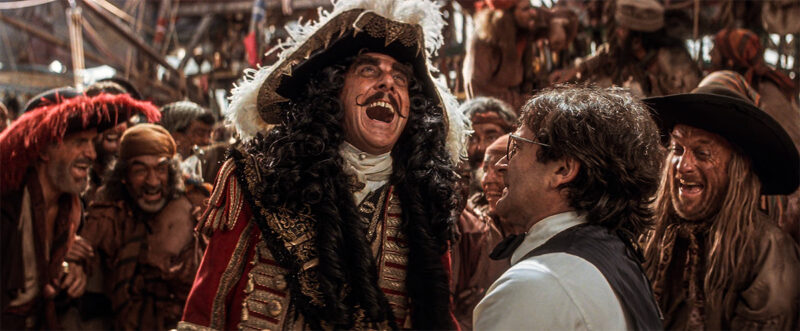
Captain Hook humiliates Peter, making his crew laugh.
This scene justifies the title of the film. Peter Banning has adopted the darker traits and cynicism of Captain Hook. By acting as a narcissistic leader who manipulates nature, he reflects the arrogance and tyranny of his former enemy. His obsession with statistical control and his tendency to preside over a court of servile associates testify to the complete disappearance of his innocence, replaced by the coldness of a social predator. Captain Hook is an allegory of the traits in Peter Banning that separate him from his family, the embodiment of what takes his children away from him. In Neverland, Hook is no longer an isolated pirate on his ship; he has set foot on land, with a pirate town that pollutes the very nature of the island, as if to claim territory: Peter’s mind.
The tourist complex project nevertheless remains a narrative thread throughout the film. In the final cut, Peter is informed in London of action taken against the project. As Moira reproaches him for his behavior toward the children, Peter feels obliged to deal with the issue, which has become a source of stress and anxiety within the marriage, we learn that Moira was firmly opposed to the project. When Brad calls Peter again in the film’s final moments, Peter no longer cares. His experience has fundamentally changed him. He ultimately chooses Moira and his family.
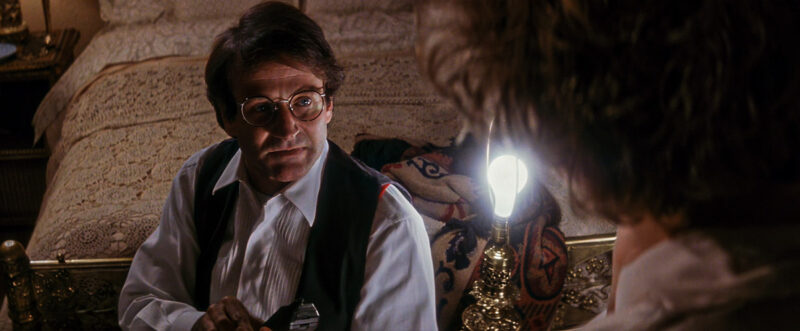
Peter chooses his project over his family.
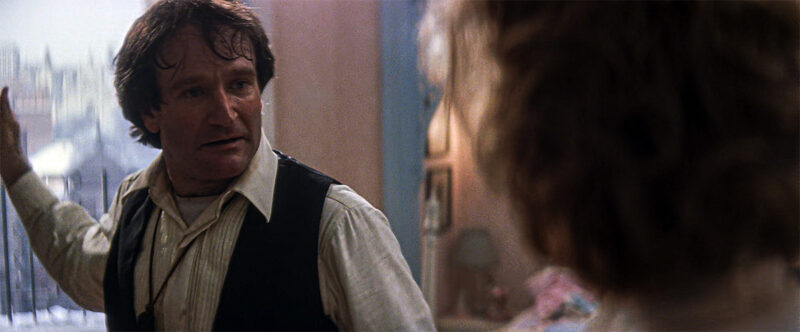
Transformed by his experience, he will choose his family. at the end of the film.
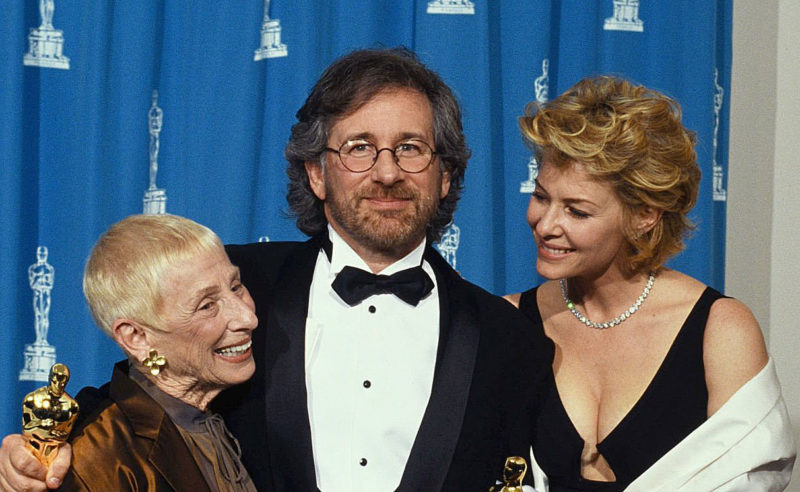
Leah Adler, Steven Spielberg and Kate Capshaw at the 1994 Academy Awards.
Dr. Fields is portrayed by Don S. Davis, later known for his role as General Hammond in the series Stargate SG-1. One of the secretaries is played by Brenda Isaacs, daughter of writer John Bradshaw. Bradshaw, is known for developing the concept of the Inner Child, which aims at reconciling oneself with one’s childhood self, a central theme of the film. Brenda obtained the role through a standard audition process, and Spielberg only learned of her family connection during filming.
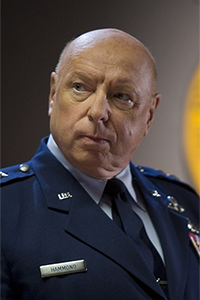
Don S. Davis

Brenda Isaacs
The scene also contains cameos. It’s important to distinguish the terms here: an actor appearing in one of their early roles or in a minor role is not the same as a cameo. Gwyneth Paltrow, for example, is not a cameo.
The cameos in this scene mainly involve family members of the cast and crew. Notably, Dustin Hoffman’s son, Jake Hoffman, appears as a player on Jack’s team.
James V. Hart’s son, Jake Hart, who inspired the story his father wrote, also appears as a player on the opposing team; he is the one who catches the ball thrown to Jack. Jake Hart also plays one of the Lost Boys later in the film.
James V. Hart’s daughter, Julia Hart, can also be seen in the audience next to Moira and Maggie.
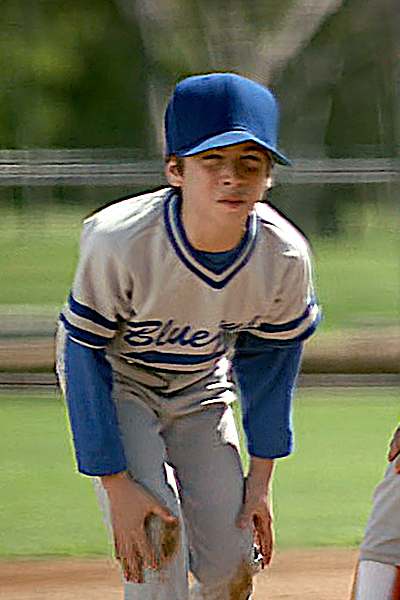
Jake Hoffman
Jake Hart
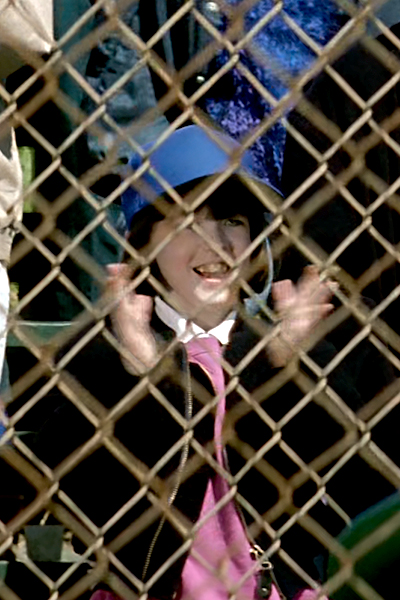
Julia Hart
It is also worth noting that the scene, as seen in the film, contains product placement and references to other productions underway at TriStar Pictures. One can spot the character Gumby, a well-known figure from a children’s stop-motion show, standing in front of a table on which there is a framed picture of a dog wearing glasses, seemingly referencing the film Bingo (1991), which was in production at TriStar Pictures at the time.
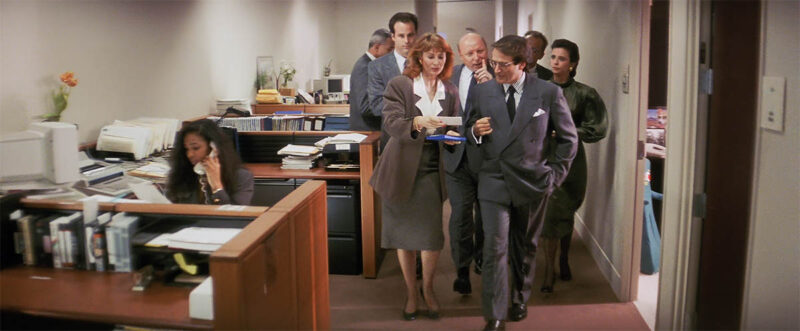
Gumby and Bingo can be seen through the door.
On Jack’s side, several Coca-Cola signs can be seen, which is particularly relevant to what the film is expressing. In the shots where these signs appear, the focus is on Jack, leaving the branding blurred in the background but still visible enough to be recognizable. This places play and enjoyment in the foreground, with the brand behind it, reflecting strategy and marketing... Peter’s world.
In another deleted scene, Coca-Cola was set to reappear when Hook manipulates Jack in Pirate Town. We will return to this later.
A commercial entirely dedicated to Coca-Cola was also directed by Steve Barron on the film’s sets.
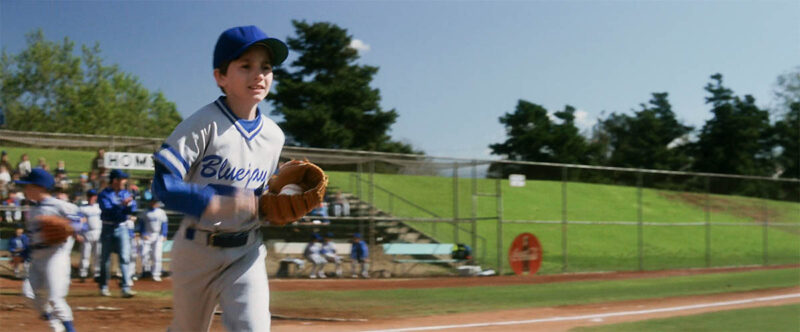
Coca-Cola signs visible in the background.
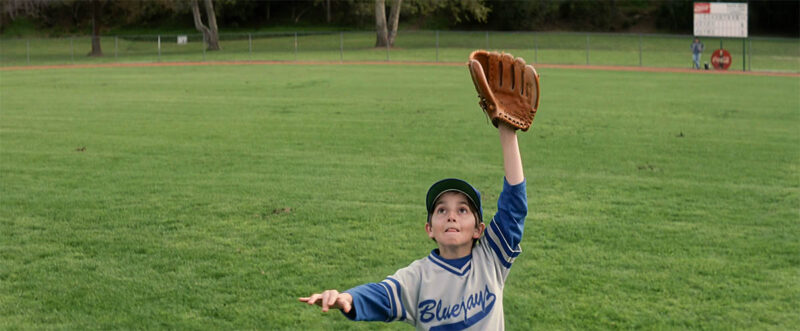
Coca-Cola signs visible in the background.
The shot creates a seamless transition: Peter catches not a ball, but his phone. This introduces another product placement, the phone Motorola brand. It once again sets the two worlds against each other: one of childhood, where play and enjoyment come first and commercial strategy fades into the background, and the world of business and high technology, emphasized by the close-up of the phone. Gumby and Bingo occupy an in-between space, two child-oriented products seemingly destined to be replaced by technology.
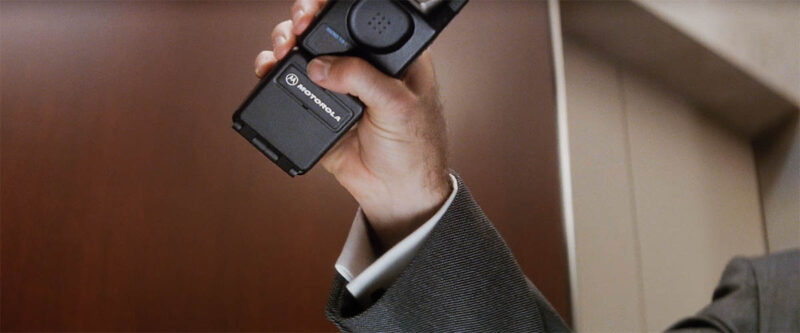
Motorola appearing in the foreground on Peter’s side.
This is only the second deleted scene, and already a significant thematic and dramaturgical density is evident in the material absent from the final cut, in no more than five minutes of footage missing from the film.
The flight to London
The scene opens with a close-up of Peter’s electronic organizer. A text appears: “Granny Wendy calls me her favorite orphan. I don’t know why…” before the letters erase themselves one by one, devoured by the cursor. The plane then enters a zone of strong turbulence. Peter is terrified, gripping his seat, while his daughter Maggie, unfazed, enjoys the shaking.
Maggie, inspired, draws during the flight. She decides to show her drawing to her father while he is overwhelmed by the turbulence. The first drawing is her own. It is a “map of her mind”, a tangle of colored lines meant to keep her from “getting lost in her thoughts”, linking San Francisco to London. For her, it is a way to organize her memory by representing it visually.
The second drawing is Jack’s, and it is much darker. The plane is shown in flames, the whole family jumping out with parachutes, except Peter, who falls headfirst into the void.
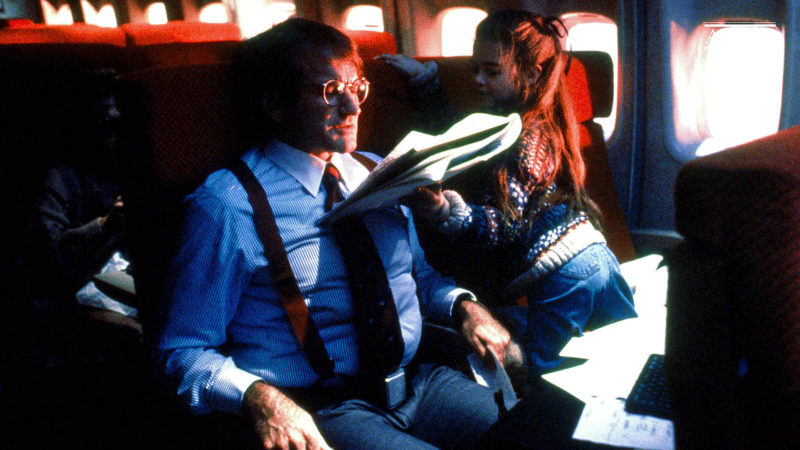
Maggie shows the drawing of the map of her mind to Peter.
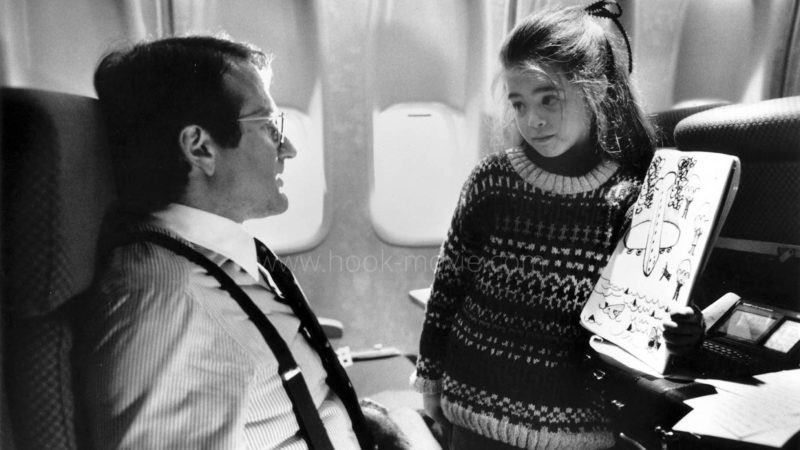
Then she shows him Jack's drawing of the airplane crash.
Jack has not accepted his father’s absence at his baseball game and had expressed his anger through his drawing. Seated in the row in front of Peter and Maggie, he quizzes Moira on baseball statistics, particularly those of Wade Boggs.
Beyond simply playing baseball, Jack is deeply fascinated by the champions of the sport, to the point of collecting baseball cards, He owns a collection of Fleer cards. He memorizes names, scores, and statistics, showing a strong capacity for memory, something Maggie lacked earlier during her stage performance. A capacity that will gradually fade as Hook manipulates him. Jack will seem to lose this ability.
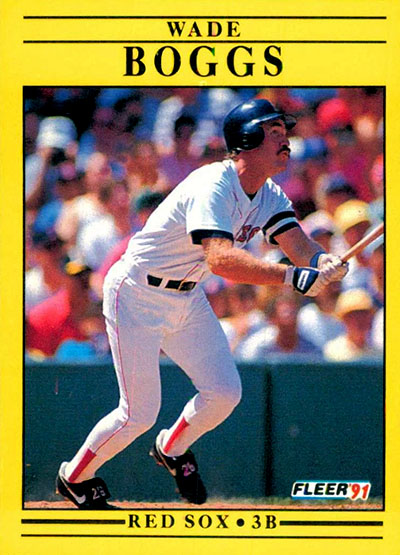
The card Jack holds in the scene.
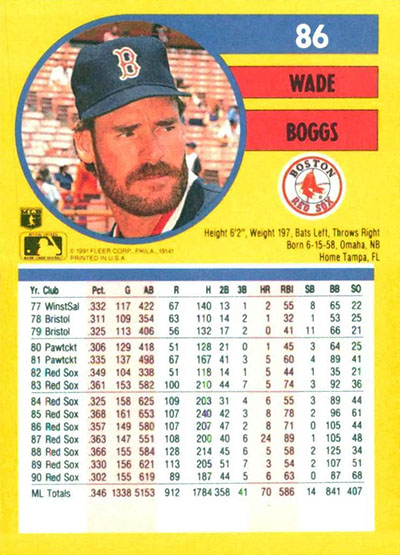
The statistics that Jack memorizes.
Urged by Moira to deal with the situation with his son, she forces Peter to switch seats with her. The attempt at reconciliation quickly fails. Peter makes a series of professional-style promises, using stock phrases that Jack rejects with contempt, using the same kind of vocabulary. In a burst of anger, Jack throws his baseball at the ceiling, accidentally triggering the release of an oxygen mask that drops down in front of Peter’s frozen face.
Although brief, this sequence adds an ironic detail to the characterization of Peter Banning: his fear of flying and of heights. For a man who once was Peter Pan, this disconnection from the air and from height emphasizes the scale of his amnesia. He wants only “good old terra firma”, solid ground, rejecting any form of elevation.
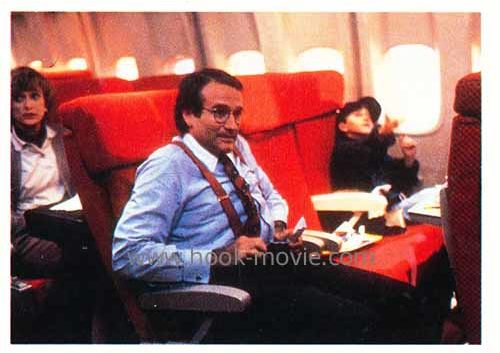
Peter sitting next to Jack.
The contrast between the two children is also more pronounced.
Maggie already uses imagination, her “map of the mind”, to organize her reality. This foreshadows her later resistance to forgetting in Neverland.
Jack, by contrast, uses his father’s cynicism and vocabulary against him. By using the financial term “junk bonds” to describe Peter’s promises, he shows that he has fully absorbed the language of the business world in order to express his emotional hurt.
One can notice that the two children develop their memory in different ways. Maggie does so through creativity, drawing her map of the mind, while Jack uses cards to memorize statistics from the sport he is passionate about. This connection appears obvious to me because of my native language. In French, both "card" and "map" are called “carte.” The same word refers to the two objects that Maggie and Jack use to structure their minds.
Jack is gradually influenced by Peter. His passion for these statistics makes him more inclined to join the pirates, since they embody some of the traits Peter will later have to confront, traits that make Wendy see him as a “pirate.” In a later deleted scene, Captain Hook manipulates Jack by offering him even more baseball cards, even giving him an entire chest of them.
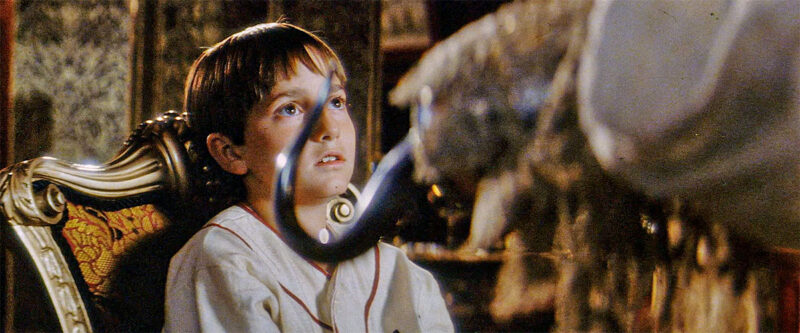
Jack falling victim to Hook's manipulation.
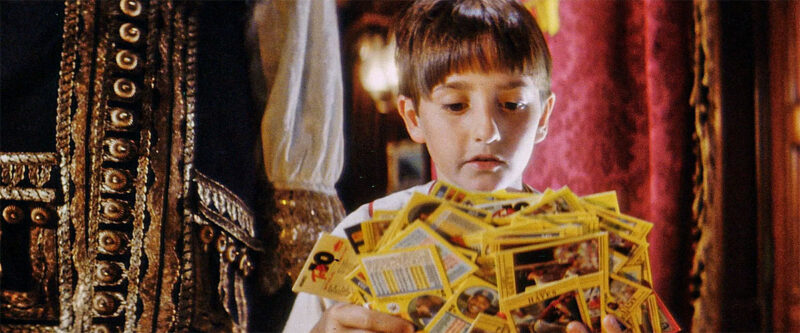
Hook offering Jack more cards than he can hold.
The oxygen mask that drops at the end of the scene closes the sequence, signaling the state of the family, a state of suffocation. Peter is unable to breathe or find balance between his work and his family. A state of suffocation that Peter will experience again after his humiliation and the failure of his attempt to negotiate with Captain Hook. Peter’s arrogance and cynicism are confronted with their own embodiment, like a mirror effect.
Peter only regains his breath thanks to the intervention of the mermaids. It is important to note that in the early scripts, the mermaids’ rescue scene also represents Peter’s first flashes of memory. We will return to this later.
Peter Banning’s failure is not limited to missing Jack’s baseball game or his inability to communicate with him. In the previous scene, a secretary gives him a speech for Wendy’s tribute, written by a colleague, Ned Miller. Peter, in a cold professional reflex, described it as “very personal.”
Once on board the Boeing, the close-up of his electronic organizer reveals that he has forgotten Miller’s notes and now has to write the speech himself. Cornered, he admits to Moira that his own drafts do not sound right. The situation highlights a revealing contradiction. Peter judged a text written by someone else to be personal, yet he is unable to express any genuine emotion with his own words. Peter Banning is a man whose memory and voice seem blocked, a creative void. And once again, a contrast emerges between technology and the human: Maggie uses her imagination to create a map, an organized and connected world that preserves relationships, while Peter relies on his electronic organizer, erasing rather than creating, a man without imagination. Lost in a sky with turbulence.
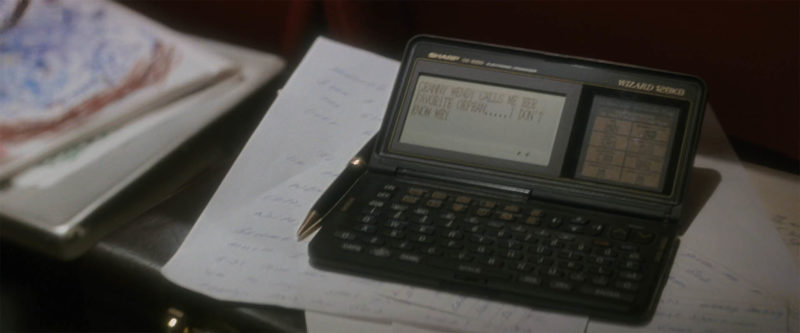
Close-up on the electronic organizer. The Maggie mind map is visible on the left.
Faced with this creative void, Maggie’s “map of the mind” becomes a key idea for understanding the thematic structure of Hook. Maggie explains clearly that the drawing helps her not get lost in her thoughts. For this child, who earlier struggled to remember her lines in the school play, drawing becomes a tool to organize her memory. She turns the clutter of her thoughts into an organized mental space, physically represented by a drawing.
This map of mind concept even inspired the film’s teaser trailer. The teaser, which summarizes the film without revealing any footage. It shows a magnifying glass traveling across a map, much like the travel sequences in Indiana Jones, tracing Peter’s route from London to the Lost Boys’ Tree. In reality, it is Captain Hook’s magnifying glass, preparing his revenge. The fact that he destroys this map with fire, the same method he used to destroy Peter’s house, may even represent the erasure of Peter’s memory.
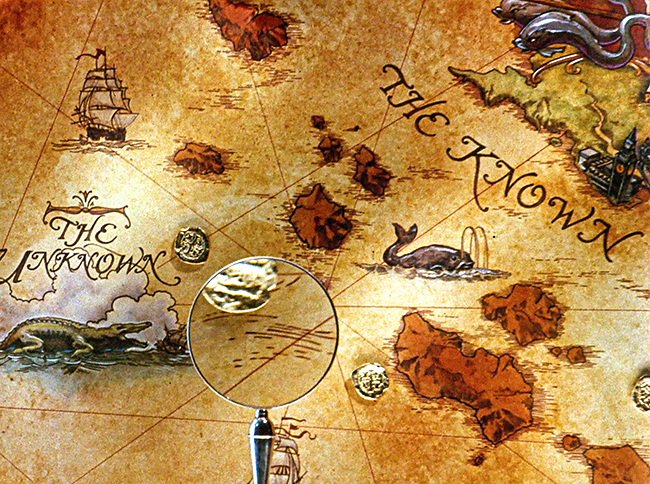
A journey from the known to the unknown.
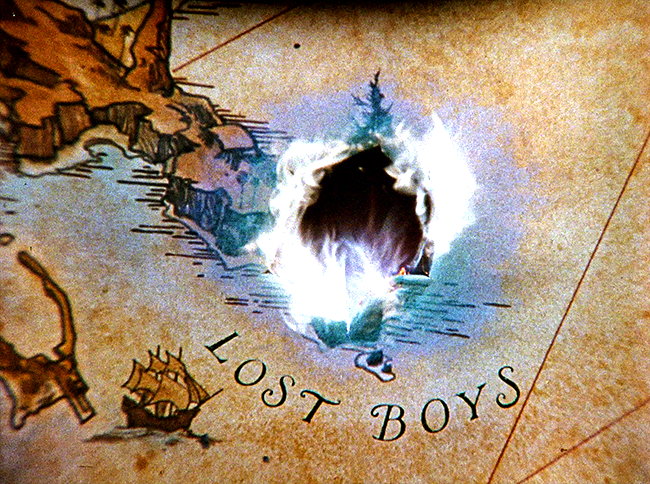
Until the destruction of the map.
The kidnapping of the children forces Peter to undertake a process of reconstruction. From that moment on, Neverland becomes his mental space, a physical extension of his “map of the mind”, where he must restore balance. To rid himself of his own flaws, he will have to confront Captain Hook, who represents the traits that separate him from his children: cynicism, arrogance, and tyranny.
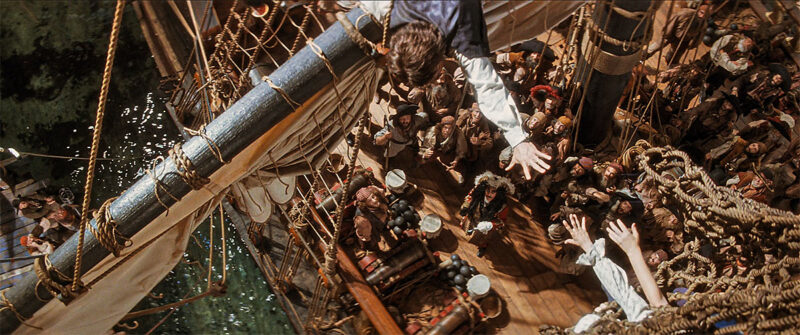
Other elements will reinforce the concept of the map of the mind. When Tinker Bell pulls the nursery rug, which depicts a map, Peter trips and falls. The most striking moment comes later, in the scene where Peter regains his memory by flying high above Neverland. Flying freely, without turbulence, he rises above the island and reveals the giant compass that physically indicates the nature of Neverland: Peter’s map of the mind.
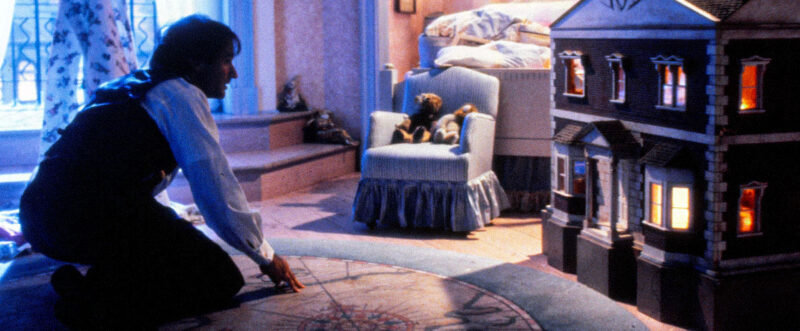
The nursery rug depicts a map, and a compass can be seen on it.
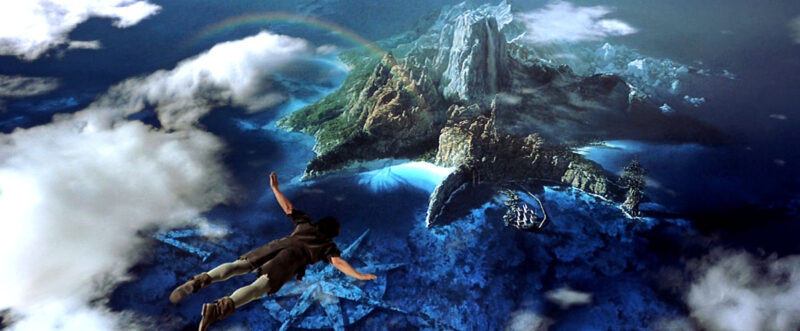
Neverland, Peter’s map of the mind, in which a giant coral compass is visible.
This idea is essential to understanding that Hook goes beyond being a simple adaptation or sequel to Peter Pan. The film is not merely an adventure inspired by Peter Pan, but a fable about the healing of the mind, where the fantastical serves as a way to make visible the process of memory recovery and Peter’s redemption.
Note: the scene was filmed on Stage 747 at Universal Studios. It is a soundstage that reproduces the interior and cockpit of a Boeing 747. The same set appears in many other films or series, including Die Hard 2 and Kindergarten Cop, to name just two.
The airplane captain’s voice is performed by Dustin Hoffman.
The Lost Cufflinks
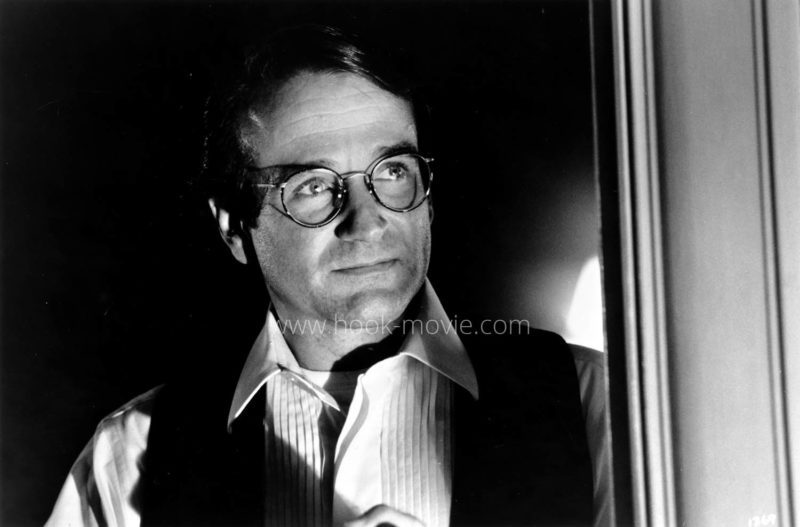
Peter observing Moira and Wendy.
The scene begins after a temporal ellipsis following Peter’s reunion with Wendy. Night has fallen over Kensington, and snow drifts softly through the air, shining like silver beneath the streetlamps. Peter, now dressed for the gala, stops in the hallway outside Wendy’s bedroom and looks down at his polished shoes. As he bends forward, he sighs and pulls in his stomach, a gesture that reveals his physical discomfort and the constrained relationship he has with his own body.
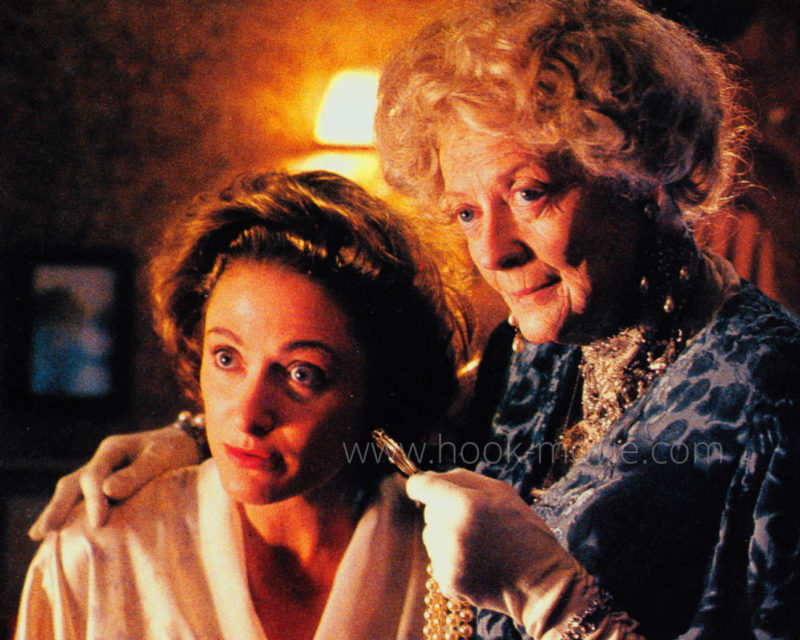
Moira sharing a moment of complicity with Wendy.
Through the slightly open door, he observes Wendy and Moira sharing a moment of quiet intimacy. Wendy wears a pink and mauve silk dress with lace sleeves. She deliberately moves her arms to prevent Moira from fastening her cuffs, making them both laugh. The moment reveals a bond that has remained intact since Moira’s childhood.
This calm atmosphere is interrupted when Jack and Maggie burst into the hallway, chased by Nana. The children rush into the room, jumping from the bed to the sofa while the dog circles the furniture barking. Maggie calls to her father and asks him to play with them.
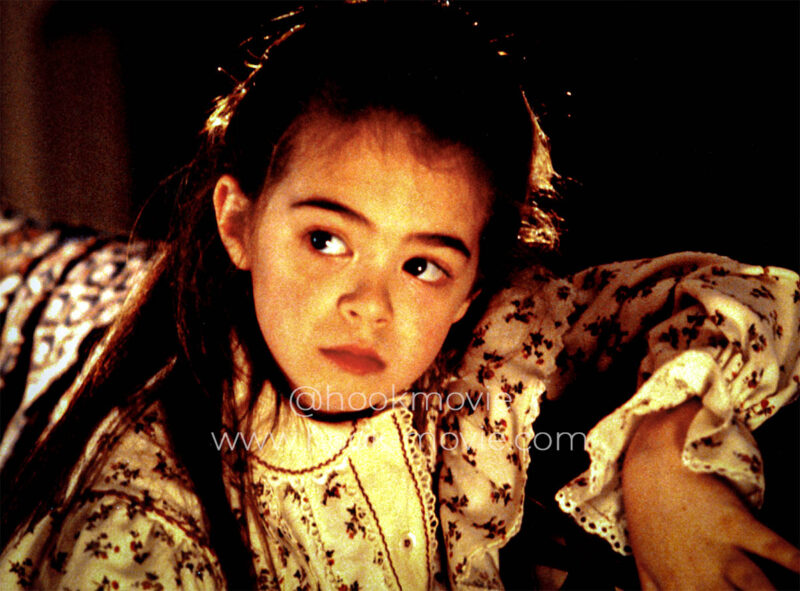
Peter, nervously fiddling with his tie, refuses. Nevertheless, he enters the room complaining about his slippery shoes, as if they prevent him from joining in, and asks if anyone has seen his gold cufflink. He eventually gets down on all fours to look under the bed. Maggie immediately jumps onto his back, thinking he wants to play. After asking her to help him, which she eventually does before moving away, Peter continues searching around an armchair. He then finds himself face to face with Tootles, who is also kneeling on the floor. Tootles murmurs, “I lost my marbles.” Peter replies, “I lost a cufflink.”
Feeling suddenly ridiculous crawling on the floor, Peter stands up, brushes off his trousers, and decides to take another pair of cufflinks instead. He leaves Wendy’s bedroom.
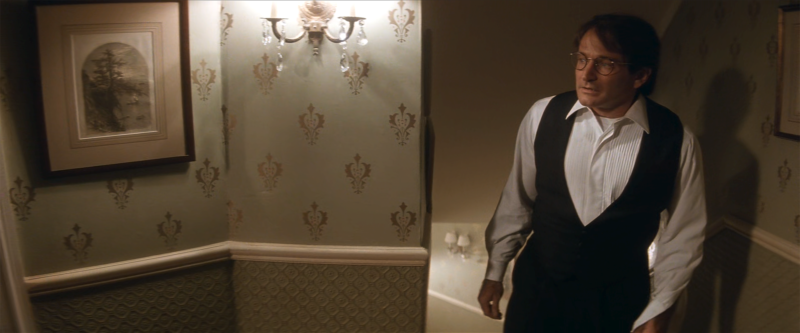
Peter, as if called by his memory.
On his way to get his other cufflinks, he seems drawn toward the nursery. The room has an almost mystical atmosphere. It has remained exactly as it was during Wendy’s childhood. Everything has been preserved like a sanctuary dedicated to the memories of Peter Pan. The illustrations, objects, and decorations directly evoke those adventures.
Without fully understanding why, the place awakens something in him. Not clear memories, but sensations. Sounds seem to return to him: the sea of Neverland, the bell of the Jolly Roger in the ocean mist, his crow of Pan, the clash of swords. Shivering slightly, he closes the window just as Moira calls him to say that Brad is on the phone with an urgent matter.
In the guest room, Peter takes the call in a chaotic atmosphere. Moira continues getting ready for the gala while the children play nearby. Peter learns that the Sierra Club is launching legal action against the project mentioned in the deleted scene The Meeting. The news, combined with the surrounding noise, makes him explode with anger and lash out at the children.
In the hallway, Wendy invites the children to come and see the nursery. Meanwhile, Moira decides to confront Peter. She reminds him of the promises he has already broken, especially his promise to leave his work in the United States and spend time with his family in London. When the phone rings again, she grabs it and throws it out the window. Peter is left stunned, abruptly cut off from his professional world.
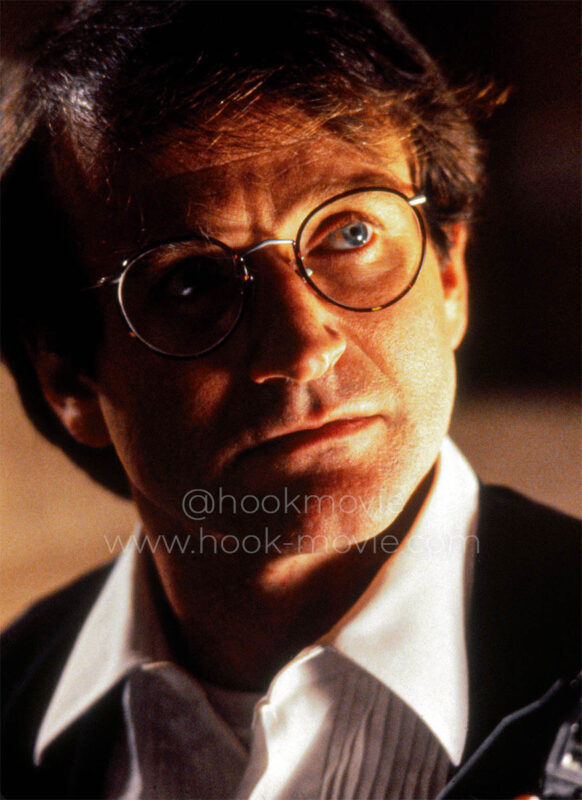
Peter gives Moira a defiant look, as if provoking her, before answering the call without waiting for her approval.
The sequence contrasts the lightness of childhood with the rigidity of adulthood. Wendy still retains a playful connection with Moira, as if their relationship had never changed. Peter, by contrast, is completely disconnected from that energy. His daughter’s request to play is overshadowed by a trivial material concern, his cufflink. He treats family interaction as a problem to manage and remains fixated on his appearance.
The slippery shoes symbolize his lack of grounding within family intimacy. Anything that does not belong to his professional world is rejected.
His position on all fours is interpreted by the children as an invitation to play, whereas for him it is merely a physical constraint in the search for an object representing his social status. His encounter with Tootles is a form of foreshadowing. The two men find themselves at the same level, each searching for something lost. Tootles says he has lost his marbles, an expression suggesting madness. Peter, meanwhile, has lost his memory but searches only for a symbol of professional and social success.
Here Peter occupies the role of George Darling, Wendy’s father. In the theatrical tradition of Peter Pan, this role is often played by the same actor who portrays Captain Hook. The staging highlights that Peter has become what Wendy describes in the previous scene: a pirate. His cold authority, narcissism, and obsession with control echo the traits of Captain Hook and create a barrier between him and his children. The same disconnection that George Darling shows toward his children, traits symbolized in the story by Captain Hook.
The nursery, the real place where the original adventure started, triggers the first traces of memory. But his rationality suddenly leads him to refuse to let himself be carried away by this kind of mysterious nostalgia, closing the windows. This portal to the world of Neverland, once again crossed by a light similar to the spotlight that allowed the show to come to life, the same light that enables the film to be projected. This light, which is the source of creativity, is once again blocked by Peter, who seals its access with the window latch represented by the hook, once again refusing access to his imagination and his memories.
It is important to note that Captain Hook does not appear only through the illustrations and the hook-shaped window latch. Peter is being watched throughout the sequence. This is suggested through the design of the furniture in Wendy’s bedroom, which resembles a face: two large glass cabinet doors evoke the stern of the Jolly Roger. The children’s bedside lamps add what appear to be pupils to these two windows, increasing the pressure on Peter, who is quite literally being watched.
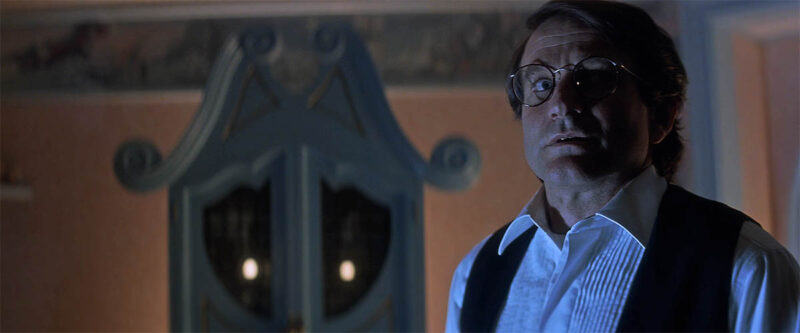
Shivers as fragments of memory return, under Captain Hook’s eyes.
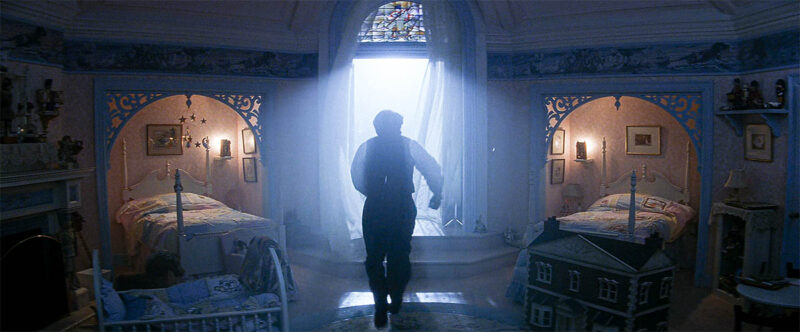
Peter rushes to close the window, the portal, cutting off the light.
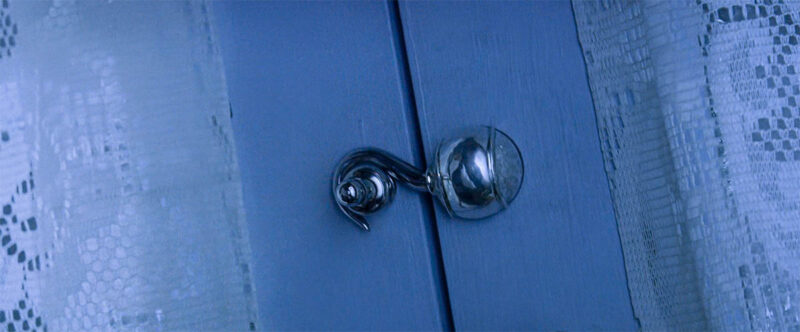
Once again, Peter’s traits reveal his refusal of the light and the memory symbolized by the hook. Peter's reflection is trapped in the hook.
When he resumes speaking with Brad and shows contempt toward his family, Peter expresses precisely the traits embodied by Hook: a form of domestic tyranny and absolute authority within the household. Reaching the paroxysm of the traits embodied by George Darling/Captain Hook.
By confronting him and throwing the telephone out the window, Moira breaks this authority and cuts the technological link that keeps Peter tied to his professional world. This act creates the first crack in Peter’s posture. The way Moira presents herself to defend the well-being of her children highlights the risk of a possible separation from Peter. His traits are becoming a real problem for the balance of the family, making the need for his transformation and the return of his memory and personal balance even more urgent and necessary.
Light in the Nursery
Peter is ready for the gala and meets Wendy and the children in the nursery. The atmosphere there is subdued, almost outside of time. The room is now brightly lit and full of life. Granny Wendy and Maggie are nestled under a sheet stretched like a tent, reading the adventures of Peter and Wendy. While Maggie sews ribbons along the hem of their improvised shelter, Wendy explains the origin of fairies to her, insisting that every child’s laugh creates a new one. Wendy then points to an original illustration depicting her as a young girl and confides to Maggie that she was that Wendy, a very long time ago. Despite Jack’s skepticism, Wendy insists: the window where he is standing is the same one from the stories, the very one from which the tales of Neverland and Captain Hook were born.
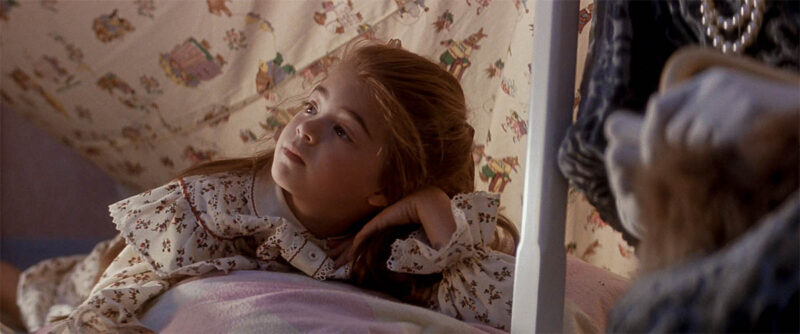
Maggie beside Wendy, fully absorbed in the story.
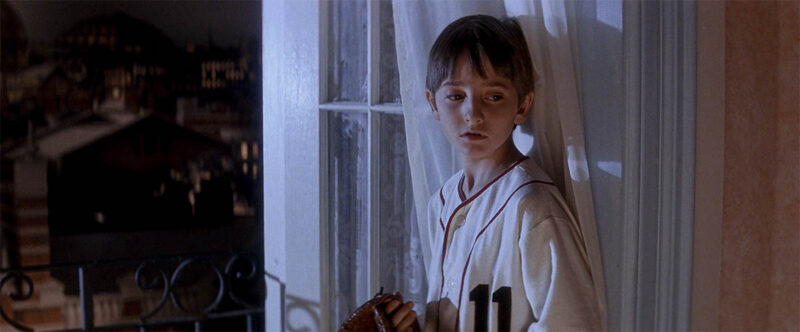
Jack at the window, still caught in between, which makes him doubt.
Peter’s entrance, nervous and absorbed in his speech notes, instantly breaks this magic. Maggie offers him the sheet, presenting it as a parachute so he will no longer be afraid of flying and trying to reassure him. The cheerful atmosphere fades. The children fall silent in the face of paternal authority. Before leaving, Wendy recites a solemn prayer to the watchful lights so they may protect her little ones "Dear nightlights that protect my sleeping babes, burn clear and steadfast tonight.”. Once alone with his children, Peter quickly closes the window with force, locking the latches as if to banish any external threat, unaware that Jack compares this security to the bars of their house in San Francisco.
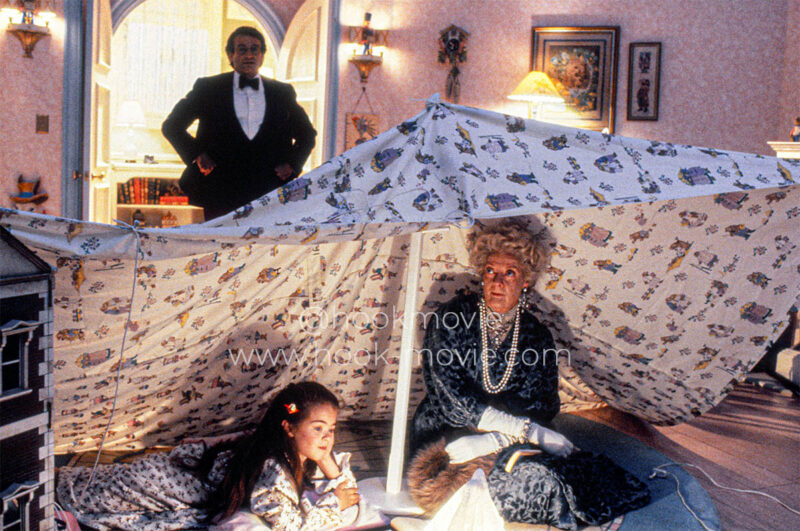
Peter’s entrance breaks the magic of the moment.
Peter, still searching for a solution to his lost cufflinks, notices a teddy bear with the ear fixed using a safety pin. He removes the safety pin that was holding the toy’s ear in place and fastens it to his own sleeve, substituting a symbol of childhood for his social attire. The tension rises when Jack accuses his sister of stealing his baseball, but Maggie, staring at the window, speaks of a terrifying man who supposedly took it. Peter dismisses her fears with a dark joke, claiming there is no other scary man than himself as long as the window remains closed. In a rare moment of tenderness, he accepts a paper flower from Maggie and exchanges a promise of love before handing his watch to Jack and appointing him responsible in his absence. The scene ends with a role play between Moira and Maggie, repeating Wendy’s words about the protective watchlights of mothers, while Moira sings a lullaby. Once the children are asleep, she whispers, “Why can’t they stay like this forever?”
Moira
There’s an angel watching you,
When you’re alone.
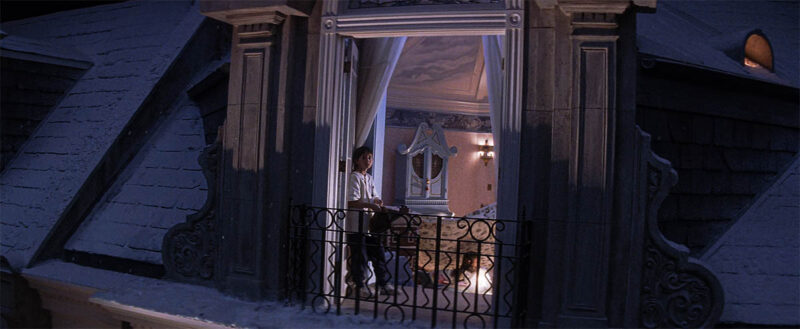
Peter finds a safety pin on a teddy bear, which he uses as a cufflink.
We rediscover the place from a new perspective. As if guided by Wendy’s voice telling the story to Maggie, we enter it this time through the window, that portal Peter keeps closing. The room appears this time, bathed in bright light and full of life.
Wendy shares her story with Maggie, who has no doubt about it, while Jack remains resistant to what Wendy tells. It is a trait he inherits from his father. The fact that he doubts while standing between the bedroom and the outside, almost as if being called by the portal, emphasizes the uncertainty within him. It already reveals the inner struggle taking place in his mind, one that is slowly leading him to adopt the same traits as Peter and eventually join Captain Hook.
For Peter, the window represents a danger that must be sealed. As in the previous scene, Peter rejects the opening of the portal to adventure, and above all to his own memory.
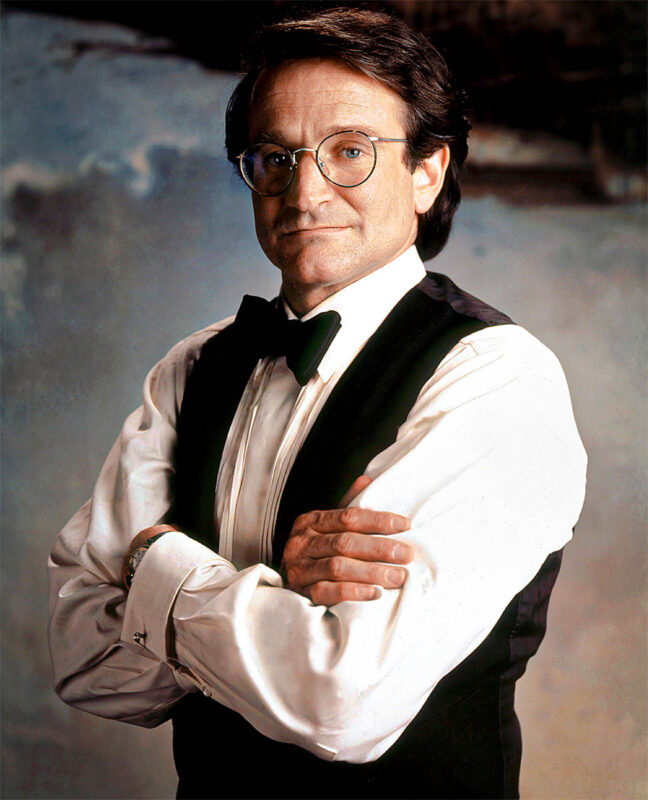
Peter finds a safety pin on a teddy bear, which he uses as a cufflink. Clearly visible in this promotional photo.
Moreover, the deleted cufflinks scene finds a resolution here. Peter, who never found his cufflinks, ultimately uses the safety pin taken from the teddy bear. It is the same teddy bear he will later encounter in Neverland, which will trigger the return of his memory. At this moment, however, Peter sees only the practical aspect that allows him to replace a valuable object representing social status.
It is a small gesture that initiates, without him realizing it, his gradual return toward childhood. At the same time, the gift of his watch to Jack marks a transfer of burden. Peter delegates his own obsession with time to his son, forcing him to grow up too early and too quickly while simultaneously trying to imprison him within an oppressive sense of security.
This watch will later symbolize Jack’s discomfort toward his father, crystallizing within a single object all the wounds that Captain Hook will exploit.
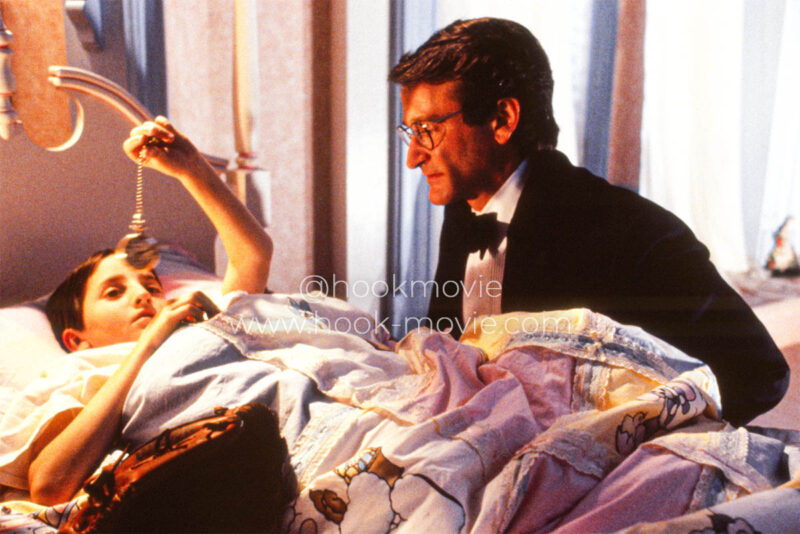
Peter gives his watch to Jack.
Peter’s reaction to Maggie’s fear of the scary man at the window is also revealing. By designating himself as the frightening man, he implicitly acknowledges his role as a domestic tyrant. The line highlights Peter’s transformation into a cold authority figure, closer to Captain Hook than to the boy who never wanted to grow up.
Finally, Moira sings a lullaby. In doing so, she perfectly embodies the role of a protective and loving mother, offering her children the emotional refuge that Peter, in his rigidity, can no longer provide. As she softly sings a melody learned countless times, the agitation of the day fades away and Jack and Maggie drift into sleep.
The lyrics of When You’re Alone, partially sung by Moira in this scene, connect the nightlights that protect children’s sleep with the stars. These small lights function as watchlights, silent guardians watching over the night. Later in the film, Maggie will take on Moira’s role and sing the same song in its entirety. Although the song remains in the final cut, the reason that leads her to sing it at this moment in the story was deleted. We will return to this later.
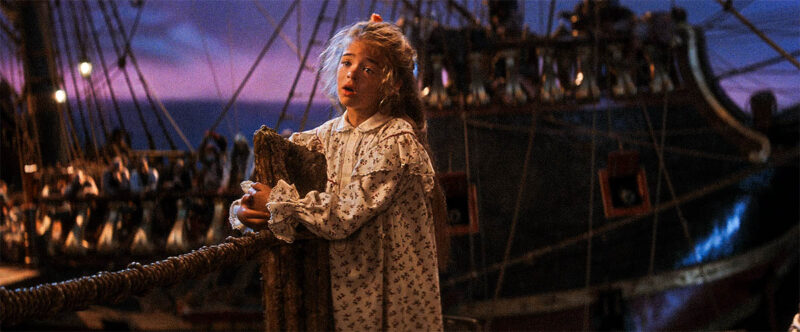
Later, Maggie will sing the same lullaby to the Lost Boys held prisoner by the pirates, taking on the role of a mother.
By telling the story of the creation of fairies and their connection to children, whose laughter brings them into existence, Wendy indirectly evokes Tinker Bell and her role as Peter’s guardian, a being of light, a living watchlight. This is the very light that Peter has kept blocking since the beginning of the film, either with his shadow or by closing its source.
The scene again emphasizes the fundamental contrast between the two parents. Where Peter attempts to protect his family through locks and cold authority, Moira relies on transmission and imagination. Whispering, once the children are asleep, “Why can’t they stay like this forever?” She expresses the deepest wish of any parent, but also the thematic core of the story: preserve innocence as one grows older. In this suspended moment, she becomes the true pillar of the family, the one who maintains the connection to wonder while Peter sinks deeper into forgetfulness.
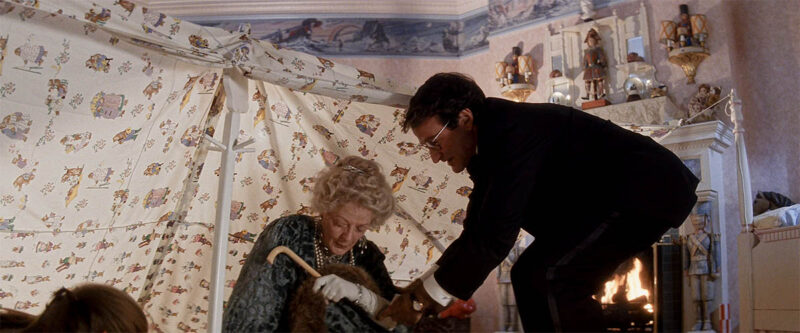
Peter has the safety pin on his sleeve when he comes to get Wendy.
The final cut of the film significantly alters this sequence. The bedtime scene unfolds in the same order, but the elements referring to the deleted cufflinks scene, as well as the song, are deleted. Peter is already wearing the safety pin when he comes to get Wendy, which suggests that the scene was filmed but that the order of events was rearranged. Wendy does not leave the room before Peter and Moira tuck the children in but instead takes part in the moment. The scene ends with her prayer.
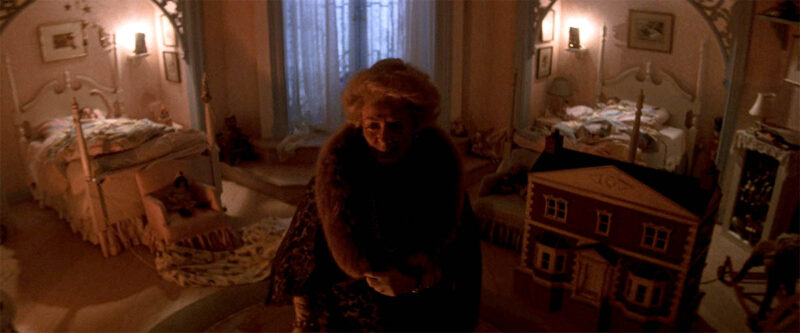
In the final cut, Wendy is the last to leave the bedroom, praying that the nightlights will protect the children.
The Bannings In Distress
After the kidnapping of the children, Wendy’s house has turned into a grim crime scene. Outside, two police Jaguars are parked with their sirens flashing, while bobbies climb a ladder to carefully inspect the roof. Inside, Peter helps Inspector Good put on his coat. The inspector reveals a troubling conclusion: the lock on the nursery window was forced from the inside, a claim Peter rejects, certain that he had closed everything before they left. Good then presents a dagger and a note signed by a certain “Captain J. A. S. Hook”, pieces of evidence he handles with deep skepticism.
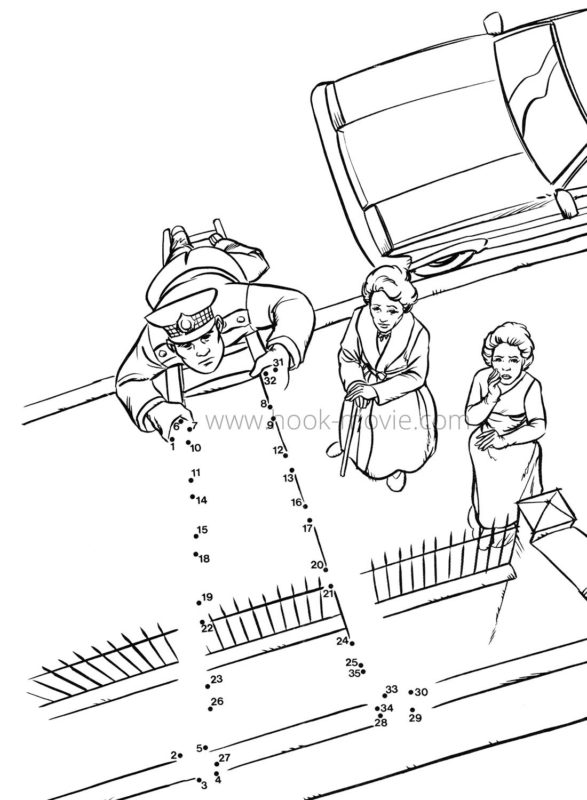
The police officer climbs the ladder to check the roof.
Moira tries to explain the origin of the name by revealing that her grandmother is none other than the Wendy who inspired the stories of Sir James Barrie. The inspector dismisses this information, treating it as a literary joke before taking his leave. At that moment, all the lights in the house suddenly turn on, casting a harsh brightness over the Christmas tree, which becomes the brightest object in the room.
In the silence that follows, Tootles, frozen near the window, murmurs that he has forgotten how to fly and that happy thoughts have disappeared, leaving only emptiness. Moira, acting in a completely mechanical way, begins to tidy the room to conceal her despair. She moves objects aimlessly until an awkward gesture sends something crashing to the floor: a ship in a bottle shatters. The sound acts as an emotional trigger, and Moira collapses into an armchair, overcome with tears. Peter, struggling with his helplessness, gathers the broken pieces and then freezes: it is the Jolly Roger, Captain Hook’s pirate ship.
The police officers investigating the house are searching for physical traces, trying to understand how this could have happened. Inspector Good’s comment about the direction of the door opening, that it had been opened from the inside, already suggests introspection. The problem that caused the disappearance of the children does not come from outside the family, but from within it.
Moira is devastated by the disappearance of the children. In the course of the scene, she breaks the bottle containing Hook’s ship. It is a striking visual metaphor for Peter’s mind and couple. When the object shatters, it releases Captain Hook. Peter gathers the fragments of his memory, pieces he must reconstruct in order to save his family.
This visual element reinforces Moira’s speech to Peter after Brad’s call. She triggers in Peter the realization of the urgency for him to change. By breaking the bottle, she initiates the expulsion of Hook from his mind and forces Peter to piece his mind back together.
The Forgotten Past of Peter
In the intimacy of Granny Wendy’s bedroom, immediately after the authorities acknowledge their powerlessness in the face of the children’s kidnapping, Peter tries to cling to rational logic, reassuring himself that the police are doing everything they can. Wendy abruptly interrupts him. In her view, police cannot do anything against a threat that does not belong to their world.
To create a private conversation, Wendy sends Moira away by asking her to prepare tea. Once alone with Peter, the tone changes radically. Wendy confronts him. With renewed authority, she states that the children’s kidnapping is directly connected to his true nature.
Wendy orders Peter to hand her the book Peter Pan and Wendy and begins reading the famous opening line: All children, except one, grow up. She questions him about his earliest memories. Peter mentions the hospital at Great Ormond Street, but Wendy corrects him: he was already older at that time. Wendy then reveals the truth about Peter’s origins. She explains that she found him half frozen on the nursery windowsill, fifty years after their adventures. Peter himself, trying to remember, confirms that he recalls feeling that intense cold before his memories faded.
Wendy confides, with melancholy, that she once hoped he would come to interrupt her wedding vows, but he never came. Only much later, when she was already a grandmother, did he return for good. Upon discovering Moira, Peter made the immediate and definitive choice never to return to Neverland. Wendy reminds him firmly that it was precisely the moment he saw the young girl that he decided to remain in the real world.
The scene takes another turn when Wendy reveals that Peter’s enemy has returned to seek revenge. She presses Peter’s hand against the book, imploring him to remember who he is in order to save Maggie and Jack. She then shows him an original illustration of Peter Pan, sword in hand, standing in a defiant pose. Peter remains unmoved, confronted with the image of what he once was, yet still refusing to recognize it.
Although this scene remains close to the final version, it offers far more detailed memories shared by Wendy, foreshadowing the visions Peter will later recover during his inner journey in Neverland, in the underground of the Nevertree.
Amnesiac Peter is no longer capable of creating and is unable to write his speech, as depicted in the scene of the flight to London. Wendy’s use of the book contrasts with the shot of the electronic organizer that erases the beginning of Peter’s writing, wiping his memory each time he attempts to recall it.
Barrie’s book functions as the preservation of Peter’s memory: a structured record of his lost past, a factual account of a reality that Peter has deliberately suppressed. Wendy maintains this memory not only by carefully preserving the book but also by decorating her house with elements inspired by her memories of their adventures.
The importance of the missing part of the scene reveals that Peter did not initially choose to return to the real world. Wendy recounts that she took him in after finding him half frozen on the nursery windowsill. Peter Pan is therefore not presented as a triumphant hero or a fearless symbol of adventure, but as a child in distress who needed to be rescued.
By reminding him that the sight of Moira is what led him to stay for good, Wendy highlights a deeply formative moment. Peter chose to stay out of pure love.
The removal of this portion of the scene was likely intended to preserve the film’s narrative pacing. These lines reveal very explicitly the mechanisms that will later allow Peter to become Peter Pan again. By revealing at this stage that he is the “boy who was afraid to grow up,” and by explaining the circumstances of his arrival, found “half frozen” on a windowsill, the story risked weakening the mystery surrounding his inner reconstruction.
The scene contrasts with the flashback in the final film, since Peter is never depicted as cold or in distress. There is no information indicating whether these alternate versions of the flashback were ever filmed.
This scene, along with several others, contributes to an interpretation of the film suggesting that it symbolizes something far more serious and profound than a simple story inspired by Peter Pan. I will not develop that idea on this page, but I will return to it in a separate article entirely devoted to the subject.
Tink in the Dollhouse
Peter is overwhelmed with grief. His big deal falls through, his marriage is strained, and his children have disappeared. Having lost control over everything, Peter turns to alcohol. He wanders again through the house to the scene of the crime: the children’s bedroom, the nursery.
A mystical breeze rises again, leading him to the balcony. As he opens and steps through the window and leans on the railing, he notices a light moving toward him, bursting into the room. It moves so fast that it knocks over the room’s decorations. Mistaking it for an insect, Peter tries to crush it with a rolled-up magazine. The light retaliates, striking him back and causing him to stumble.
The light is revealed to be Tinker Bell. Enthusiastic, she immediately recognizes him. She approaches him, stepping on an ink pad on the small desk and leaving tiny footprints on his shirt. Peter exclaims, “Moira!”
Tinker Bell immediately identifies him by scent. Peter, incredulous, puts his glasses back on and lashes out at her, dismissing her as a hallucination. She forcefully grabs him, urging him to fly to Neverland to rescue his children, who have been kidnapped by Hook. Peter sees himself dying at the thought of following the light.
When she throws fairy dust at him, Peter sneezes and sends her flying.
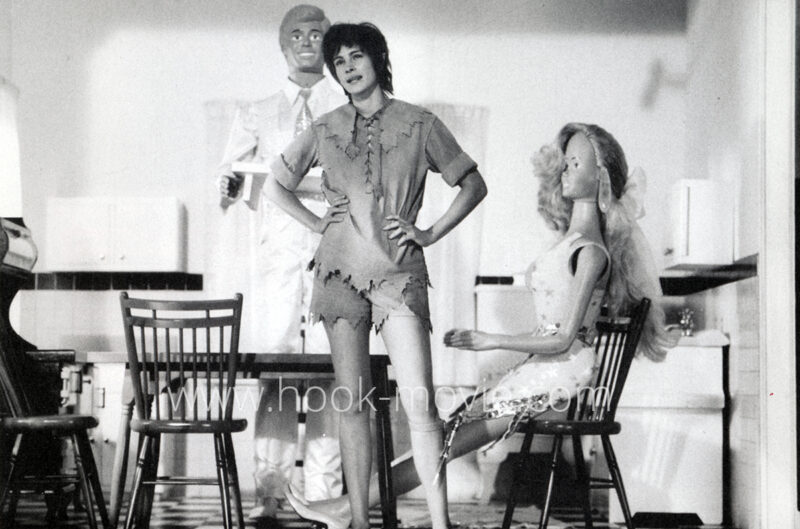
Julia Roberts on the dollhouse set.
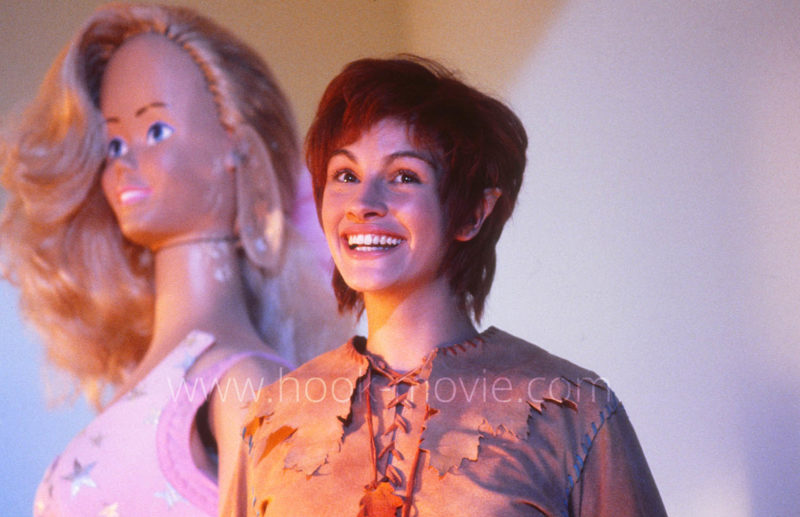
One of the most iconic photo of the film: Julia Roberts during filming of the scene.
Peter then searches for her and finds her in the dollhouse, where Tinker Bell is disappointed that he doesn’t remember her. Peter, who does not believe in fairies at all, says so, prompting a theatrical scene in which Tinker Bell pretends to die, falling down the stairs and lying motionless on the ground, asking Peter to clap to save her; he does so instinctively, without questioning it.
Tinker Bell recovers, and while Peter continues trying to rationalize what is happening, she explores the dollhouse kitchen. Ken is seated at the table, being served by Barbie. Tinker Bell reverses the roles, seating Barbie and making Ken serve her.
Barely paying attention to Peter’s rambling, Tinker Bell throws herself onto the rug and forcefully flips him into the parachute made by Maggie, dragging him off to Neverland, under Tootles’ amused gaze.
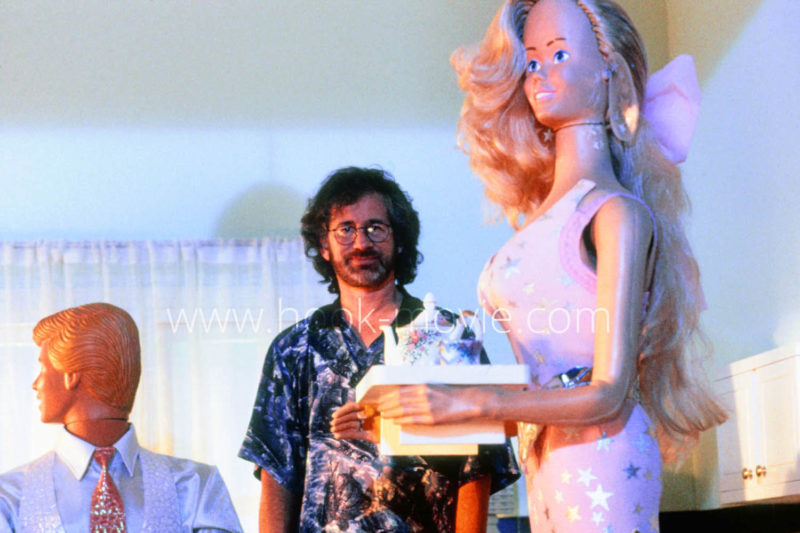
Steven Spielberg on the dollhouse set.
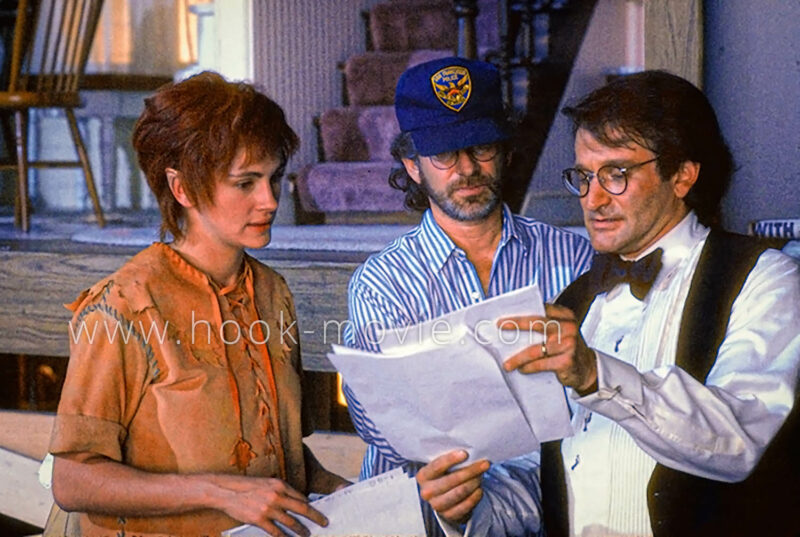
Julia Roberts, Steven Spielberg and Robin Williams preparing the scene.
The scene does not differ significantly from the final version of the film, but it helps clarify elements introduced in earlier deleted scenes. Peter returns to the dark nursery, but the light no longer shines in the room or through the window. He chooses to cross the portal he had previously closed, triggering Tinker Bell’s arrival. We adopt her point of view as she arrives, forcing Peter to look directly at the camera. This direct look at the camera recurs at another point in the film, and each time it marks a significant shift in Peter’s mindset and his perspective on things.
The look into the camera breaks the fourth wall, much like I developed in the School Play deleted scene section. Steven Spielberg clearly signals that there will be visible strings in his film, and that the film openly acknowledges its own artifice. Peter quite literally looks toward the theater projector, and in doing so, meets our gaze as well.
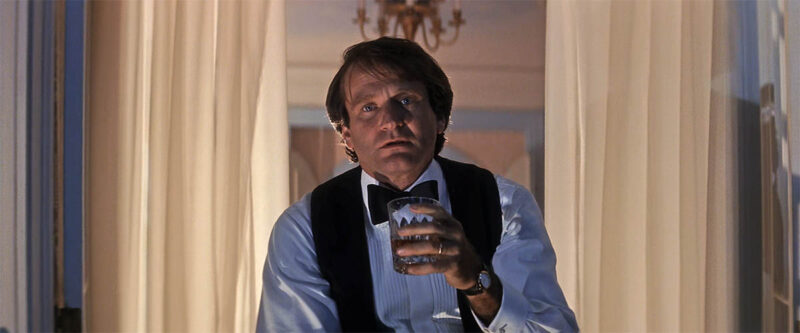
The light reaching for Peter.
Peter’s first look into the camera occurs when Tinker Bell appears. He looks at Tinker Bell / the projector and, at the same time, at the audience. But Peter still refuses to enter the story. He resists and tries to extinguish the light that allows the story to exist. But Tinker Bell is stronger.
In the opening, Tinker Bell was embodied by the central beam of light from the audience, like a theater projector bringing the movie to life on the screen. Here, she becomes real, taking on a living form. She is a being of light. Peter sees, with doubt and fear, that light coming to reach him. He refuses to be part of this story, his own story. He has forgotten everything, and he does not believe in it, but Tink carries him away by force.
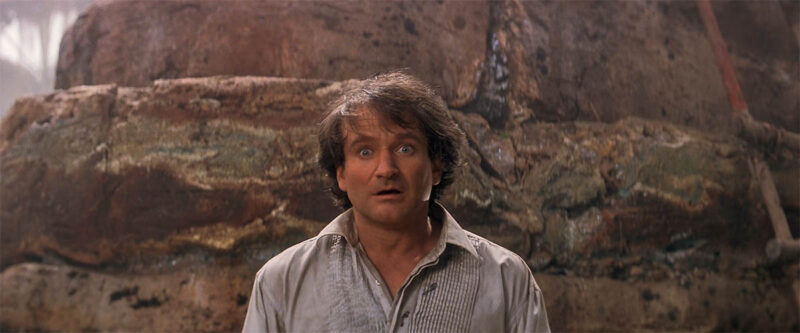
Peter struck by Jack’s ball, which triggers the return of his memory.
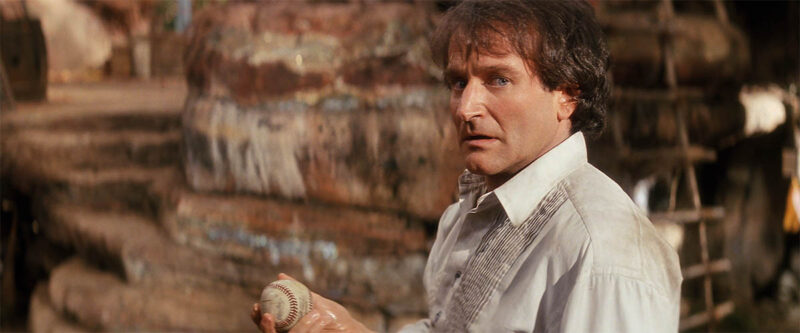
Peter, after seeing his shadow move, looks to the audience. “Am I dreaming, or did you just see that too?”
Still breaking the fourth wall, Spielberg then shows Peter staring directly at the camera as he begins to realize that he is the main character of his own story, and that he must stop being passive and start exploring what lies buried within him. He is first struck by Jack’s ball, which triggers the final phase of his transformation.
When he notices his shadow, he turns to the audience with a look that clearly says, “Am I dreaming, or did you just see that too?”
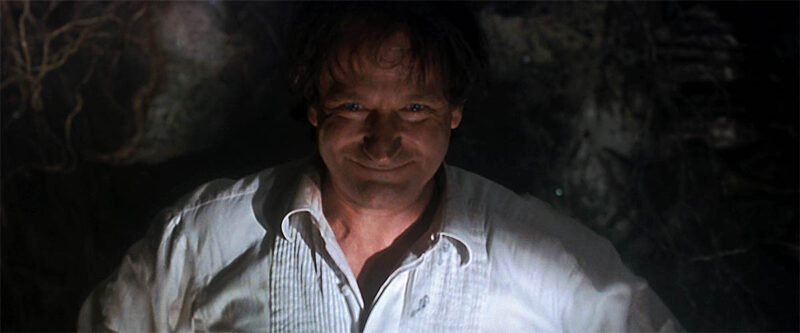
Peter regains confidence and looks at the audience with assurance.
Finally, Peter looks straight at the audience as he fully understands that his own choices have led him here, and that his amnesia had distanced him from his true identity. He regains confidence, fully aware that he is the hero of his world, his island, and his own mind. That concludes this aside on the film’s intentions. Let’s return to the scene in question.
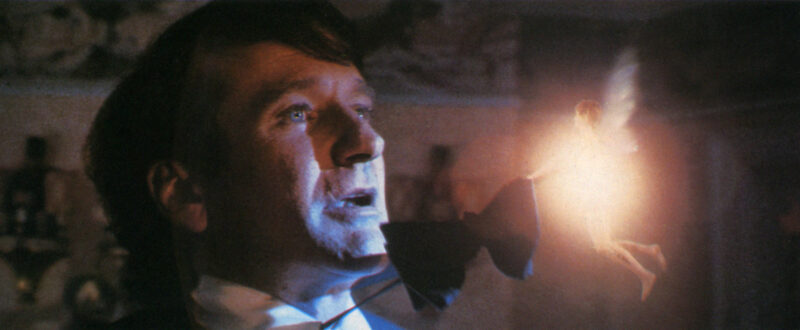
Tinker Bell tries to take Peter to Neverland.
Faced with what he considers to be a hallucination, Peter’s reflex is to call out for Moira. Moira represents his anchor to reality, in contrast to Tinker Bell, who embodies the fantastical, the extraordinary, and the wondrous. When Tinker Bell later tries to kiss him in Neverland, Peter reacts the same way, which brings him back to reality and reminds him of the need to act quickly against Captain Hook.
Tinker Bell forces Peter’s transition toward belief. This is illustrated by Peter clapping his hands: despite his rationality, he plays along. It marks a first step, a first crack in his resistance to the fantastical.
As seen in the deleted scene “The Meeting,” which showed Peter dominating inert miniatures (like Captain Hook will later be shown in his cabin). Peter enjoys manipulating models and miniatures, giving him total control. He stood confidently, moving buildings like game pieces. Whereas he dominated inanimate miniatures at work, Tinker Bell, a living miniature being, forces him into submission.
Peter has absolutely no control over Tinker Bell. He is forced to kneel to interact with her, reinforcing the idea that he cannot control events and that this being triggers a profound shift in his mindset.
Peter dominating inert miniatures.
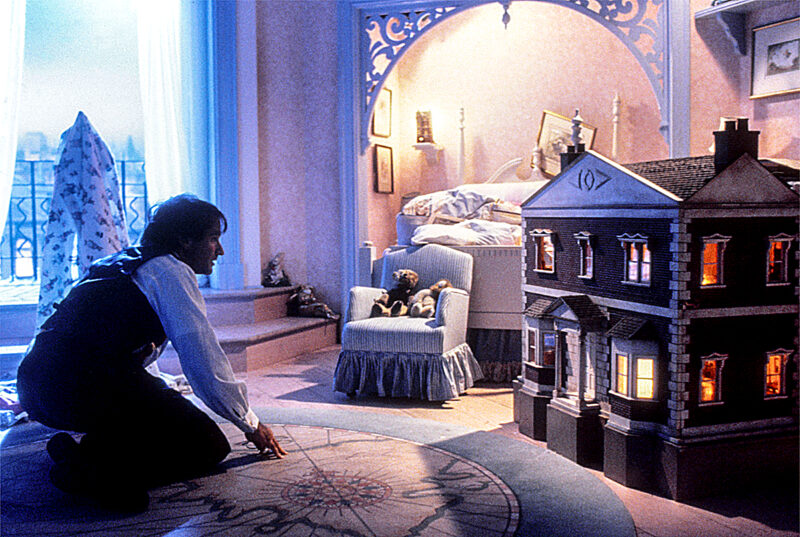
Peter submitting himself to interact with Tinker Bell, the miniature being of light.
The missing part of the scene mainly lies in the role-reversal sequence between Ken and Barbie. This adds a touch of feminism to the film.
An earlier draft of the script portrayed the Barbie scene in a much more brutal way, perhaps more in line with Tinker Bell’s temperament from the original story, as she was supposed to literally decapitate Barbie out of jealousy. Considering Barbie as a rival, as a form of unfair female competition, since she represents an idealized version of womanhood.
...
PETER
(clapping under duress)
Okay--I'm clapping. Just stop ringing--
TINK
You didn't really mean it. And ME--
the most important faerie in your life?
TINK SITS UP--livid. She straightens her gown, shaking
herself all over and huffs away through the debris--
TINK
You're scum, Pan. No card. No letter
all these years. Leaving me for that
Wendy ditz. What's she got--I haven't
got. Hmm?
Seething, she poses her mini-body next to Maggie's Barbie
doll. Seeing the competition, Tink rips Barbie's head off.
...
It would seem that this act of brutality toward Barbie was indeed filmed. Steven Spielberg was fully aware that this would likely displease Mattel, the company behind Barbie as its flagship product. Mattel was also responsible for producing the film’s toys.
In his article for Premiere, published in December 1991, journalist Fred Schruers recounts a day he spent visiting the film’s set. During his time there, He had the opportunity to witness the filming of this scene.
“When Tink must tear off Barbie's head, ‘Throw Barbie!’ is Spielberg's instruction, Roberts spikes it hard into the floor. ‘Oh, God, I think that's the end of her head. Mattel's not gonna be happy with that one,’ says Spielberg.”
As in "The Meeting" scene, product placement is once again undermined by fantasy. Coca-Cola remains in the background of Jack’s scenes, while Peter takes full control of the Motorola, his empty computer standing in contrast to Maggie’s rich drawings. Tink destroys Barbie, and by extension Mattel, as if to assert the power of the fantastical over corporate reality.
Note: The giant Barbie and Ken were created by The Character Shop company.
Here is where Act I ends, with Peter’s departure from the real world into Neverland.
As these scenes show, the first missing sequences do not represent a significant amount of screen time. Yet their contribution is decisive: they introduce and establish deeper themes than those emphasized in the final cut.
They primarily provide clarification. Several questions raised by the theatrical version find explicit answers here. This goes beyond confirming certain interpretations; it anchors the film in a fully developed psychological framework aligned with Carl Jung’s concept of individuation. Peter Banning must explore his unconscious and confront his shadow, the part of himself he has rejected, buried, or refused to acknowledge.
The final cut recenters the narrative around the conflict between Peter and Jack, as if it were the main issue. However, the deleted scenes make it clear that this conflict is a consequence rather than the core of the film.
The original project is not limited to a simple moral message about a father reconciling with his children. It is built around an internal conflict tied to memory, amnesia, and repressed trauma. The film explores the effects of this repression on identity, relationships, and personal development. These deleted scenes present a far less sympathetic Peter Banning than the one shown in the final cut. He is not merely a busy, distracted father; he appears arrogant, dismissive, emotionally closed off, and at times contemptuous. This distinction is important because it makes his transformation psychologically necessary. Peter does not simply need to spend more time with his children; he needs to confront the person he has become.
Through this lens, Neverland is more than a place of adventure. It becomes a space of reconstruction, where Peter can recover what he has forgotten and confront what has been repressed. His return to Neverland marks the beginning of his individuation process, as he moves beyond reacting to external events and begins confronting his unconscious and the archetypal figures within it. In this sense, Neverland allows his internal conflict to be externalized and confronted.
The film belongs to the same type of story as A Christmas Carol, from which it clearly draws inspiration. It should not be approached as a narrative requiring literal rationalization or strict realism. Its logic is symbolic. The aim is not to determine whether every detail is plausible, but to understand what each element represents.
This is precisely what many critics failed to do. Very few engaged with the film’s symbolic structure. Most attempted to rationalize it or rejected it outright because it did not conform to realist expectations. Dismissing the sets as “cardboard-looking” already reflects a refusal to engage with the film on its own terms. It means judging a symbolic, theatrical, almost dreamlike space as if it were meant to function as naturalistic realism. In doing so, such criticism misses the point: Neverland is not intended to resemble the real world, but to function as a constructed psychic space, a stage where Peter’s repressed self can reappear, take form, and be confronted.
Act II will be divided into two parts due to the number of deleted scenes it contains.